

Protégé Alumni Superstars: Benjamin Beilman, Nina Bernat & Viano Quartet
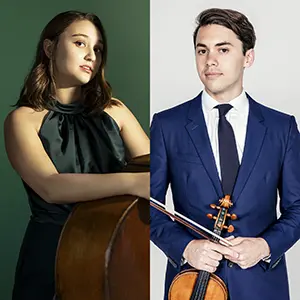
Six supremely talented Protégé Project alumni—violinist Benjamin Beilman, bassist Nina Bernat, Viano Quartet—return to their CMNW roots at Lincoln Recital Hall, showcasing their musical growth and maturity since their time as protégés in our program, with works by Eugène Ysaÿe and Felix Mendelssohn.
Chamber music is meant to be up-close and personal—our Spotlight Recitals are exactly that! These casual noontime concerts feature CMNW’s rising-star Protégé Artists with repertoire they have chosen to share for their special spotlight performance. Over the course of 60–75 minutes in the intimate 200-seat Lincoln Recital Hall, experience superb chamber music by some of the world’s most exciting early-career artists!
The Protégé Spotlight Recital series is sponsored by Linda & John Hardham.
PSU, College of the Arts, Lincoln Recital Hall
Tuesday, 7/15 • 12:00 pm
Program
Click on any piece of music below to learn more about it.
- EUGÈNE YSAŸE Violin Sonata in D Minor, Op. 27, No. 3 (“Ballade”)
EUGÈNE YSAŸE (1858–1931)
Violin Sonata in D Minor, Op. 27, No. 3 (“Ballade”)Belgian violinist/composer Eugène Ysaÿe belongs to a storied tradition that includes Wolfgang Amadeus Mozart, Niccolò Paganini, Joseph Joachim, and other virtuoso violinists who composed bravura solo works. Ysaÿe’s six sonatas for solo violin are considered technical and artistic masterpieces. Written in 1924, Ysaÿe composed each one with a particular violinist in mind; the “Ballade” was written for Romanian violinist/composer George Enescu.
Ysaÿe declared those who played his sonatas “must be a violinist, a thinker, a poet, a human being, he must have known hope, love, passion and despair, he must have run the gamut of the emotions in order to express them all in his playing.”
Unlike its predecessors, the “Ballade” is written in one movement with two sections: a languid, quasi-recitative in a richly expressionistic vein, which leads into an eye-popping virtuoso Allegro, full of double-stops, dotted rhythms, and dizzying passages of triplets and sixteenth note runs executed at lightning speed.
—© Elizabeth Schwartz
- J. S. BACH Cello Suite No. 5 in C Minor, BWV 1011
J. S. BACH (1685-1750)
Cello Suite No. 5 in C Minor, BWV 1011I. Prélude
II. Allemande
III. Courante
IV. Sarabande
V. Gavotte I
VI. Gavotte II
VII. Gigue
When Johann Sebastian Bach composed his Six Suites for Unaccompanied Cello, no precedent for such music existed. Even the cello itself was new; instrument makers in Bologna began experimenting with the cello’s predecessors around 1660, but it wasn’t until the early 1700s that the cello began to emerge as a new instrument in its own right, with distinctly unique timbres and expressive capabilities.
In the 300 years since they were composed, the Cello Suites have moved beyond the concert hall and into popular culture. Today, the ubiquity of this music makes the fact that all the cello suites languished in near-total obscurity for almost 200 years after Bach’s death seem bizarre. It was a 13-year-old Pablo Casals who discovered an old edition of the cello suites in a second-hand shop in Barcelona in 1890. According to some sources, Casals practiced them for 12 years before he felt ready to perform them in public. Today, Bach’s cello suites are a rite of passage for all cellists, professional and amateur alike, a yardstick used to measure both technical mastery and artistic expression.
The Cello Suite in C Minor, BWV 1011 is the most introspective of the six, and its C minor tonality creates a sober, occasionally stark mood. Bach enhances this quality by indicating the cello’s highest A string be tuned down from A to G, which allows chords in C minor to be played more easily. The Prelude, in the style of a French overture, feels weighty with the heaviness of its stop-and-start dotted rhythms. Bach contrasts this stateliness with a quasi-fugue section, in which the cello’s single line presents a swift-moving theme.
As with the other suites, the remainder of the movements are in the form of different Baroque dances: allemande, courante, sarabande, a pair of gavottes, and a concluding gigue. The central Sarabande features an eloquent melody, with no embellishing chords, that carries profound emotional resonance. French cellist Paul Tortelier described it as “an extension of silence,” and Yo-Yo Ma played it at the first anniversary of the September 11 attacks, while victims’ names were read aloud.—© Elizabeth Schwartz
- FELIX MENDELSSOHN String Quartet No. 3, Op. 44 No. 1
FELIX MENDELSSOHN (1809–1847)
String Quartet No. 3, Op. 44 No. 1I. Molto allegro vivace
II. Menuetto. Un poco Allegretto
III. Andante espressivo ma con moto
IV. Presto con brioFelix Mendelssohn was that rarest of composers, a man who wrote great music in times of joy. It is a romantic trope that tragedy and turmoil are the most effective stimuli for creativity, and that little worthwhile art is generated from happiness. The greatest tragedy of Mendelssohn’s life was its brevity—he died at the age of 38—but that life was full of advantages: financial stability, prodigal talent, a first-rate education, and a close, loving family, among other things. Thus safeguarded and supported, Mendelssohn produced a masterful body of works in many genres, from expansive symphonies to elegant chamber works.
Mendelssohn wrote the three string quartets of Op. 44 in 1837–38, a time of both personal and professional achievement. In March 1837, he married Cécile Jeanrenaud; while the couple enjoyed their honeymoon in the Black Forest, Mendelssohn wrote the E Minor Quartet. Eight months later, the day before his first son was born, Mendelssohn completed the E-flat Major Quartet; the D Major Quartet followed in July 1838.
Of the three quartets in Op. 44, Mendelssohn seemed most pleased with the Quartet in D Major, Op. 44, No. 1. “I have just finished my Quartet in D,” he wrote to violinist Ferdinand David. “I like it very much. I hope it may please you as well. I rather think it will, since it is more spirited and seems to me likely to be more grateful to the players than the others.”
The Molto allegro vivace lives up to its tempo marking (very happy and lively) with its exuberant primary theme declared by the first violin. The Menuetto flows by smoothly with a gently rocking theme, like a boat bobbing in a shaded brook, and eases seamlessly into the expressive but pensive Andante. Mendelssohn ends with a saltarello, an Italian Renaissance dance he had also used to conclude his high-spirited Italian Symphony.
—© Elizabeth Schwartz
Artists
-
 Benjamin Beilman
Violin
Benjamin Beilman
Violin
-
Benjamin Beilman is one of the leading violinists of his generation. He has won international praise for his passionate performances and deep, rich tone which The New York Times described as “muscular with a glint of violence”, and The Strad described as “pure poetry.“ Le Monde has described him as “a prodigious artist, who combines the gift of utmost sound perfection and a deep, delicate, intense, simmering sensitivity”.
Benjamin’s 2024/25 season includes his debut with the Berlin Philharmonic and Kirill Petrenko on tour in the US, and returns to the Chicago, Cincinnati, and Antwerp symphonies. He also makes his debut with the Belgian National Orchestra the Tokyo Metropolitan Symphony. He will also tour with pianist Steven Osborne across the US.
In recent seasons, Beilman’s commitment to and passion for contemporary music has led to new works written for him by Frederic Rzewski, Gabriella Smith, and a concerto by Chris Rogerson. He has also given multiple performances of Jennifer Higdon’s violin concerto, and recorded Thomas Larcher’s concerto with Hannu Lintu and the Tonkünstler Orchester.
He has received many prestigious accolades including a Borletti-Buitoni Trust Fellowship, an Avery Fisher Career Grant, and a London Music Masters Award. He has also recorded works by Stravinsky, Janáček, and Schubert for Warner Classics. In 2022, he became one of the youngest artists to be appointed to the faculty of the Curtis Institute of Music.
He performs with the ex-Balaković F. X. Tourte bow (c. 1820), and plays the “Ysaÿe” Guarneri del Gesù from 1740, generously on loan from the Nippon Music Foundation.
-
 Nina Bernat
Bass, Past Protégé
Nina Bernat
Bass, Past Protégé
-
American double bassist Nina Bernat, acclaimed for her interpretive maturity, expressive depth and technical clarity, emerges onto the world stage with awards and accolades, thrilling audiences everywhere. She was hailed by Star Tribune as a “standout” for her recent concerto debut with the Minnesota Orchestra, praising her performance as “exhilarating, lovely and lyrical…technically precise and impressively emotive.”
In 2023, Nina was honored as a recipient of the Avery Fisher Career Grant and winner of the CAG Elmaleh Competition. Recent 1st prizes include the Barbash J.S. Bach String Competition, the Minnesota Orchestra Young Artist Competition, the Juilliard Double Bass Competition, and the 2019 International Society of Bassists Solo Competition.
Engaged in all aspects of double bass performance, she has been invited to perform as guest principal bassist with the Israel Philharmonic Orchestra and Oslo Philharmonic, serving under the batons of conductors such as András Schiff and Osmo Vänskä. Nina is in demand as a passionate chamber musician. She began her involvement with the Chamber Music Society of Lincoln Center as a member of the Bowers Program in 2025. She has spent summers at Marlboro Music Festival, Verbier Festival, Music@Menlo, and Chamber Music Northwest.
She is quickly becoming a sought-after pedagogue, having given masterclasses at the Colburn School, Boston University Tanglewood Institute, and University of Texas at Austin, among others. She is on the faculty of Stony Brook University.
Nina performs on an instrument passed down from her father, Mark Bernat, attributed to Guadagnini.
Upcoming Concerts & Events
-
 Aiden Kane
Viola
Aiden Kane
Viola
-
American violist Aiden Kane has performed in North America, Europe, and Asia as a current member of the Viano Quartet, First Prize Laureates of the 2019 Banff International String Quartet Competition and recipients of the 2025 Avery Fisher Career Grant.
After leaving violin for the dark side, Aiden first studied viola with Daniel Foster through the National Symphony Orchestra’s Youth Fellowship Program. She subsequently earned a Bachelor’s and two Master’s degrees (in viola performance and chamber music studies, respectively) at the Colburn Conservatory of Music, where she studied with Paul Coletti. During her undergraduate years at Colburn, Aiden discovered her love for quartet life as the violist of the Calla Quartet, which received the Silver medal at the 2015 Fischoff Chamber Music Competition, and presented Colburn’s inaugural Musical Encounters outreach program. Since she joined the Viano Quartet, Viano has won international competitions, weathered a pandemic, moved from one coast to another, studied at the Curtis Institute of Music in the Nina von Maltzahn String Quartet-in-Residence program, and joined the Chamber Music Society of Lincoln Center Bowers Program—and Aiden loves quartet life even more for it all.
When she isn’t playing the viola, Aiden enjoys hiking, composing, and keeping an assortment of remarkably self-reliant houseplants.
-
 Lucy Wang
Violin
Lucy Wang
Violin
-
Canadian violinist Lucy Wang is a recipient of the prestigious 2025 Avery Fisher Career Grant and a founding member of the Viano Quartet. Praised for their “virtuosity, visceral expression, and rare unity of intention” (Boston Globe), the quartet rose to international acclaim as First Prize winners of the 2019 Banff International String Quartet Competition and are Bowers Artists at the Chamber Music Society of Lincoln Center from 2024–2027.
Lucy performs widely across North America, Europe, and Asia, and collaborates with leading artists such as pianists Marc-André Hamelin, Sir Stephen Hough, and Jon Kimura Parker, violinists James Ehnes and Pinchas Zukerman, guitarist Milos Karadaglic, soprano Fleur Barron, mandolinist Avi Avital, and singer-songwriter Vienna Teng. She has performed at renowned venues including London’s Southbank Centre, the Berlin Konzerthaus, Carnegie Hall, Dublin’s National Concert Hall, Walt Disney Concert Hall, Toronto’s Koerner Hall, and Hong Kong City Hall Theatre.
Committed to both core and contemporary repertoire, Lucy regularly collaborates with leading composers including Sir Stephen Hough, Kevin Lau, and Caroline Shaw, and will premiere a new work by Reena Esmail in 2026. She has mentored young artists at institutions such as Music@Menlo, the Colburn Academy, Stanford University, the University of Victoria, Northwestern University, and Duke University.
Her discography includes Voyager (Platoon Records, 2025) and Portraits (Curtis Studio, 2023), featured on CBC, BBC, and Performance Today. She maintains a vibrant social media presence with 50 million views and 600,000 followers worldwide.
Lucy graduated from the Curtis Institute and the Colburn Conservatory, where she studied with Martin Beaver. She plays on the ca. 1700 Bell Giovanni Tononi violin, generously on loan from the Canada Council for the Arts Musical Instrument Bank.
-
 Tate Zawadiuk
Cello
Tate Zawadiuk
Cello
-
Canadian cellist Tate Zawadiuk is known for connecting with audiences through his dynamic and zestful musicianship. He’s a founding member of the Viano Quartet, recipients of the 2025 Avery Fisher Career Grant and currently in residence at the Chamber Music Society of Lincoln Center Bowers Program (2024-2027). The quartet won first prize at the 2019 Banff International String Quartet Competition and has performed on some of the world’s most iconic stages, including Wigmore Hall, the Berlin Konzerthaus, and Flagey.
As a soloist, Tate has performed with orchestras like the Vancouver Symphony Orchestra, Calgary Philharmonic Orchestra, and Vancouver Youth Symphony Orchestra. He’s also had the chance to collaborate with incredible musicians like Emanuel Ax, James Ehnes, Marc-André Hamelin, and Johannes Moser.
Whether playing for a crowd of thousands or a small group of chamber music fans, Tate’s focus is always on sharing a story through his music that hopefully resonates with each listener. Tate studied at the Curtis Institute of Music as part of the Nina von Maltzahn String Quartet-in-Residence and earned his Bachelor’s and Master’s degrees from the Colburn Conservatory of Music, where he trained with Clive Greensmith and Ronald Leonard. In his spare time, Tate enjoys running, brewing specialty coffee, and is most likely somewhere trying on a new suit.
-
 Hao Zhou
Violin
Hao Zhou
Violin
-
“Personal, impassioned, courageous, and unostentatiously brilliant” (Musical America), American violinist Hao Zhou rose to international acclaim as both the Grand Laureate and Audience Favorite of the 2019 Concours Musical International de Montréal and a First Prize winner of the 2019 Banff International String Quartet Competition. In 2025, he was a recipient of the prestigious Avery Fisher Career Grant.
An accomplished soloist and chamber musician, Hao made his Carnegie Hall debut at the age of 12. He made solo appearances with the Orchestre Symphonique de Montréal, Downey Symphony Orchestra, and Peninsula Symphony Orchestra alongside conductors such as Esa-Pekka Salonen, Alexander Shelley, and Thierry Fischer. Hao is a founding member of the award-winning Viano Quartet, in residence at the Chamber Music Society of Lincoln Center Bowers Program from 2024-2027, and has performed worldwide alongside such internationally distinguished artists as Emanuel Ax, Roberto Diaz, James Ehnes, Noah Bendix-Balgley, and Marc André-Hamelin.
Hao is a recent graduate of the Curtis Institute of Music and has been invited to perform at the Kronberg Academy Festival. He was the first recipient of the Frances Rosen Violin Prize at the Colburn Conservatory, where he studied with Martin Beaver and received his Bachelor’s and Master’s degrees. Hao plays on a 1910 Vincenzo Postiglione violin, on generous loan from Nathan Cole.
-
 Viano Quartet
String Quartet, Past Protégé Ensemble
Viano Quartet
String Quartet, Past Protégé Ensemble
-
Lucy Wang, violin
Hao Zhou, violin
Aiden Kane, viola
Tate Zawadiuk, celloPraised for their “virtuosity, visceral expression, and rare unity of intention” (Boston Globe), the Viano Quartet has quickly soared to international acclaim as one of the most dynamic and in-demand string quartets of their generation. The ensemble has captivated audiences worldwide ever since they were awarded First Prize at the 13th Banff International String Quartet Competition, with appearances at renowned venues such as Lincoln Center in New York, Berlin’s Konzerthaus, Toronto’s Koerner Hall, Hong Kong’s City Hall, and London’s Wigmore Hall. The Viano Quartet are Bowers Program Artists at The Chamber Music Society of Lincoln Center from 2024–2027.
Viano Quartet’s 2025–26 season includes debut performances at London’s Southbank Centre, the Frick Collection in New York, Dublin’s National Concert Hall, Vivo Performing Arts, Coast Live Music, Friends of Chamber Music Kansas City, Apex Concerts, the Amelia Island Chamber Music Festival, the Fortas Series at the Kennedy Center, Premiere Performances HK, and a mainstage full recital debut at the Chamber Music Society of Lincoln Center. This season also features collaborations with Avi Avital, Sir Stephen Hough, Gilbert Kalish, Anthony McGill, Miloš Karadaglić, and Vienna Teng. The quartet will premiere a newly written piece by composer Reena Esmail in the summer of 2026.
In 2025, the quartet received the Avery Fisher Career Grant as well as released their first full-length album, Voyager, with Apple Music/Platoon Records.
The Viano Quartet was formed in Los Angeles at the Colburn Conservatory of Music in 2015. The quartet is grateful for the unwavering support from their mentors at the Curtis Institute and Colburn Conservatory.
Upcoming Concerts & Events