

SPOTLIGHT RECITAL: Soovin Kim & Alexi Kenney
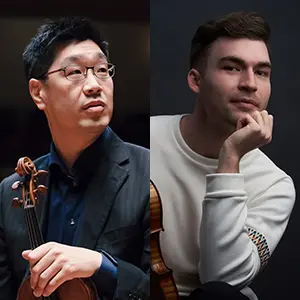
Multi-award-winning violinist Alexi Kenney returns this summer to play on two programs with umama womama, and this showcase recital will illuminate his masterful virtuosity and depth of expression with pianist Zitong Wang. Join us for a midday interlude of superbly performed Bach, Salina Fisher, and Eugène Ysaÿe.
PSU, College of the Arts, Lincoln Recital Hall
Tuesday, 7/11 • 12:00 pm
Program
Click on any piece of music below to learn more about it.
- J.S. BACH Sonata for Violin & Keyboard, BWV 1016
J. S. BACH (1685-1750)
Violin & Keyboard Sonata in E Major, BWV 1016 (20’)I. Adagio
II. Allegro
III. Adagio ma non tanto
IV. AllegroDuring the lifetime of Johann Sebastian Bach (1685–1750), the trio sonata was one of the most important multi-movement chamber music forms. Trio sonatas typically included two melodic instruments and a continuo, or the instrument(s) that would provide the harmonic and rhythmic backbone in Baroque music. Despite their name, trio sonatas were generally performed by four musicians, for instance two violinists, a harpsichordist, and a cellist.
Although Bach did write some trio sonatas, he generally preferred to write sonatas for only one melodic instrument and continuo. Rather than including the second melodic instrument, he preferred to notate a full melodic line for the keyboardist to play with their right hand above the rhythmic and harmonic bass line provided by their left hand. By doing so, Bach helped elevate the importance of the keyboard from the background to the foreground and arguably created the template for instrumental sonata composers ever since.
Bach structured his Sonata for Violin and Keyboard in E Major, BWV 1016, in an old-fashioned Italian style known as the “sonata de chiesa,” or church sonata. Church sonatas typically consisted of four movements: slow-fast-slow-fast. In this sonata’s opening Adagio, the violin offers the primary melodic material, while the keyboard provides the bass line as well as a gently flowing treble countermelody. In the second movement, the keyboard introduces a dancelike theme, soon imitated by the violin then repeated in three-part dialogue between the violin, keyboard right hand, and keyboard left hand. The third movement Adagio ma non troppo is a mesmerizing duet that unfolds slowly into a series of elegant exchanges between violin and keyboard right hand. Bach ends the sonata with a jubilant Allegro dance, showcasing the virtuosity of violinist and keyboardist alike in an ecstatic yet carefully crafted finale.
—© Ethan Allred
- SALINA FISHER “Hikari” (2023)
SALINA FISHER “Hikari” (2023)
Hikari, by Salina Fisher, was commissioned by the Borletti-Buitoni Trust on behalf of Alexi Kenney.
Salina Fisher writes: “‘Hikari,’ meaning light, brightness, or radiance, leans into the violin’s natural resonance and brilliance. Its
musical language integrates the instrument’s expressive warmth and lyricism with more transparent timbres, in a constant search for light.
The featured open string-crossing is an homage to Bach’s Chaconne, a work that is both central to this recital and to my own relationship with the violin.”—© Princeton University Concerts
- EUGÈNE YSAŸE Sonata for two Violins
EUGÈNE YSAŸE (1858-1931)
Sonata for two Violins, IEY. 20 (30’)I. Poco lento, maestoso: Allegro fermo
II. Allegretto poco lento
III. Allegro vivo e con fuoco
Artists
-
 Alexi Kenney
Violin
Alexi Kenney
Violin
-
Violinist Alexi Kenney is forging a career that defies categorization, following his interests, intuition, and heart. He is equally at home creating experimental programs and commissioning new works, soloing with major orchestras, and collaborating with some of the most celebrated artists and musicians of our time. Alexi is the recipient of an Avery Fisher Career Grant and a Borletti-Buitoni Trust Award.
Alexi has performed as soloist with the Cleveland Orchestra, the San Francisco, Dallas, Pittsburgh, Detroit, and San Diego symphonies, l’Orchestre de la Suisse Romande, Gulbenkian Orchestra, and the St. Paul Chamber Orchestra. This season, he plays the complete violin sonatas of Robert Schumann with Amy Yang on period instruments at the Frick Collection, Philadelphia Chamber Music Society, and the Phillips Collection.
He continues to tour his project Shifting Ground in collaboration with the new media artist Xuan, which intersperses works for solo violin by J.S. Bach with pieces by Matthew Burtner, Mario Davidovsky, Salina Fisher, Nicola Matteis, Angélica Negrón, and Paul Wiancko.
Alexi is a founding member of the two-cello quartet Owls, hailed as a “dream group” by The New York Times. He regularly performs at chamber music festivals including Caramoor, ChamberFest Cleveland, Chamber Music Northwest, La Jolla, Ojai, Marlboro, Music@Menlo, Ravinia, Seattle, and Spoleto. He is an alum of the Bowers Program at the Chamber Music Society of Lincoln Center.
He plays a violin made in London by Stefan-Peter Greiner in 2009 and a bow made in Port Townsend, WA by Charles Espey in 2024.
Upcoming Concerts & Events
-
 Zitong Wang
Piano, Past Protégé
Zitong Wang
Piano, Past Protégé
-
Zitong Wang’s authenticity, bravura, and sensitivity have enchanted audiences over the years, particularly so at the 19th International Fryderyk Chopin Piano Competition, where she claimed the Bronze Medal and the Krystian Zimerman Award for the Best Performance of a Sonata.
In her most recent season, she has taken the stage at prestigious venues, including the Berlin Philharmonie, the Prinzregententheater in Munich, the Warsaw Philharmonic, the National Centre for the Performing Arts, the Polish Baltic Philharmonic in Gdańsk, and the Shanghai Symphony Hall, among others, where her performances won ardent reception.
In 2026, her engagements include appearances at at the Tokyo Metropolitan Theatre, Kyoto Concert Hall, and Seoul Arts Center for the Chopin Competition Laureates Tour. Her China recital tour, starting in April, brings her back to Beijing, where she made her solo debut at age thirteen.
Born into a family of piano educators, Wang is pursuing her graduate studies with Dang Thai Son at the New England Conservatory. At an early age, she studied with Hua Chang and Yuan Sheng at the Central Conservatory of Music. Entering the Curtis Institute of Music on a full scholarship, she was mentored by Meng-Chieh Liu and the late Eleanor Sokoloff. Almost becoming a harpsichordist, she studied historical performance practice as a secondary major with Leon Schelhase and took a philosophy course at the University of Pennsylvania. This affinity led to an invitation from Trevor Pinnock to perform on original harpsichords from the antique Karen Flint Collection.
She has shared the stage with major orchestras such as the Philadelphia Orchestra, Cleveland Orchestra, Warsaw Philharmonic Orchestra, Galicia Symphony Orchestra, Sichuan Symphony Orchestra, Hangzhou Philharmonic Orchestra, as well as the New Jersey Symphony, NEC Philharmonia Orchestra (Boston), the Polish Baltic Philharmonic, and the Amadeus Chamber Orchestra of Polish Radio. She has collaborated with conductors including Jahja Ling, Xian Zhang, Antoni Wit, Andrzej Boreyko, Anthony Hermus, Lina González-Granados, Hugh Wolff, Daniel Smith, Darrell Ang, and Yang Yang.
Not just a soloist par excellence, she is also an active chamber musician, performing with artists including David Shifrin, Roberto Díaz, Soovin Kim, and Gloria Chien, as well as ensembles such as the Isidore Quartet and Curtis Ensemble 20/21. She was selected as a Protégé Project Artist at Chamber Music Northwest in Portland, Oregon, where her performances received wide recognition. She also interprets contemporary music, working closely with composers such as Unsuk Chin, Bright Sheng, David Ludwig, and Alvin Singleton.
Prior to the Chopin Competition, she won Sixth Prize and the Special Prize for the Performance of Contemporary Works at the Ferruccio Busoni International Piano Competition. She also received First Prize in the 33rd Ferrol International Piano Competition and the “Nelson Freire Prize” for the Best Performance of a Work by Chopin (2022).
She has been featured on Deutsche Grammophon Stage+, Medici TV, Amadeus TV, WRTI, WHYY-TV, and All Classical Radio. Her performances from the Chopin Competition are featured on an album released by the Fryderyk Chopin Institute as part of its Blue Series of competition recordings in 2026.
-
 Soovin Kim
Violin & Artistic Director
Soovin Kim
Violin & Artistic Director
-
Soovin Kim enjoys a broad musical career regularly performing Bach sonatas and Paganini caprices for solo violin, sonatas for violin and piano ranging from Beethoven to Ives, Mozart, and Haydn concertos and symphonies as a conductor, and new world-premiere works almost every season.
When he was 20 years old, Kim received first prize at the Paganini International Violin Competition. He immersed himself in the string quartet literature for 20 years as the 1st violinist of the Johannes Quartet. Among his many commercial recordings are his “thrillingly triumphant” (Classic FM Magazine) disc of Paganini’s demanding 24 Caprices and a two-disc set of Bach’s complete solo violin works that were released in 2022.
Kim is the Founder and Artistic Director of the Lake Champlain Chamber Music Festival (LCCMF) in Burlington, Vermont. In addition to its explorative programming and extensive work with living composers, LCCMF created the ONE Strings program through which all 3rd through 5th grade students of the Integrated Arts Academy in Burlington study violin. The University of Vermont recognized Soovin Kim’s work by bestowing an Honorary Doctorate upon him in 2015.
In 2020, he and his wife, pianist Gloria Chien, became Artistic Directors of Chamber Music Northwest in Portland, Oregon. He, with Chien, were awarded Chamber Music Society of Lincoln Center’s 2021 CMS Award for Extraordinary Service to Chamber Music. Kim devotes much of his time to his passion for teaching at the New England Conservatory in Boston and the Yale School of Music in New Haven.