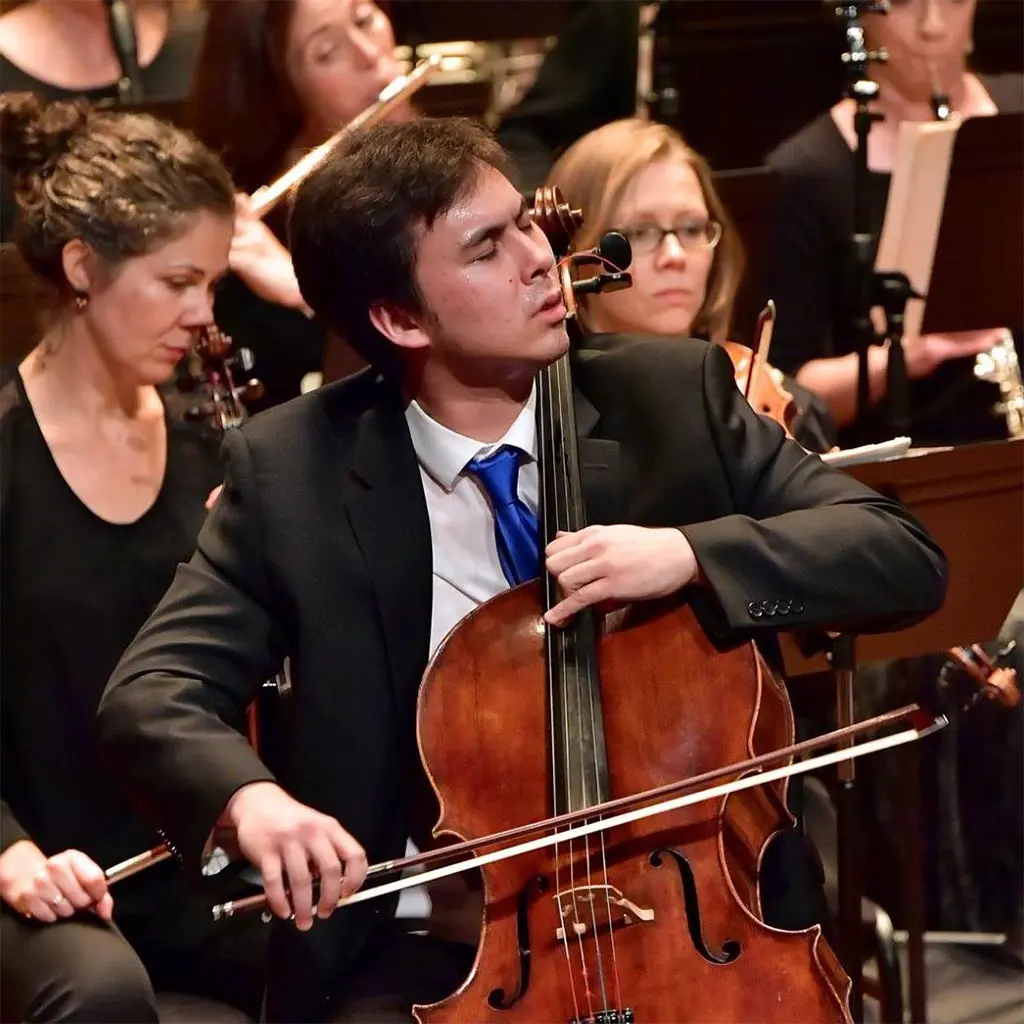
Protégé Spotlight Recital: Sam Rosenthal, Viola
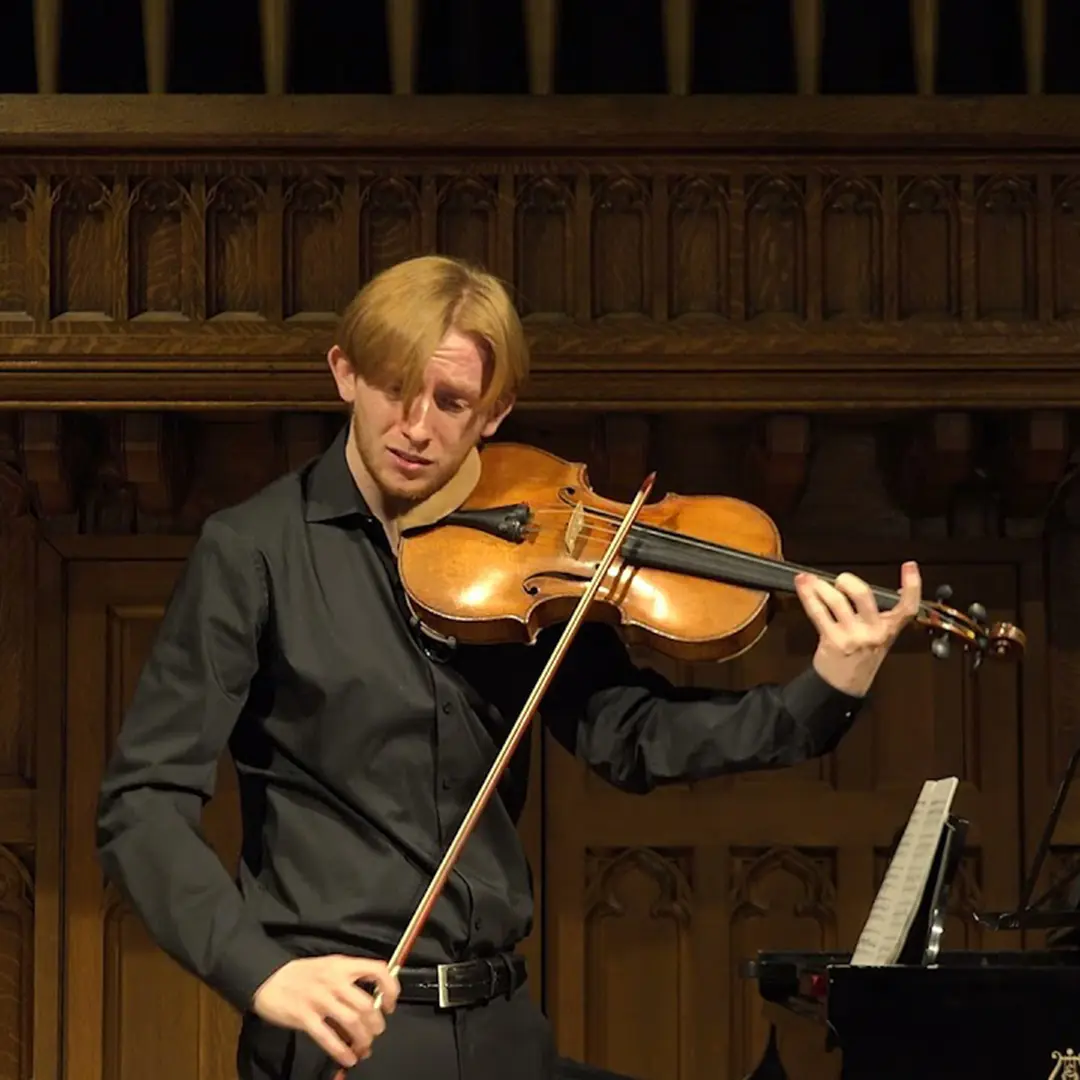
This summer’s Protégé Violist Samuel Rosenthal grew up in Cleveland, Ohio where he began his musical studies at the Cleveland Institute of Music. This rising star of the viola world won the Silver Medal in the Junior Division of the 2018 Fischoff National Chamber Music Competition as a member of the Razumovsky Quartet and has received numerous other prestigious prizes, including the Kovner Fellowship at the Juilliard School. More than anything, Sam enjoys playing chamber music with colleagues and friends.
Hear Sam as he partners with pianist Jeewon Park for a recital of his favorite works by Robert Schumann, Puccini, Frank Bridge, and more.
Sponsored by John & Linda Hardham.
PSU, College of the Arts, Lincoln Recital Hall
Tuesday, 7/14 • 12:00 pm
Program
Click on any piece of music below to learn more about it.
- Program Notes for Protégé Spotlight Recital: Sam Rosenthal, Viola
Tosca, a perennially relevant Italian opera by Giacomo Puccini (1858–1924), tells a tragic story of love and politics. Amidst the chaos of the Napoleonic wars, an opera diva struggles to save her revolutionary lover from a corrupt police chief and his authoritarian government.
When writing a paraphrase (as opposed to a transcription or arrangement), a composer can take considerable liberty in reordering and elaborating on the source material. Young American violist Keoni Bolding’s Tosca Act II Paraphrase is an excellent example, freely weaving together some of Tosca’s most moving melodies.
Bolding’s paraphrase begins near the end of Act II, as Tosca reflects on her fateful decision to kill the police chief. He then explores the drama’s key musical moments, especially Tosca’s iconic aria “Vissi d’arte” (I lived for art), in which she laments her shaken Catholic faith. Bolding adapts Puccini’s lyrical music into a dazzling showpiece, in which violist and pianist each have plenty of opportunities to take center stage.
Although Robert Schumann (1810–1856) often struggled to find inspiration, he found plenty in 1849, completing more than 40 compositions that year alone. He especially focused on writing “Hausmusik,” or music meant to be performed at home among friends and family.
To maximize its sales potential, Schumann often wrote Hausmusik that could be performed on a variety of instruments. Such is the case for the Adagio and Allegro, Op. 70, performed here on viola and piano, but originally written for horn and piano.
More specifically, Schumann wrote the piece to show off the capabilities of the newly invented valve horn. The stately Adagio begins to illustrate the valve horn’s rich, expanded lower range. In the Allegro, on the other hand, Schumann emphasizes the valve horn’s improved ability to produce long, flowing melodies. The music works equally brilliantly on viola, giving the instrumentalist an opportunity to emulate “hunting horn” sounds and other melodies not typically written for strings.
Errollyn Wallen (b. 1958) has built a reputation as one of the leading composers in contemporary British music. With over 20 operas to her name, the Belize-born, London-raised composer defies genre, with influences from Anglican choral music to Stevie Wonder. In 2024, she became the first black woman to become Master of the King’s Music.Wallen’s 2021 opera Dido’s Ghost continues the story begun by a foundational English-language opera: Henry Purcell’s Dido and Aeneas. After Dido’s death, Aeneas marries the princess Lavinia, who experiences a dark, emotional journey powered by her jealousy of Dido.
Violist Stephen Upshaw and The Riot Ensemble commissioned Wallen to write LAVINIA for a 2021 online premiere. This character study uses music from Lavinia’s centerpiece aria as a starting point to further explore the internal mindset of a conflicted character. For the violist, it offers an opportunity to push the boundaries between operatic and instrumental music, or, in Upshaw’s words, “to introduce that vocal element into string performance.”
Composer and violist Frank Bridge (1879–1941) never quite found success in the notoriously traditionalist English classical music scene. Although Bridge’s music fell into relative obscurity after his death, his most famous student, Benjamin Britten, led a successful revival in the 1960s and ’70s. “He fought against anything anti-instrumental,” Britten recalled of his mentor’s approach, “which is why his own music is graceful to play.”
Surprisingly, Bridge only composed two short works for his own instrument and piano, published in 1908 as Two Pieces for Viola. Pensiero (Contemplation), H. 53, begins with a fittingly inward focus, but this inner fire gradually builds to a stunning release of energy. Bridge’s writing combines moody, late-Romanticism with echoes of Claude Debussy, his key musical influence.
The Allegro appassionato, H. 82, shows off Bridge’s more exuberant side. Emblematic of the comfortable optimism of the prewar period, this lilting dance jumps around effortlessly between lush piano arpeggios.
German composer Paul Hindemith (1895–1963) began his World War I military service in the regimental band. “I play the big drum,” he wrote home. “I am told that never before has this instrument been handled here with such rhythmic precision.” In addition to these musical duties, however, Hindemith spent several months in the trenches, an experience that left him forever changed.
After the war, Hindemith began to forge a new musical approach, beginning the six instrumental sonatas of Opus 11. His Viola Sonata, Op. 11, No. 4, begins with a brilliant Fantasie, in which the viola and piano seem at odds throughout, yet somehow wind up together at the pristine ending. The second movement continues with a folklike theme and variations that contain echoes of the music of Claude Debussy, who had passed away during the war. In the finale, Hindemith unexpectedly continues to vary the same theme, but within a traditional sonata form structure. Here, Hindemith’s mature style comes into focus: unsentimental, harmonically imaginative, yet coherent, with a craftsman-like mastery of classical structure.
—© Ethan Allred
- PUCCINI Tosca Act II Paraphrase (Arr. K. Bolding)
PUCCINI (1858–1924) Tosca Act II Paraphrase (7’) (Arr. K. Bolding)
- R. SCHUMANN Adagio and Allegro, Op. 70
ROBERT SCHUMANN (1810–1856) Adagio and Allegro, Op. 70 (10’)
I. Adagio
II. Allegro- ERROLLYN WALLEN “LAVINIA”
ERROLLYN WALLEN (b. 1958) LAVINIA (5’)
- FRANK BRIDGE “Pensiero,” H. 53
FRANK BRIDGE (1879–1941) Pensiero, H. 53
- FRANK BRIDGE “Allegro appassionato,” H. 82
FRANK BRIDGE (1879–1941) Allegro appassionato, H. 82 (7’)
- PAUL HINDEMITH Viola Sonata, Op. 11, No. 4
PAUL HINDEMITH (1895–1963) Viola Sonata, Op. 11, No. 4 (20’)
I. Fantasie
II. Thema mit Variationen
III. Finale (mit Variationen)
Artists
-
 Jeewon Park
Piano
Jeewon Park
Piano
-
Jeewon Park, Korean American pianist, is widely recognized for her expressive depth, artistic versatility, and commanding technique. Acclaimed by The New York Times for her “infectious exuberance” and praised by the Indianapolis Star for her “deeply reflective playing,” she brings a rare combination of poetic lyricism and dazzling virtuosity to her performances. Equally at home in solo, chamber, and contemporary repertoire, she has established herself as a distinguished presence on international stages.
Ms. Park has appeared as soloist with the KBS Symphony Orchestra, Mexico City Philharmonic, Charleston Symphony, Florida Orchestra, and others, and has performed at venues including the Metropolitan Museum of Art, 92nd Street Y, Bargemusic, and Caramoor. She serves as Co-Artistic Director of the Performing Artists in Residence series at the Clark Art Institute and is a founding member of the Palladium Chamber Players.
She has been featured at many of the country’s leading chamber music festivals, including the Seattle Chamber Music Society, Manchester Music Festival, Bowdoin International Music Festival, Lake Champlain Chamber Music Festival, Bridgehampton Chamber Music Festival, Spoleto USA, Taos School of Music, Maui Classical Music Festival, Norfolk Chamber Music Festival, Chautauqua Institution, Brooklyn Chamber Music Society, the Four Seasons Chamber Music Festival, and the Pablo Casals Festival. International appearances include the Seoul Spring Festival, Great Mountains Music Festival, Seoul Arts Center (IBK Hall), Emilia-Romagna Festival (Italy), Music Alp (France), and Kusatsu Festival (Japan).
A committed educator, she has taught at the University of Massachusetts Amherst and given masterclasses at Williams College, Swarthmore College, University of Washington, University of South Carolina, and Amherst College. Starting this fall, she will serve as Artist-in-Residence in Piano, Director of Keyboard Studies, and Artistic Director of the Williams Chamber Players at Williams College. She holds degrees from Yonsei University, Juilliard, Yale, and a DMA from Stony Brook University.
Upcoming Concerts & Events
- Piano Masterclass with Jeewon Park
- Protégé Spotlight Recital: Sam Rosenthal, Viola (currently selected)
- Souvenir: Tchaikovsky Sextet
- Souvenir: Tchaikovsky Sextet
-
 Samuel Rosenthal
Viola, Protégé
Samuel Rosenthal
Viola, Protégé
-
Internationally acclaimed for his generous musical spirit, violist Samuel Rosenthal delights in sharing music with audiences of all ages and collaborating with some of today’s preeminent artists. His performances are recognized for their “intimate, personal approach” (Journal of the American Viola Society) and communicative style “clearly conveying the range of human emotions” (Cleveland Classical).
First Prize winner at the 2025 Lionel Tertis International Viola Competition, Sam was also recipient of the silver medal at the 2021 Primrose International Viola Competition. Other awards and recognitions include major prizes at the Johansen International Competition and, as a member of the Razumovsky String Quartet, at the Fischoff National Chamber Music Competition.
Sam began his musical studies in Cleveland and continued his viola studies with Jeffrey Irvine as a member of the Young Artist Program at the Cleveland Institute of Music. His passion for chamber music was ignited by formative work with the Cavani String Quartet and Cleveland Quartet violinist Peter Salaff. Since 2016, he has been a member of the Perlman Music Program community as a student at both the Summer Music School and the Chamber Music Workshop.
Chamber music plays a central part in Sam’s musical life. Since 2023, he has attended the Marlboro Music Festival in Vermont, where he had the opportunity to perform and collaborate with its legendary roster of extraordinary artists. Sam has been invited to perform at a variety of celebrated chamber music festivals across the United States and abroad including Chamberfest Cleveland, Musique de Chambre en Normandie, Lake Champlain Chamber Music Festival, Music from Angel Fire, and Ravinia’s Steans Music Institute.
Sam is a graduate of the Juilliard School where he had the honor of studying with Heidi Castleman, Misha Amory, and Hsin-Yun Huang, and was a proud recipient of a Kovner Fellowship. He is currently studying at the Kronberg Academy under the tutelage of Nobuko Imai and Antoine Tamestit. These studies are funded by the Annika and Wolfgang Fink Patronage.
Upcoming Concerts & Events
- Protégé Spotlight Recital: Sam Rosenthal, Viola (currently selected)
- FREE Open Rehearsal: Mozart Clarinet Quintet
- Universal Harmony: Schumann Piano Quintet
- Timeless Classics: Mozart Clarinet Quintet & “Rhapsody in Blue”
- Timeless Classics: Mozart Clarinet Quintet & “Rhapsody in Blue”
- Souvenir: Tchaikovsky Sextet
- Souvenir: Tchaikovsky Sextet