Protégé Spotlight Recital: Jonah Ellsworth, Cello
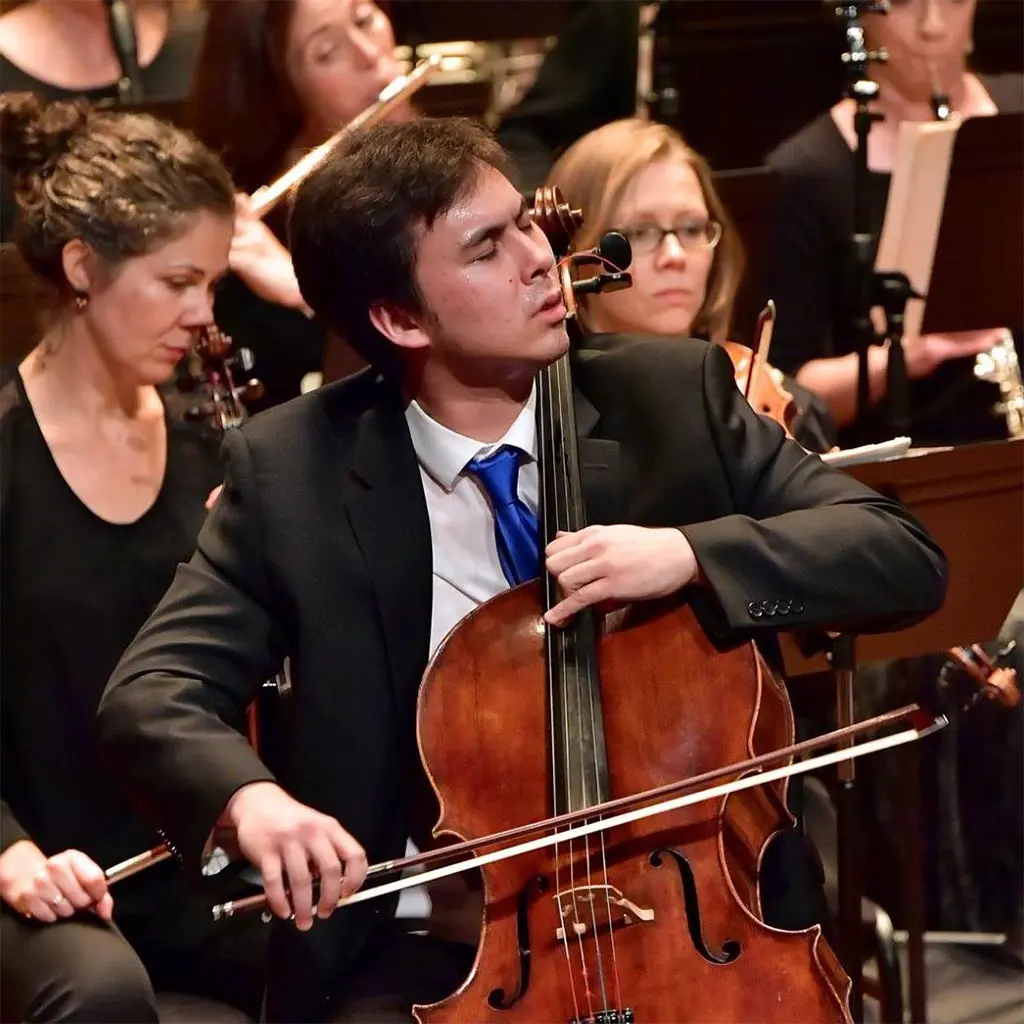
Born and raised in Cambridge, Massachusetts, our 2026 Protégé Cellist Jonah Ellsworth is already making his mark on the world of chamber music. A recent graduate of New England Conservatory and the Yale School of Music, he has won critical acclaim for both his solo performances and those with orchestras across the nation. He is a member of the renowned Boston Trio, the Boston Symphony, and Germany’s Leipzig Gewandhaus. Welcome Jonah as he makes his CMNW debut performing some of his favorite works by Brahms, Eugène Ysaÿe, and Paul Hindemith—and meet him after his recital!
Sponsored by John & Linda Hardham.
PSU, College of the Arts, Lincoln Recital Hall
Tuesday, 7/7 • 12:00 pm
Program
Click on any piece of music below to learn more about it.
- PAUL HINDEMITH “Phantasiestück,” Op. 8, No. 2
PAUL HINDEMITH (1895–1963) Phantasiestück, Op. 8, No. 2
In 1917, German composer Paul Hindemith (1895–1963) found himself on the verge of his first big career breakthrough. That year, the 21-year-old rising star not only became the concertmaster of the Frankfurt Opera Orchestra but also composed his first published work: the Three Pieces for Cello and Piano, Op. 8.
At the end of that exciting year, however, Hindemith was drafted into the Imperial German Army, an experience that would radically shake his perspective going forward. He emerged from the war believing the time had come for a hard break from the musical past. “The composer today should write only if he knows for what purpose he is writing,” as he later described. “The days of composing only for the sake of composing are perhaps gone forever.”
As a result of this change in perspective, Hindemith never published most of his pre-war music, considering it not representative of his mature style. Thus, the Opus 8 pieces for cello and piano offer a unique opportunity to experience the peak of his early output before he moved on to his post-war point of view. The Phantasiestück, Op. 8, No. 2, with its dramatic left-hand piano arpeggios, especially shows the young Hindemith’s interest in the music of Johannes Brahms. In this exquisite composition’s soaring cello melodies, we can hear a last gasp of Romanticism before it became subsumed by the forces of war, progress, and modernity.
—© Ethan Allred
- GEORGE CRUMB Sonata for Solo Cello
GEORGE CRUMB (1929-2022) Sonata for Solo Cello (1955)
- BRAHMS Cello Sonata No. 2 in F Major, Op. 99
BRAHMS (1833-1897) Cello Sonata No. 2 in F Major, Op. 99
I. Allegro vivace
II. Adagio affettuoso
III. Allegro passionato
IV. Allegro moltoThirty years before Hindemith wrote his Opus 8, musical Romanticism had just entered its climactic phase. Richard Wagner, one of the leading figures of the middle or High Romantic period, had died in 1883. A new generation including composers like Gustav Mahler and Richard Strauss took charge, pushing beyond previously imagined limits of chromaticism, harmony, and expressivity.
Despite the changes happening around him, the other leading figure of German High Romanticism, Johannes Brahms (1833–1897), remained committed to his own musical journey. The summer of 1886 found Brahms in the calm retreat town of Hofstetten, Switzerland, surrounded by mountains, streams, and a 12th-century castle. Brahms spent a relaxing summer in Hofstetten composing, hiking, smoking cigars, drinking coffee, and spending time with friends.
Musically, that summer proved quite productive, as Brahms finished two violin sonatas, a piano trio, several songs, and the Cello Sonata No. 2 in F Major, Op. 99. He wrote the cello sonata for his friend Robert Hausmann, cellist of the Joachim String Quartet, who performed the premiere with Brahms on piano after the composer returned to Vienna in the fall.
The other key muse who inspired much of Brahms’s music that summer was Hermine Spies, a young contralto who had performed many of his songs lately. While the two clearly shared an infatuation with one another, it remained unrequited, reflecting Brahms’s desire to protect his independence by avoiding romantic entanglements.
Brahms’s second cello sonata unfolds in four brilliant movements, described at the time by Austrian music critic Eduard Hanslick as “fiery to the point of vehemence, now defiantly challenging, now painfully lamenting.” Indeed, Hanslick wasn’t the only one to find this music challenging; Arnold Schoenberg lovingly described the opening Allegro vivace as “indigestible” to audiences, even at the time of Brahms’s death. Today, this music continues to challenge listeners to keep up with Brahms’s constantly evolving harmonies and the bounding, unsettled quality of its main theme.
The sonata’s slow movement, marked Adagio affettuoso, remains harmonically unsettled, although the gentle cello melody offers a welcome source of respite. The Allegro passionato third movement begins and ends with an eerie scherzo, which surrounds a more wistful middle section. Brahms concludes the sonata with a rondo marked Allegro molto, in which a rustic main theme alternates with a variety of musical departures. This relatively brief movement packs in a wide range of ideas, resolving any lingering unease from the earlier movements and bringing the sonata to an emphatic close.
—© Ethan Allred
Artists
-
 Gloria Chien
Piano & Artistic Director
Gloria Chien
Piano & Artistic Director
-
Taiwanese-born pianist Gloria Chien has one of the most diverse musical lives as a noted performer, concert presenter, and educator. She made her orchestral debut at the age of sixteen with the Boston Symphony Orchestra with Thomas Dausgaard, and she performed again with the BSO with Keith Lockhart. She was subsequently selected by The Boston Globe as one of its Superior Pianists of the year, “who appears to excel in everything.” In recent seasons, she has performed as a recitalist and chamber musician at Alice Tully Hall, the Library of Congress, the Phillips Collection, the Dresden Chamber Music Festival, and the National Concert Hall in Taiwan. She performs frequently with the Chamber Music Society of Lincoln Center. In 2009, she launched String Theory, a chamber music series in Chattanooga, Tennessee that has become one of the region’s premier classical music presenters. The following year she was appointed Director of the Chamber Music Institute at Music@Menlo, a position she held for the next decade. In 2017, she joined her husband, violinist Soovin Kim, as Artistic Director of the Lake Champlain Chamber Music Festival in Burlington, Vermont. The duo became Artistic Directors at Chamber Music Northwest in Portland, Oregon in 2020. Most recently, she released two albums—her Gloria Chien LIVE from the Music@Menlo LIVE label and Here With You with acclaimed clarinetist Anthony McGill on Cedille Records.
Chien studied extensively at the New England Conservatory of Music with Wha Kyung Byun and Russell Sherman. She is Artist-in-Residence at Lee University in Cleveland, Tennessee, and she is a Steinway Artist.
Upcoming Concerts & Events
- Chamber Party | An Unforgettable Evening with David Shifrin & Gloria Chien
- Protégé Spotlight Recital: Jonah Ellsworth, Cello (currently selected)
- Crossing Borders: Brahms Piano Quartet
- Crossing Borders: Brahms Piano Quartet
- NEW@NIGHT: Across the Americas
- Universal Harmony: Schumann Piano Quintet
- Timeless Classics: Mozart Clarinet Quintet & “Rhapsody in Blue”
- Timeless Classics: Mozart Clarinet Quintet & “Rhapsody in Blue”
- Voices of Our Land: Dvořák “American” Quintet
- Americana: “Appalachian Spring”
- Voices of Our Land: Dvořák “American” Quintet
- Americana: “Appalachian Spring”
- SPECIAL EVENT | NEW@NIGHT: George Takei’s “Lost Freedom: A Memory”
-
 Jonah Ellsworth
Cello, Protégé
Jonah Ellsworth
Cello, Protégé
-
Born and raised in Cambridge, Massachusetts, Jonah Ellsworth started playing the cello at age five. He holds degrees from the New England Conservatory and the Yale School of Music. His principal teachers have been Laurence Lesser, Kim Kashkashian, Lluís Claret, Natasha Brofsky, Andrew Mark, Peter Wiley, and Paul Watkins. At Yale, he was awarded the Aldo Parisot Prize and the Yale School of Music Alumni Association Prize. He joined the Boston Symphony Orchestra cello section in 2023. After a year and a half playing with the BSO, he participated in the exchange program with the Leipzig Gewandhaus Orchester. This exchange was created by Andris Nelsons, the conductor of both orchestras. After spending six months with the Gewandhaus Orchester, Jonah decided to take an audition with this orchestra and now is a member of the Leipzig Gewandhaus cello section. He started this job in September 2025.
Along with orchestral playing, Jonah has been featured as soloist with numerous orchestras, including the Boston Symphony, Boston Philharmonic, Akron Symphony, Symphony By the Sea, and the New England Conservatory Philharmonia. In 2016, Jonah filled in for Nicolas Altstaedt on 72 hours’ notice to play the Schumann Cello Concerto with the Jacksonville Symphony in Florida. He also toured Europe as soloist in 2015 with the Boston Philharmonic Youth Orchestra, alternating solo performances with Natalia Gutman. He has participated in many music festivals, including Marlboro Music Festival, Verbier Festival, Steans Institute of Ravinia, Music@Menlo, Rockport Music Festival, and Orford Musique Academy. Jonah has devoted much of his professional life to honing his skills as a chamber musician. He spent eight years with the Boston Trio, and with them he performed in some of the most prestigious concert venues in the United States including Carnegie Hall, Newport Music, and Jordan Hall.Upcoming Concerts & Events
- Protégé Spotlight Recital: Jonah Ellsworth, Cello (currently selected)
- NEW@NIGHT: Across the Americas
- Souvenir: Tchaikovsky Sextet
- Souvenir: Tchaikovsky Sextet
- Universal Harmony: Schumann Piano Quintet
- Timeless Classics: Mozart Clarinet Quintet & “Rhapsody in Blue”
- Timeless Classics: Mozart Clarinet Quintet & “Rhapsody in Blue”