

Folk Voices: Dvořák “Dumky” Trio
Our most important and durable memories are those brought to life by our senses: the flavors of a family recipe, the scent of a special place, or the sound of a loved one’s voice. All connect us with something deep inside and remind us of who we are.
Music is a vital connection to one’s culture and heritage, and few composers have harnessed its power of memory quite like those featured in this concert. Dvořák’s epic “Dumky” Piano Trio captures the essence and thrill of Dumka—Slavic and Ukrainian historical epics—while Leoš Janáček’s Pohádka and Béla Bartók’s Suite for Piano embrace their unique Czech and Hungarian musical traditions.
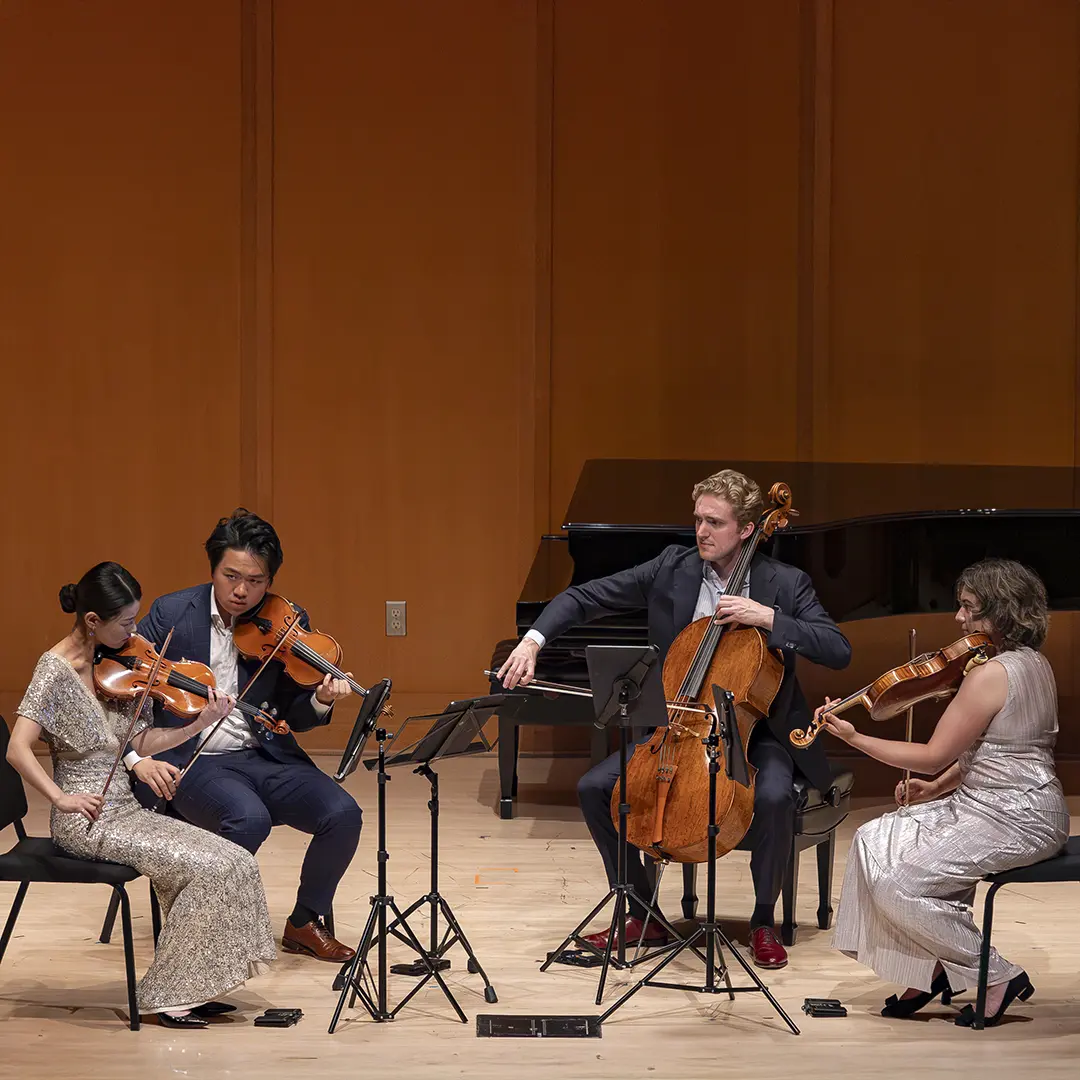
We will also celebrate the world premiere of a CMNW-commissioned string quartet, Dhara, by Indian American composer Reena Esmail—written for the dynamic Viano Quartet—whose music bridges the worlds of Indian and Western classical music.
Come early at 3:15 PM for a moderated discussion in Lincoln Performance Hall with composer Reena Esmail.
Concert sponsored by Linda & Richard Jenkins.
Reena Esmail’s String Quartet, Dhara, was co-commissioned for the Viano Quartet by Chamber Music Northwest, Chamber Music Tulsa, Coretet, and the Schubert Club.
PSU, College of the Arts, Lincoln Performance Hall
Sunday, 7/5 • 4:00 pm
Program
Click on any piece of music below to learn more about it.
- REENA ESMAIL String Quartet “Dhara” World Premiere
REENA ESMAIL (b. 1983) String Quartet #2: Dhara (धरा) (20’)
World Premiere | CMNW Co-Commission
There is something so uniquely beautiful about traveling through remote natural landscapes. A desert can feel vast and endless, and then a sudden curve in the road reveals a lush, green forest. A quick peek over a cliff can open into a massive canyon. A mountain range can unfold in an instant to expose an endless expanse of ocean.
I love these moments of revelation—the knowledge that another world might be just out of sight, and that the slightest move or change of perspective can suddenly bring it into view.
—© Reena Esmail
- BÉLA BARTÓK Suite for Piano, Op. 14, Sz. 62
BÉLA BARTÓK (1881–1945) Suite for Piano, Op. 14, Sz. 62
I. Allegretto
II. Scherzo
III. Allegro molto
IV. SostenutoThe piano music of Béla Bartók is filled with the hard edges and exhilarating, swirling motion of Eastern European peasant dances. It strips away Romantic embellishment in favor of something more direct, austere, earthy, and primal. The piano, with its hammer-striking mechanism, becomes a full-fledged percussion instrument.
All of this can be heard in Bartók’s solo piano Suite, Op. 14, composed in 1916. In a 1944 radio interview, Bartók said, “When this work was composed I had in mind the refining of piano technique, the changing of piano technique, into a more transparent style. A style more of bone and muscle opposing the heavy chordal style of the late, latter Romantic period, that is, unessential ornaments like broken chords and other figures are omitted and it is more a simpler style.”
Although Bartók did not include any direct quotes, echoes of folk music pervade the Suite’s four movements. Modal and whole tone scales create an exotic flavor. The first movement (Allegretto) whirls with the breathless energy and rhythmic repetition of a Romanian folk dance. (There is a clear homage to the Ardeleana rhythm). Rising from a bright vamp, the harmony pulls our ears in many different directions. Listen carefully for all of the “wrong” chords and subtle surprises. Following the middle section’s crashing, tumultuous climax, the giddy melodic line jumps briefly a beat and then deftly rights itself (1:20).
The athletically leaping second movement (Scherzo) includes a twelve-tone row, a compositional device Bartók rarely used. We hear the piano at its most thrillingly percussive. As the music progresses, the tension builds amid cloudy, ominous chords and jagged rhythms set against an ostinato. There is a hint of jazzy improvisation. We ride the thin line between playful adventure and danger.
In the summer of 1913, Bartók traveled to the Biskra region of North Africa (now part of Algeria). In the third movement (Allegro molto), we hear the strong influence of the Arab music he heard there. (Bartók remained fascinated with the music of North Africa, and attended the Cairo Conference of Arab Folk Music in 1932). This music hurtles forward with the wild, demonic ferocity which would later emerge in Bartók’s 1926 ballet score, The Miraculous Mandarin.
The final movement (Sostenuto) fades into dreamy, nocturnal shadows. With each of the first three movements, the tempo is nudged slightly faster. Yet here, we get a sense of the music winding down. There is a quiet, underlying restlessness in these halting, sighing lines. In the final bars we are left with a sense of haunting mystery.
—© Timothy Judd
- LEOŠ JANÁČEK “Pohádka” (Fairytale), JW. 7/5
LEOŠ JANÁČEK (1854–1928) Pohádka (Fairy Tale), JW. 7/5 (11’)
Pohádka (Fairy Tale) was originally a chamber work for cello and piano written by Janácek in 1910 and reworked twice later on in 1912 and 1923. It is now available in a version for solo cello and ensemble by Dutch conductor, pianist, and composer Reinbert de Leeuw. Pohádka is based on the epic poem by Russian author Vasily Zhukovsky (The Tale of Tsar Berendey) and reflects Janácek’s interest in Russian culture. Janácek’s work consists of three movements which explore the mood of the fairy tale with tender lyricism.
—© Courtesy of Universal Edition
- DVOŘÁK Piano Trio No. 4, Op. 90 (“Dumky”)
DVOŘÁK (1841–1904) Piano Trio No. 4, Op. 90 (“Dumky”) (34’)
I. Lento maestoso – Allegro quasi doppio movimento
II. Poco adagio – Vivace non troppo
III. Andante – Vivace non troppo
IV. Andante moderato – Allegretto scherzando
V. Allegro – Meno mosso
VI. Lento maestoso – VivaceDvořák began working on his sixth piano trio (today the fourth in existence), with its subtitle “Dumky” (“Dumkas”), immediately after completing his Requiem, in November 1890. It took him less than three months to complete, and this including an extended break from his endeavours. As he progressed Dvořák informed his friend Alois Göbl that he was working on a new composition which he characterised as “a little piece for violin, cello, and piano. It will be both happy and sad. In some places it will be like a melancholic song, elsewhere like a merry dance; but, all told, the style will be lighter or, if I might put it another way, more popular, in short, so that it will appeal to both higher and lower echelons.” The mention of this deliberate “lightness” of style might explain why the highly popular “Dumky” has, in the long term, eclipsed the composer’s masterpiece, the Piano Trio in F minor, even though it cannot match its sophistication, the gravity of its musical testimony or its intellectual depth. The premiere of the “Dumky” was performed just two months after Dvořák had completed the score, in Prague on 11 April 1891, during a gala evening held in his honour—the composer had recently been awarded an honorary degree from Prague’s university. Dvořák himself sat at the piano for the premiere. This was not the last time that he performed this work in public: we have documentation which confirms that Dvořák performed his “Dumky” at the piano on forty-four occasions. The majority of these were part of an extended “farewell” concert tour of Czech and Moravian towns and cities which the composer organised in the spring of 1892 before his departure for the United States. The trio was published in 1894 by Berlin-based publisher Simrock. At this time Dvořák was still in the United States, so the corrections were selflessly carried out by his friend, Johannes Brahms.
—© Courtesy of www.antonin-dvorak.cz
Artists
-
 Kit Armstrong
Piano/Organ
Kit Armstrong
Piano/Organ
-
Ever since Kit Armstrong entered the international music stage twenty years ago, his activities have exerted an enduring fascination upon music lovers. He performs recitals in major series, appears with the world’s finest orchestras, and has developed close artistic partnerships with leading instrumentalists and vocalists. He has held artist-in-residence appointments incorporating a wide spectrum of musical formats, combining his roles as composer, pianist, conductor, and organist. His project, Expedition Mozart, traverses Mozart’s music in various genres with an international group of distinguished chamber musicians and soloists—and has become a main feature at prestigious festivals and venues.
Armstrong came to classical music through composition at the age of five. He has since created a broad oeuvre of vocal, instrumental, chamber, and symphonic works, many of which have been commissioned by notable European cultural institutions. His compositions are published by Edition Peters.
Born in 1992 in California, USA, Armstrong pursued undergraduate studies in physics at California State University, chemistry, and mathematics at the University of Pennsylvania and mathematics at Imperial College London. Alfred Brendel has guided Armstrong as a musical mentor since 2005. In 2008, he earned a bachelor’s degree in music at the Royal Academy of Music, London, and in 2012 a master’s degree in pure mathematics at the University of Paris VI.
In 2012, Kit Armstrong purchased the Church of Sainte-Thérèse in Hirson, France, and transformed it into a hall for concerts, exhibitions, and outreach. This cultural centre has become home to interdisciplinary projects, reaching a regional as well as cosmopolitan public.
-
 Soovin Kim
2026 YAI Faculty, Violin & Artistic Director
Soovin Kim
2026 YAI Faculty, Violin & Artistic Director
-
Soovin Kim enjoys a broad musical career regularly performing Bach sonatas and Paganini caprices for solo violin, sonatas for violin and piano ranging from Beethoven to Ives, Mozart, and Haydn concertos and symphonies as a conductor, and new world-premiere works almost every season. When he was 20 years old, Kim received first prize at the Paganini International Violin Competition. He immersed himself in the string quartet literature for 20 years as the 1st violinist of the Johannes Quartet. Among his many commercial recordings are his “thrillingly triumphant” (Classic FM Magazine) disc of Paganini’s demanding 24 Caprices and a two-disc set of Bach’s complete solo violin works that were released in 2022.
Kim is the founder and artistic director of the Lake Champlain Chamber Music Festival (LCCMF) in Burlington, Vermont. In addition to its explorative programming and extensive work with living composers, LCCMF created the ONE Strings program through which all 3rd through 5th grade students of the Integrated Arts Academy in Burlington study violin. The University of Vermont recognized Soovin Kim’s work by bestowing an Honorary Doctorate upon him in 2015. In 2020, he and his wife, pianist Gloria Chien, became artistic directors of Chamber Music Northwest in Portland, Oregon. He, with Chien, were awarded Chamber Music Society of Lincoln Center’s 2021 CMS Award for Extraordinary Service to Chamber Music. Kim devotes much of his time to his passion for teaching at the New England Conservatory in Boston and the Yale School of Music in New Haven.
-
 Peter Stumpf
Cello
Peter Stumpf
Cello
-
Peter Stumpf is Professor of Cello at the Indiana University Jacobs School of Music. Prior to his appointment, he was the Principal Cellist of the Los Angeles Philharmonic for nine years, following a twelve-year tenure as Associate Principal Cellist of the Philadelphia Orchestra. He received a Bachelor’s degree from the Curtis Institute of Music and an Artist’s Diploma from the New England Conservatory of Music.
A dedicated chamber music musician, he is a member of the Weiss-Kaplan-Stumpf Trio and has appeared at Carnegie Hall and the Kennedy Center, and in Amsterdam, Tokyo, and Cologne. He has performed with the chamber music societies of Boston and Philadelphia, and at numerous festivals including Marlboro, Santa Fe, Bridgehampton, Spoleto, and Aspen. He has toured with Music from Marlboro, and with pianist Mitsuko Uchida in performances of the complete Mozart Piano Trios. As a member of the Johannes Quartet, he collaborated with the Guarneri String Quartet on a tour including premieres of works by Bolcom and Salonen.
Concerto appearances have included the Boston Symphony, the Los Angeles Philharmonic, the Philadelphia Orchestra, and the Aspen Music Festival, among others. Solo recitals have been at Jordan Hall in Boston, on the Philadelphia Chamber Music Society series, on the Chamber Music in Historic Sites series in Los Angeles, and at the Philips and Corcoran Galleries in Washington, D.C. His awards include first prize in the Washington International Competition.
He has served on the cello faculties at the New England Conservatory and the University of Southern California.
-
 Viano Quartet
String Quartet, Past Protégé Ensemble
Viano Quartet
String Quartet, Past Protégé Ensemble
-
Lucy Wang, violin
Hao Zhou, violin
Aiden Kane, viola
Tate Zawadiuk, celloPraised for their “virtuosity, visceral expression, and rare unity of intention” (Boston Globe), the Viano Quartet has quickly soared to international acclaim as one of the most dynamic and in-demand string quartets of their generation. The ensemble has captivated audiences worldwide ever since they were awarded First Prize at the 13th Banff International String Quartet Competition, with appearances at renowned venues such as Lincoln Center in New York, Berlin’s Konzerthaus, Toronto’s Koerner Hall, Hong Kong’s City Hall, and London’s Wigmore Hall. The Viano Quartet are Bowers Program Artists at The Chamber Music Society of Lincoln Center from 2024–2027.
Viano Quartet’s 2025–26 season includes debut performances at London’s Southbank Centre, the Frick Collection in New York, Dublin’s National Concert Hall, Vivo Performing Arts, Coast Live Music, Friends of Chamber Music Kansas City, Apex Concerts, the Amelia Island Chamber Music Festival, the Fortas Series at the Kennedy Center, Premiere Performances HK, and a mainstage full recital debut at the Chamber Music Society of Lincoln Center. This season also features collaborations with Avi Avital, Sir Stephen Hough, Gilbert Kalish, Anthony McGill, Miloš Karadaglić, and Vienna Teng. The quartet will premiere a newly written piece by composer Reena Esmail in the summer of 2026.
In 2025, the quartet received the Avery Fisher Career Grant as well as released their first full-length album, Voyager, with Apple Music/Platoon Records.
The Viano Quartet was formed in Los Angeles at the Colburn Conservatory of Music in 2015. The quartet is grateful for the unwavering support from their mentors at the Curtis Institute and Colburn Conservatory.
Upcoming Concerts & Events