

Crossing Borders: Brahms Piano Quartet
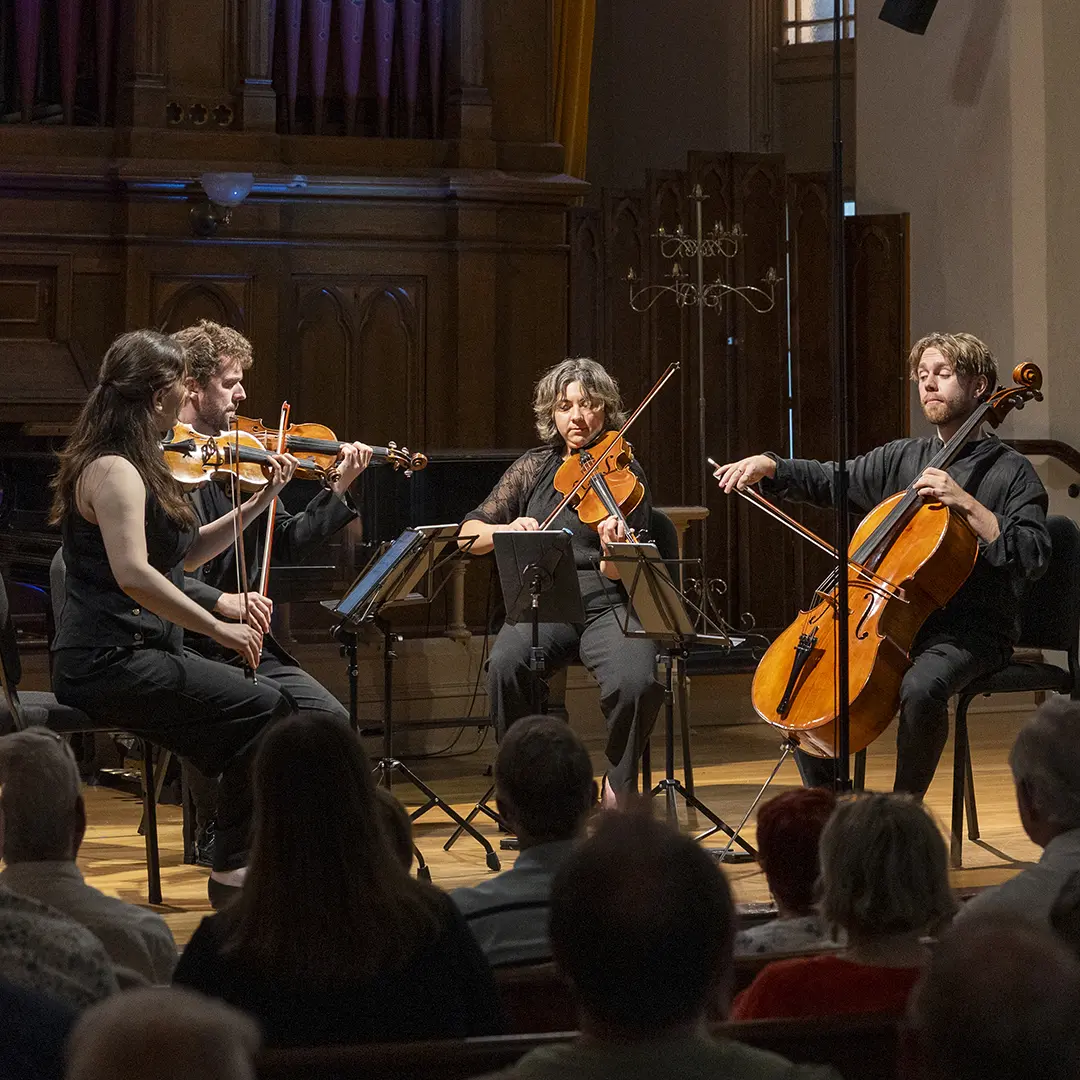
Few things in our fractured world bring us together quite like music, connecting us with our shared humanity across borders and time.
Premiered by Clara Schumann in 1861 and famous for its fiery “Rondo alla Zingarese” finale, Brahms’s youthful and exuberant Piano Quartet in G Minor transports us to both Brahms’s youth (he was just 23 when he started composing it) and to Hungary with its folk inspiration. Two soaring solo works by Austrian American composer Fritz Kreisler magically take us to Vienna in the hands of virtuoso violinist and CMNW Protégé Alumnus Claire Wells. This program also features revolutionary 20th century composer Erwin Schulhoff’s Five Pieces for String Quartet—innovative and entertaining reinterpretations of five different national dances, including the Viennese Waltz, Italian Tarantella, and Argentinian Tango.
6:30 PM | Reser lobby Prelude Performance with local students
Sponsored by Terwilliger Plaza.

Patricia Reser Center for the Arts
Thursday, 7/9 • 7:30 pm
Program
Click on any piece of music below to learn more about it.
- FRITZ KREISLER Selections
FRITZ KREISLER (1875–1962)
Marche miniature viennoise (4’)
Viennese Rhapsodic Fantasietta (10’)
Unlike many violin virtuosos, Fritz Kreisler (1875–1962) did not become famous for flashy, firework-filled performances. Instead, he made his name on the richness of his tone, seeming to effortlessly imbue every note with delicately applied vibrato.
As a composer, Kreisler primarily wrote music designed to help showcase this style of playing in concert, although he also wrote several operettas and a string quartet. His lighthearted 1925 encore Marche miniature viennoise (Miniature Viennese March) contrasts two humorous sections, the first a self-serious dance with hints of tango, the second an extravagantly cheery march.
Kreisler wrote the Viennese Rhapsodic Fantasietta, a nostalgic reflection on his Austrian homeland, in the early 1940s after moving to the United States. Its tender melodies make extensive use of the double stop technique, where the violinist plays two notes at the same time—a deceptively challenging technique to execute beautifully. In this free-reign structure, Kreisler adventures through a plethora of waltz-inspired ideas, some slow, some fast, some pensive, some ebullient.
—© Ethan Allred
- ERWIN SCHULHOFF Five Pieces for String Quartet
ERWIN SCHULHOFF (1894–1942) Five Pieces for String Quartet
I. Alla Valse Viennese. Allegro
II. Alla Serenata. Allegretto con moto
III. Alla Czeca. Molto Allegro
IV. Alla Tango. Andante
V. Alla Tarantella. Prestissimo con fuocoErwin Schulhoff was born in Prague in 1894 to a German-speaking Jewish family. His relatively brief life spanned a period of incredible change in both music and world affairs, beginning under the tutelage of Antonín Dvořák in the late Romantic tradition, and ending in 1942 as a victim of the Holocaust. Something of a stylistic wanderer—moving through several artistic movements including German Expressionism, the Second Viennese School, Dadaism, and Socialist Realism—Schulhoff has never found a firm place in the repertoire. The injustice of his death also meant his artistry had no chance to coalesce in a later career, and his political leanings—toward communism and the Soviet Union, where he had hoped to immigrate—made his work less sympathetic for revival in the West after the War.
One recurring element in Schulhoff’s music was an interest in popular dance and jazz, clearly represented in this suite of five pieces from 1923. The opening Viennese waltz is barred in two, rather than in the usual meter of three, which allows phrases to be stretched unpredictably, perhaps mocking the bourgeois dance. The Serenade stands on the border of French and German styles, with an added dose of musical Chinoiserie (a European idea of Asian music). Czech Folk Music evokes Schulhoff’s native land and memories of Dvořák. The shadowy Tango ends with a distorted chord, offsetting the rest of the movement with an Expressionistic touch, while the final Tarantella spins in measured fury.
This music was considered by the Nazis to be Entartete Musik: degenerate music. The label, combined with (and related to) Schulhoff’s Jewish heritage and communist beliefs, led to his unemployment and destitution in occupied Czechoslovakia, followed by arrest, and finally death from tuberculosis in a Bavarian prison camp.
—© Benjamin Pesetsky
This note originally appeared in the program book of Tippet Rise Art Center.
- BRAHMS Piano Quartet No. 1 in G Minor, Op. 25
JOHANNES BRAHMS (1833–1897) Piano Quartet No. 1 in G Minor, Op. 25 (38’)
I. Allegro
II. Intermezzo: Allegro ma non troppo – Trio: Animato
III. Andante con moto
IV. Rondo alla Zingarese: PrestoIn 1861, Johannes Brahms (1833–1897) finally moved into an apartment of his own in the Hamburg suburbs. This literal breath of fresh air enabled a new sense of creative freedom to emerge as he settled into a new sunlit studio, balcony, and garden.
Before long, Brahms’s move bore fruit in new music, including the Piano Quartet No. 1 in G Minor, Op. 25, from his first summer in his new abode. When he first visited Vienna the following year, Brahms used this pivotal early work as his musical “introduction” to the Imperial City. “This is Beethoven’s heir,” exclaimed one violinist upon reading it for the first time. After Brahms first performed the quartet publicly, renowned critic Eduard Hanslick described him as “possibly the most interesting among our contemporary composers.”
Not everyone loved the quartet immediately, though. Brahms’s friend Clara Schumann, for example, felt that its first movement contained “too little unity.” From Brahms’s perspective, this lack of unity was the point, a result of his deliberate attempts to subvert listeners’ expectations. Most importantly, instead of repeating the entire opening section (as would be expected), Brahms only repeats the first ten measures, then abruptly goes on to develop that same material. This clever approach to form, described by Arnold Schoenberg as “developing variation,” has since become one of the key parts of Brahms’s appeal, even if it took people a while to get used to it.
Brahms originally called the quartet’s second movement a Scherzo, but Clara Schumann insightfully suggested that he call it an Intermezzo instead. Brahms often followed this practice going forward, since he generally preferred gentle inner movements to the fiery scherzos of a composer like Beethoven. The Intermezzo’s rolling melodic exchanges combine with the shimmering harmonies of the Andante third movement to provide a soothing counterpoint to the first movement’s complexity.
The quartet concludes with a Rondo alla Zingarese, inspired by the Romani folk music popular in central Europe at the time. Early in his career, Brahms often struggled to bring his longer works to an appropriately dramatic conclusion. This final movement, on the other hand, demonstrates his growing maturity as a composer, as its rip-roaring scales and ferocious rhythms power his first piano quartet to a satisfying close.
—© Ethan Allred
Artists
-
 Gloria Chien
Piano & Artistic Director
Gloria Chien
Piano & Artistic Director
-
Taiwanese-born pianist Gloria Chien has one of the most diverse musical lives as a noted performer, concert presenter, and educator. She made her orchestral debut at the age of sixteen with the Boston Symphony Orchestra with Thomas Dausgaard, and she performed again with the BSO with Keith Lockhart. She was subsequently selected by The Boston Globe as one of its Superior Pianists of the year, “who appears to excel in everything.” In recent seasons, she has performed as a recitalist and chamber musician at Alice Tully Hall, the Library of Congress, the Phillips Collection, the Dresden Chamber Music Festival, and the National Concert Hall in Taiwan. She performs frequently with the Chamber Music Society of Lincoln Center. In 2009, she launched String Theory, a chamber music series in Chattanooga, Tennessee that has become one of the region’s premier classical music presenters. The following year she was appointed Director of the Chamber Music Institute at Music@Menlo, a position she held for the next decade. In 2017, she joined her husband, violinist Soovin Kim, as Artistic Director of the Lake Champlain Chamber Music Festival in Burlington, Vermont. The duo became Artistic Directors at Chamber Music Northwest in Portland, Oregon in 2020. Most recently, she released two albums—her Gloria Chien LIVE from the Music@Menlo LIVE label and Here With You with acclaimed clarinetist Anthony McGill on Cedille Records.
Chien studied extensively at the New England Conservatory of Music with Wha Kyung Byun and Russell Sherman. She is Artist-in-Residence at Lee University in Cleveland, Tennessee, and she is a Steinway Artist.
-
 Jennifer Frautschi
Violin
Jennifer Frautschi
Violin
-
Two-time Grammy nominee and Avery Fisher Career Grant recipient violinist Jennifer Frautschi has appeared as soloist with innumerable orchestras such as the Cincinnati Symphony, Chicago Symphony, Los Angeles Philharmonic, Milwaukee Symphony, Minnesota Orchestra, and St Paul Chamber Orchestra. She is an artist-member of the Boston Chamber Music Society and has appeared as chamber musician at Chamber Music Northwest, the Chamber Music Society of Lincoln Center, La Jolla Summerfest, Music@Menlo, Tippet Rise Art Center, Toronto Summer Music, and the Bridgehampton, Cape Cod, Charlottesville, Great Lakes, Lake Champlain, Moab, Ojai, Salt Bay, Santa Fe, Seattle, and Spoleto Festivals. Her extensive discography for the Albany, Artek, and Naxos labels includes the Stravinsky Violin Concerto with the Philharmonia Orchestra and Prokofiev’s Violin Concerti with the Seattle Symphony. Born in Pasadena, California, Jennifer attended the Colburn School, Harvard, the New England Conservatory, and the Juilliard School. She performs on a 1722 Antonio Stradivarius violin known as the “ex-Cadiz,” on generous loan from a private American foundation with support from Rare Violins in Consortium. She teaches in the graduate program at Stony Brook University.
-
 Alexander Hersh
Cello
Alexander Hersh
Cello
-
A top laureate of the 2024 Naumburg International Cello Competition, Alexander Hersh is widely recognized as one of the most creative and versatile cellists of his generation. Praised for his 2022 Carnegie Hall debut recital, he has appeared as soloist with major orchestras including the Houston Symphony, Baltimore Chamber Orchestra, Dallas Chamber Symphony, and Boston POPS, and received top prizes from the Pro Musicis International Award, Astral Artists National Auditions, and Salon de Virtuosi Career Grant.
An avid chamber musician, Hersh has toured with Musicians from Marlboro and performed at leading festivals, including Marlboro, Chamber Music Northwest, Ravinia, Caramoor, Music@Menlo, Lucerne, and IMS Prussia Cove. He is Co-Artistic Director of NEXUS Chamber Music, an artist-led collective dedicated to breaking down the barriers for how classical music is experienced through intimate performances, multimedia projects, and new commissions.
His debut album, ABSINTHE (2023) received critical acclaim, and he was recently featured on PBS’s Now Hear This series in an episode exploring the music of Boccherini.
A fourth-generation string player, Hersh’s parents are both active professional violinists; his grandfather, Paul Hersh, taught at the San Francisco Conservatory of Music for 49 years and his great-grandfather, Ralph Hersh, was a member of the WQXR and Stuyvesant String Quartets and Principal Violist of the Dallas and Atlanta Symphony Orchestras.Raised in Chicago, Hersh began playing the cello at the age of five. He received his B.M. and M.M. from New England Conservatory and continued his studies in Berlin at the Hanns Eisler Hochschule für Musik. His teachers have included Laurence Lesser, Hans Jørgen Jensen, Kim Kashkashian, Nicolas Altstaedt, and Paul Katz. He plays a G.B. Rogeri cello, courtesy of Guarneri Hall NFP and Darnton & Hersh Fine Violins. In his spare time he composes original music and creates short films that marry classical music with narrative, viewable on his YouTube channel: @AlexanderHersh.
-
 Erin Keefe
Violin
Erin Keefe
Violin
-
American violinist Erin Keefe is currently the Concertmaster of the Minnesota Orchestra and on the violin faculty of the Curtis Institute of Music. Winner of an Avery Fisher Career Grant as well as numerous international competitions, she has appeared as soloist in recent seasons with the Minnesota Orchestra, New York City Ballet Orchestra, Korean Symphony Orchestra, Iceland Symphony, Lahti Symphony, Sendai Philharmonic, and the Gottingen Symphony, and has given recitals throughout the United States, Austria, Italy, Germany, Korea, Poland, Finland, Japan, and Denmark.
Ms. Keefe has been performing with the Chamber Music Society of Lincoln Center since 2005 and has been featured with them on Live from Lincoln Center three times. She has collaborated with artists such as the Emerson String Quartet, Edgar Meyer, Gary Hoffman, David Finckel, Wu Han, Richard Goode, Menahem Pressler, Gary Graffman, and Leon Fleisher, and she has recorded for Naxos, the CMS Studio Recordings label, BIS, and Deutsche Grammophon. She has made festival appearances with Music@Menlo, the Marlboro Music Festival, Music from Angel Fire, Music in the Vineyards, and the Bridgehampton, Seattle, OK Mozart, La Jolla Summerfest, and Bravo! Vail chamber music festivals.
As a guest concertmaster, Ms. Keefe has appeared with the New York Philharmonic, Pittsburgh Symphony, Seoul Philharmonic, and the Sao Paulo Symphony Orchestra.
Ms. Keefe earned a Master of Music degree from The Juilliard School and a Bachelor of Music degree from The Curtis Institute of Music. Her teachers included Ronald Copes, Ida Kavafian, Arnold Steinhardt, and Philip Setzer.
-
 Lesley Robertson
Viola
Lesley Robertson
Viola
-
After celebrating a final 34th year with the internationally celebrated St. Lawrence String Quartet (SLSQ), Lesley Robertson (viola) continues at Stanford University (1998–present), where she and her St. Lawrence colleagues direct Chamber Music in the Department of Music. Ms. Robertson teaches viola, coaches chamber music, and spearheads both the Emerging String Quartet Program and the annual St. Lawrence Chamber Music Seminar at Stanford. A graduate of the Curtis Institute and the Juilliard School, she also holds a degree from the University of British Columbia, where she studied with her mentor Gerald Stanick. A founding member of the SLSQ, Ms. Robertson toured regularly with the ensemble, performing 100+ concerts worldwide per season (in Berlin, Florence, London, Paris, New York, and Toronto), while nurturing close ties to the Stanford community through performances in classes, dormitories, laboratories, hospitals, and Stanford’s glorious Bing Concert Hall. She participated in the Marlboro Festival for several years and toured with Musicians from Marlboro before co-founding the SLSQ. She has served on the jury of international competitions including the Banff, Melbourne, Geneva, and Wigmore Hall string quartet competitions. Summer festivals include Spoleto Festival USA, Norfolk, Banff, Santa Fe, Rockport, Bravo Vail, Music@Menlo, and more. Robertson plays a viola (1992) by fellow Canadian John Newton and a bow (2016) by François Malo.
-
 Peter Stumpf
Cello
Peter Stumpf
Cello
-
Peter Stumpf is Professor of Cello at the Indiana University Jacobs School of Music. Prior to his appointment, he was the Principal Cellist of the Los Angeles Philharmonic for nine years, following a twelve-year tenure as Associate Principal Cellist of the Philadelphia Orchestra. He received a Bachelor’s degree from the Curtis Institute of Music and an Artist’s Diploma from the New England Conservatory of Music.
A dedicated chamber music musician, he is a member of the Weiss-Kaplan-Stumpf Trio and has appeared at Carnegie Hall and the Kennedy Center, and in Amsterdam, Tokyo, and Cologne. He has performed with the chamber music societies of Boston and Philadelphia, and at numerous festivals including Marlboro, Santa Fe, Bridgehampton, Spoleto, and Aspen. He has toured with Music from Marlboro, and with pianist Mitsuko Uchida in performances of the complete Mozart Piano Trios. As a member of the Johannes Quartet, he collaborated with the Guarneri String Quartet on a tour including premieres of works by Bolcom and Salonen.
Concerto appearances have included the Boston Symphony, the Los Angeles Philharmonic, the Philadelphia Orchestra, and the Aspen Music Festival, among others. Solo recitals have been at Jordan Hall in Boston, on the Philadelphia Chamber Music Society series, on the Chamber Music in Historic Sites series in Los Angeles, and at the Philips and Corcoran Galleries in Washington, D.C. His awards include first prize in the Washington International Competition.
He has served on the cello faculties at the New England Conservatory and the University of Southern California.
-
 Claire Wells
Violin, Past Protégé
Claire Wells
Violin, Past Protégé
-
Born in 2001, Claire Wells is an American violinist who is fast emerging as an original, distinctive musical voice on the international scene. As an artist, Claire’s work is shaped by an instinctive curiosity that guides her across periods and styles, drawing her toward music she finds genuinely compelling, from early repertoire to contemporary works.
Highlights in the upcoming 2026 season include Prokofiev’s Concerto No. 1 with the Illinois Symphony Orchestra and the Tchaikovsky Violin Concerto with the Maryland Symphony Orchestra, and past highlights include performing Kaija Saariaho’s Graal théâtre with the Finnish Radio Symphony Orchestra under the baton of Dima Slobodeniouk in May 2025, as well as working on and performing Jörg Widmann’s Etude No. 3 alongside the composer as part of CMNW’s 2024 Summer Festival.
As a soloist, Claire has performed with orchestras including the Dallas Symphony, Konzerthausorchester Berlin, the Fort Worth Symphony Orchestra, the Stuttgart Philharmoniker, Czech Orchestra Prague, Auckland Philharmonic, Helsinki Philharmonic, Indianapolis Symphony Orchestra, Webern Kammerphilharmonie, and the Finnish Radio Symphony Orchestra, working with conductors such as Leonard Slatkin, Dima Slobodeniouk, Pietari Inkinen, Robert Kružík, and Andrew Litton, among others.
Having won major prizes at many internationally renowned competitions including the Michael Hill, Sibelius, Mirecourt, Mendelssohn-Bartholdy, and Indianapolis violin competitions, Claire was the 2023 scholarship winner of the Mozart Gesellschaft Dortmund, and was most recently the winner of the 2025 Susan Wadsworth Young Concert Artists International Auditions.
Having always held a love and passion for chamber music, Claire appears at leading festivals such as Chamber Music Northwest, Chamber Music Connects the World in collaboration with Christian Tetzlaff and Steven Isserlis, the IMS Prussia Cove Open Chamber Music Festival in Cornwall, the Verbier Festival Academy, Tippet Rise Chamber Festival in Montana, and the Kryzyowa Festival in Kreisau, Poland. As well as performing regularly with top young artists of today, Claire has collaborated with many distinguished musicians, including Noah Bendix-Balgley, Christian Tetzlaff, Steven Isserlis, Gary Hoffman, Enrico Pace, and Nobuko Imai, among others.
Claire is represented worldwide by Young Concert Artists. She currently resides in Berlin, and is studying at the Kronberg Academy under the tutelage of Mihaela Martin, made possible by the Opel/Dr. Schaefer patronage. Claire Wells plays on a Nicolo Amati and a Grand Adam bow, on loan from a generous donor.