

Raphaël Feuillâtre: Latin Passions
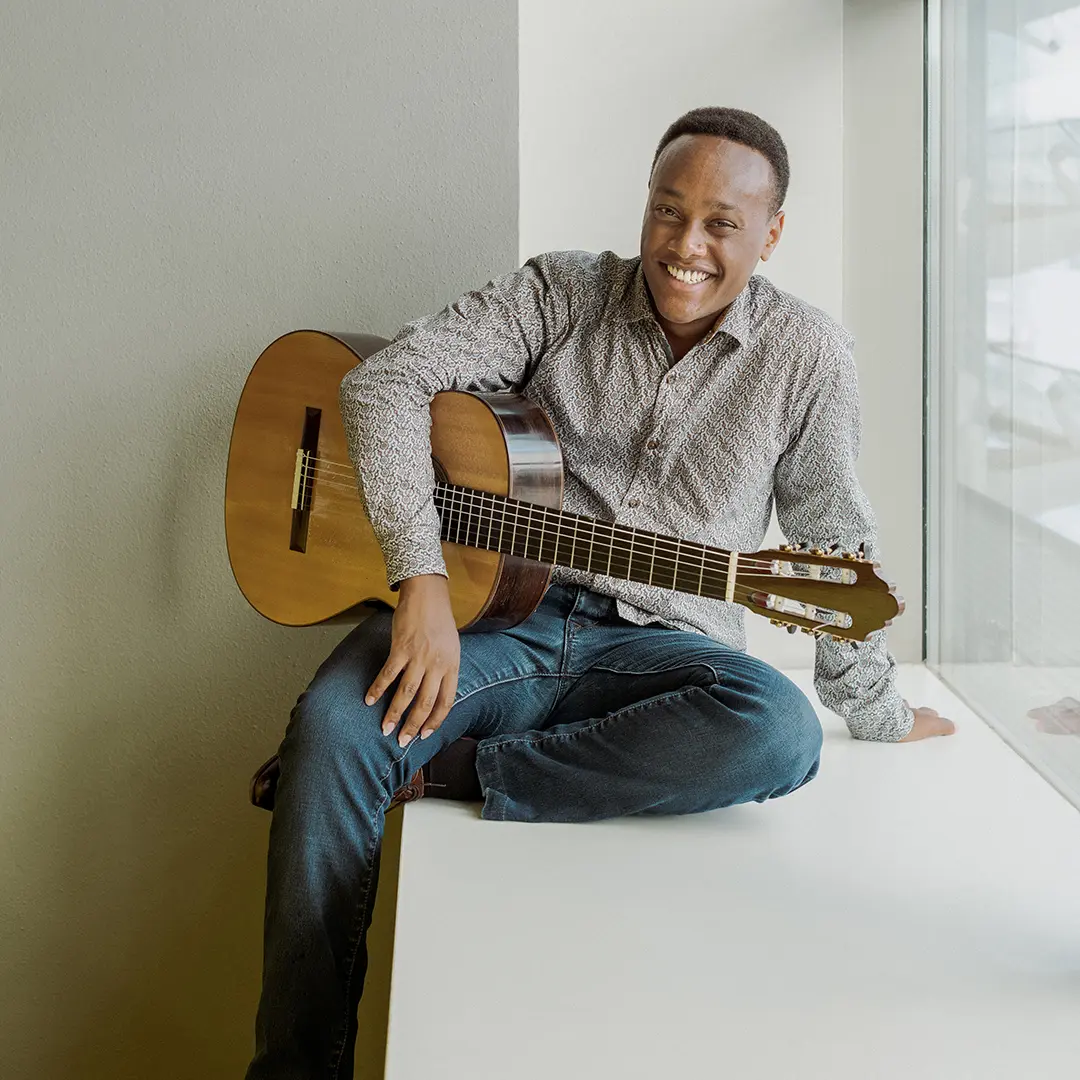
Hailed by France Musique as the new face of the classical guitar, Djibouti-born French guitarist Raphaël Feuillâtre regularly delights audiences and critics worldwide with his charismatic artistry, embracing everything from Baroque-period repertoire to compositions by trailblazing contemporary composers. His jaw-dropping precision, technical mastery, and creative vision make works from all time periods sound as if they were written yesterday–alive, heartfelt, and filled with color. Don’t miss a passionate evening of Latin music, including many of Feuillâtre’s own arrangements.
This program is approximately 90 minutes.
“The music…fitted the guitar so well that, if you didn’t know better, you would have sworn they were written for them. They fitted the instrument absolutely beautifully in these transcriptions and Feuillâtre played them with such a lovely sense of legato and an understatedly gentle dynamic that, by the time the interval began, I found myself in something approaching a state of zen.”
— Seen and Heard International
The Old Church Concert Hall
Thursday, 11/5 • 7:30 pm
Program
Click on any piece of music below to learn more about it.
- Program Notes for Raphaël Feuillâtre: Latin Passions
From Madagascar to Madrid, from Rio de Janeiro to the Rio de Plata, the nylon-string guitar has become an essential vehicle in a disparate constellation of creatively fecund cultures. Over the past decade, Raphaël Feuillâtre has emerged as one of the instrument’s most commanding champions of this far-flung realm. Combining virtuosity with a steadily expanding repertoire that embraces the guitar’s epic journey, he’s among the classical world’s foremost ambassadors. Making his Chamber Music Northwest debut, he presents “Latin Passions,” a program that seamlessly connects the guitar’s Iberian roots to its manifold New World musical fruits.
Born in the nation of Djibouti in the Horn of Africa and raised in Cholet, a small city in western France, the 30-year-old Feuillâtre is a dedicated educator who has earned a steady stream of awards and honors, including the prestigious Guitar Foundation of America competition in 2018 and the coveted, young-career boosting “Classical Revelation” award by France’s ADAMI collective in 2021. His rapid ascent was further fueled by Deutsche Grammophon, which signed him as an exclusive artist in 2022, making him one of only a handful of guitarists featured on the storied label.
Feuillâtre’s “Latin Passions” program expands on his second Deutsche Grammophon release, 2025’s Spanish Serenades, while embodying the wide-spectrum scope of his vision. In many ways he offers a narrative that’s both global and granularly intimate, opening as a dialogue between friends by alternating signature works of 19th-century guitarist Francisco Tárrega and pianist Isaac Albéniz. Creative confidants who influenced and inspired each other, both Spanish composers were deeply engaged with the country’s cultural multiplicity. Tárrega explicitly drew on the Gitano culture of Andalusia and Spain’s deep ties to the Maghreb on his Capricho árabe, while Albéniz offers a picaresque tour through Spain’s distinct regions on Suite española No. 1, Op. 47. Evoking the sweeping romance of Granada, the terpsichorean rituals of Catalonia, and the far-reaching power of Cuban rhythm (via Sevilla), among other locales, it’s a piece shaped by Feuillâtre’s interpretive brilliance as a player and arranger.
The conversation widens with El Testament D’Amelia, Miguel Llobet Solés’s deceptively unadorned rendering of a Catalan folk song, but it’s Tárrega who provides the thread running through “Latin Passions.” His iconic, technically demanding Recuerdos de la Alhambra is a de rigueur proving ground for classical guitarists, and it serves as the program’s emotional centerpiece. Feuillâtre is less interested in displaying his prowess than in revealing the vivid mélange of nostalgia, mystery and romance conjured by a site that represents the creative ferment of Al-Andalus and the Spanish Renaissance.
Bridging his love letter to Spanish guitar and its New World effervescence, Feuillâtre steps back into the Baroque, a world he explored with consummate intelligence on his 2023 debut album Visages Baroques. Gérard Abiton’s arrangement of Scarlatti’s Keyboard Sonata in D Major, K. 492 leans into its flamenco source material, a space in which Feuillâtre thrives. But along with Cappricio Diabolico, Op. 85, Mario Castelnuovo-Tedesco’s finger-busting homage to the violin pyrotechnics of Niccolò Paganini, the program’s middle section essentially provides a palette-clearing (or would that be searing?) interlude before Feuillâtre plunges across the Atlantic.
The second half of the program follows the guitar to Latin America, where Feuillâtre finds possibilities for the instrument multiplying exponentially. Paraguayan composer Agustín Barrios Mangoré’s ethereal love letter, Mazurka Appassionata, showcases Feuillâtre’s sensuous touch, while Antonio Lauro’s tender ode to his daughter, Vals Venezolano No. 3 (“Natalia”), requires a different kind of sensitivity with its combination of spritely waltzes and Afro-Venezuelan syncopation. Sergio Assad, half of the Brazilian sibling duo that paved the way for Feuillâtre’s expansive repertoire, is well represented by Suite brasileira No. 4, Mvt. 1, a graceful piece inspired by a rural folk dance from Brazil’s vast southern interior.
Feuillâtre wears his debt to the Assads on his sleeve with the rest of the program, as the brothers quadruple-handedly made composers like Leo Brouwer an essential part of the guitar literature. The prolific Cuban composer’s El Decamerón Negro, Mvt. 2 is a famously tricky work that simulates a persistent echo. Feuillâtre foregrounds his love of dance rhythms with the great Brazilian composer Heitor Villa-Lobos’s Selections from Suite populaire brésilienne, W020, which draws on choro, the first Brazilian style to meld African rhythms with European forms and instrumentation. He similarly honors the Assads’ pioneering guitar transcriptions of Astor Piazzolla’s supremely dramatic nuevo tango with The Four Seasons of Buenos Aires, No. 2, a movement that encapsulates the Argentine composer’s revolutionary sound with flashing counterpoint and thick jazz harmonies.
The program concludes with Feuillâtre’s embrace of one of the guitar’s most adventurous practitioners, Roland Dyens. Though he died a decade ago at the age of 61, the Tunisian-born French maestro continues to occupy a vanguard position in the guitar firmament, and no piece of his burns more brightly than Libra Sonatine, Mvt. 3, a visceral response to a near-fatal encounter. Though his career is young, the wise-beyond-his-years Feuillâtre knows that “Latin Passions” encompass life, death, love, fury, pride, passion, and countless other feelings and experiences that can be coaxed out of a guitar’s wood and strings.
—© Andrew Gilbert
- TÁRREGA “Capricho árabe”
FRANCISCO TÁRREGA (1852–1909) Capricho árabe
- TÁRREGA Prelude No. 18 in D Major
FRANCISCO TÁRREGA (1852–1909) Prelude No. 18 in D Major
- ALBÉNIZ “Torre Bermeja”
ISAAC ALBÉNIZ (1860–1909) Torre Bermeja, Arr. Raphaël Feuillâtre
- TÁRREGA “Recuerdos de la Alhambra”
FRANCISCO TÁRREGA (1852–1909) Recuerdos de la Alhambra
- ALBÉNIZ Suite española No. 1, Op. 47, Mvt. 5
ISAAC ALBÉNIZ (1860–1909) Suite española No. 1, Op. 47, Arr. Raphaël Feuillâtre
V. Asturias – Leyenda
- MIGUEL LLOBET SOLÉS “El Testament d’Amelia”
MIGUEL LLOBET SOLÉS (1878–1938) El Testament d’Amelia
- ALBÉNIZ “España,” Op. 165, Mvt. 5
ISAAC ALBÉNIZ (1860–1909) España, Op. 165, Arr. Raphaël Feuillâtre
V. Capricho Catalan
- SCARLATTI Keyboard Sonata in D Major, K. 492
DOMENICO SCARLATTI (1685–1757) Keyboard Sonata in D Major, K. 492 Arr. Gérard Abiton
- MARIO CASTELNUOVO-TEDESCO “Cappricio Diabolico” (“Homage to Paganini”), Op. 85a
MARIO CASTELNUOVO-TEDESCO (1895–1968) Capriccio Diabolico (Hommage to Paganini), Op. 85a (1935)
- AUGUSTÍN BARRIOS MANGORÉ “Mazurka Appassionata”
AGUSTÍN BARRIOS MANGORÉ (1885–1944) Mazurka Appassionata
- ANTONIO LAURO Vals Venezolano No. 3 (“Natalia”)
ANTONIO LAURO (1917–1986) Vals Venezolano No. 3 (“Natalia”)
- ANTONIO LAURO “Ana Florencia” (canción de cuna)
ANTONIO LAURO (1917–1986) Ana Florencia (canción de cuna)
- LEO BROUWER “El Decamerón Negro,” Mvt. 2
LEO BROUWER (b. 1939) El Decamerón Negro (1981)
II. La huida de los amantes por el valle de los ecos (The Flight of the Lovers Through the Valley of Echoes)
- SERGIO ASSAD Suite brasileira No. 4, Mvt. 1
SÉRGIO ASSAD (b. 1952) Suite brasileira No. 4
I. Cateretê
- HEITOR VILLA-LOBOS Selections from Suite populaire brésilienne, W020
HEITOR VILLA-LOBOS (1887–1959) Suite populaire brésilienne, W020
III. Valse – choro
V. Chorino
I. Mazurka – choro- HEITOR VILLA-LOBOS 12 Estudos, W235, No. 12
HEITOR VILLA-LOBOS (1887–1959) 12 Estudos, W235
XII. Animé
- ASTOR PIAZZOLLA “The Four Seasons of Buenos Aires,” Mvt. 2
ASTOR PIAZZOLLA (1921–1992) The Four Seasons of Buenos Aires, Arr. Sérgio Assad
II. Invierno Porteño (Buenos Aires Winter)
- ROLAND DYENS “Libra Sonatine,” Mvt. 3
ROLAND DYENS (1955–2016) Libra Sonatine
III. Fuoco
Artists
-
 Raphaël Feuillâtre
Classical Guitar
-
Hailed as the new face of classical guitar worldwide, Raphaël Feuillâtre fascinates audiences and critics alike with the depth of his interpretations, his dazzling virtuosity, and the richness of his repertoire.
Winner of the prestigious Guitar Foundation of America competition in 2018 (USA) and ADAMI’s “Classical Revelation 2021,” Raphaël was chosen as an exclusive artist by the label Deutsche Grammophon in 2022. He is, to date, one of the very few guitarists to have signed with this legendary label. This fruitful collaboration gave birth to his debut album Visages Baroques in 2023, which displays different facets of the Baroque aesthetic. His second album, Spanish Serenades, features masterpieces from the Spanish repertoire, including works by Albéniz, Granados, Llobet, Rodrigo, and Tárrega. It includes one of Granados’s Danzas españolas with violinist María Dueñas, as well as the legendary Concierto de Aranjuez by Rodrigo, recorded with the Verbier Festival Chamber Orchestra conducted by Gábor Takács-Nagy.
Following his acclaimed debut at New York’s Carnegie Hall in 2023, he has performed in some of the world’s most prestigious concert halls and festivals—including Amsterdam’s Concertgebouw, the “Folle Journée” in Nantes, the Edinburgh International Festival, and the Beethoven Haus in Bonn—as well as at major guitar events such as the Festival International de Guitare de Paris, the Festival Guitarras del Mundo in Argentina, and the Changsha International Guitar Festival in China.His passion for chamber music and his desire to champion his instrument in this repertoire has led him to collaborate with musicians of the highest caliber: recorder player Lucie Horsch, trumpet player Lucienne Renaudin Vary, and violinist María Dueñas in venues such as Deutsche Grammophon’s Yellow Lounge, the Dresden Music Festival, Schleswig Holstein Festival, Cité de la Musique de Paris, and the Società del Quartotto Di Milano, Sala Verdi.
Born in Djibouti in 1996, Raphaël was introduced to the guitar by his first teacher, Hacène Addadi, before joining Michel Grizard’s class at the Conservatoire de Nantes in 2012. Three years later, he entered the Conservatoire National de Musique et de Danse de Paris in the classes of Roland Dyens and Tristan Manoukian.
In addition to winning first prize at the GFA, Raphaël has forged a strong reputation in the classical guitar world by winning the following competitions: Jose Tomas International Guitar Competition in Villa Petrer (Spain, 2017), Kutna Hora International Guitar Festival (Czech Republic, 2017), Viseu International Spring Music Festival (Portugal, 2016), Fontenay-sous-Bois Guitar Competition & Festival (France, 2015), and Ciudad de Coria International Guitar Festival (Spain, 2014).
An ambassador for the guitar and keen to contribute to the development of its repertoire, Raphaël has arranged numerous works from the repertoire of instruments he loves—with a particular predilection for keyboard instruments such as the piano and harpsichord—a taste particularly reflected in his choice of programs for his recordings.
Driven by a desire to pass on his passion for music and the guitar, Raphaël teaches at the Pôle Supérieur - Bretagne and is co-founder of the Lille Guitar Academy, a summer academy for guitarists. Students from all over the world receive his guidance at masterclasses given at the San Francisco Conservatory, the Manhattan School in New York, and the Haute École de Musique in Geneva. He is also involved in projects to raise awareness of the arts, particularly following a tour in the USA during which he took part in several activities in schools and prisons.
Raphaël Feuillâtre is supported by Savarez, a historic string-manufacturing company founded in 1770, and plays a guitar by Australian luthier Greg Smallman.
Upcoming Concerts & Events
- Classical Guitar Masterclass with Raphaël Feuillâtre
- Raphaël Feuillâtre: Latin Passions (currently selected)