

Schumann & Tchaikovsky Delights
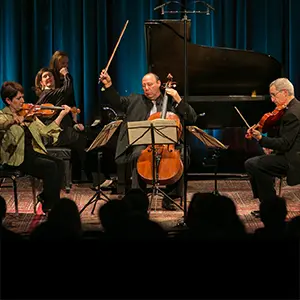
Opus One Piano Quartet – featuring revered artists Ida Kavafian, Anne-Marie McDermott, Steven Tenenbom, and Peter Wiley – and former Chamber Music Northwest Protégé ensemble the Rolston String Quartet, known for its “electrifying performance(s)” (Strings Magazine), perform masterworks by Schumann and Tchaikovsky.
Premieres June 25 @ 7 pm PT
Available through June 26 @ 11:59 pm PT
Program
Click on any piece of music below to learn more about it.
- R. SCHUMANN Piano Quartet in E-flat Major, Op. 47
ROBERT SCHUMANN Piano Quartet in E-flat Major, Op. 47
I. Sostenuto assai – Allegro ma non troppo
II. Scherzo: Molto vivace
III. Andante cantabile
IV. Finale: VivaceWhen he wrote music, Robert Schumann tended to focus on one genre at a time; in the summer of 1842 he turned his attention to chamber works. By the end of 1842, Schumann had completed three string quartets, a piano quintet, a piano quartet, and his Op. 88 Phantasiestücke for piano, violin, and cello.
The Piano Quartet in E-flat Major, Op. 47 reflects Beethoven’s influence on Schumann in the four-note motif that dominates the opening movement. It opens the slow introduction, then announces itself more forcefully in the Allegro ma non troppo. From this concise fragment Schumann generates vigorous, propulsive phrases full of energy and excitement. The energy carries into the brief Scherzo, which features a furtive, whispery theme that contrasts with a lyrical countertheme. In the Andante cantabile, the cello presents one of Schumann’s most singable instrumental melodies, a warm graceful theme of love and longing. This theme becomes a duet and then repeats in between contrasting interludes in which the string quartet comes into its own, with the piano accompanying. The four-note theme of the first movement, now shortened to three notes, launches the Vivace. The viola presents a second theme, a fugue subject played by all the instruments. Schumann reveals his contrapuntal ingenuity in combining this fugue with the three-note opener and additional lyrical phrases that recall the Andante cantabile. The quartet ends with a joyous rush of energy.
When Op. 47 premiered in December 1844 at the Leipzig Gewandhaus, a critic for the Allgemeine musikalische Zeitung described it as “... a piece full of spirit and vitality which, especially in the two inside movements, was most lovely and appealing, uniting a wealth of beautiful musical ideas with soaring flights of imagination. It will surely be received with great applause everywhere, as it was here.”
—© Elizabeth Schwartz
- TCHAIKOVSKY String Sextet in D Minor, Op. 70, “Souvenir de Florence”
TCHAIKOVSKY String Sextet in D Minor, Op. 70, Souvenir de Florence (1892)
I. Allegro con spirito
II. Adagio cantabile e con moto
III. Allegro moderato
IV. Allegro vivaceTchaikovsky’s soul was seldom at rest in the years following his marital disaster in 1877, and he sought distraction in frequent travel abroad; Paris and Italy were his favorite destinations. In January 1890, he settled in Florence and spent the next three months in that beautiful city working on his latest operatic venture, Pique Dame (“The Queen of Spades”). He took long walks along the Arno, marveled that spring flowers sprouted in February, and savored the food. After a brief stay in Rome, he arrived back in Russia on May 1st, noting five days later to a friend that after finishing Pique Dame, “I want to make sketches for a sextet for strings.” The orchestration of the opera was completed by early the next month, and on June 12th he told his brother Modeste that he was “starting the string sextet tomorrow.” The work was sketched within a month, and performed privately in November, but Tchaikovsky reported to the composer Mikhail Ippolitov-Ivanov that “it turned out poorly in all respects.” He began a revision early in 1891 but had to put it aside for his tour to the United States in April and May, and then for the composition and production of The Nutcracker and the opera Iolanthe; the new version was not finished until January 1892 in Paris. It was at that time that Tchaikovsky, without further explanation, appended the phrase “Souvenir de Florence” to the work’s title.
In their biography of Tchaikovsky, Lawrence and Elisabeth Hanson wrote, “The Souvenir de Florence is not great music but it is very pleasant and extremely cleverly constructed. It is above all suffused with an atmosphere not often associated with this composer, of a calm geniality.” It is probably this quality that prompted Tchaikovsky, who often wrote in his letters of the “heavenly” Italian climate, to add the sobriquet to the work’s original title. The music itself is decidedly Russian in mood and melody, with only a certain lightness of spirit in the first two movements showing any possible Italianate traits. Indeed, if anything the Sextet exhibits a strong German influence in the richness of its string sonorities and thematic development, which frequently recall Brahms’s chamber music. The opening movement is a full sonata structure given in the style of a bustling waltz. The following Adagio is disposed in a three-part form whose brief center section is constructed from a delightful, fluttering rhythmic figuration. The two closing movements are based on folk-like themes, the first a sad song that is the subject of considerable elaboration as it progresses, the other a bounding Cossack dance.
—© Dr. Richard Rodda