

New@Night: Rhapsodies & Demons
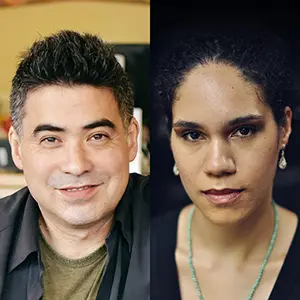
Meet us early at the Alberta Rose pre-concert and prep to explore the musical innovation of Jessie Montgomery, Steven Hartke, Kenji Bunch, and more, in a low-key/high-creative setting.
Co-Sponsors: Joan Levers & David Manhart
COME EARLY to socialize!
Alberta Rose Theatre
Wednesday, 6/29 • 8:00 pm
Program
Click on any piece of music below to learn more about it.
- BARTÓK/SHERRY 8 Romanian Folk Dances
BÉLA BARTÓK/FRED SHERRY
8 Romanian Folk DancesThe titles will be announced from the stage
Here are different sides of Béla Bartók and Fred Sherry than one is accustomed to hearing. Bartók visited remote and isolated Romanian villages to collect folk songs and dances between 1908 and 1917. These melodies had never been notated until Bartók took on the superhuman task of understanding the subtleties of this centuries-old traditional music. He became obsessed by the tunes themselves and the evolution of their performance, which was passed down from generation to generation. The process radically changed his approach to composition and he wove some of the melodies into his original compositions.
Fred Sherry claims that he was aware of these melodies and tracked down the manuscripts to their home at Columbia University‘s Butler Library. He studied them, and eventually began to transcribe them for two cellos. As he made progress through the 809 melodies he began to understand Bartók’s enthusiasm for this enticing and important part of music history. Later, he began to write introductions, accompaniments, and codas for the melodies. Sherry confessed that he made up the titles, and thanked people in his life, past and present, in dedications at the beginning of each melody.
— © Esmeralda Katz, Buenos Aires
- JESSIE MONTGOMERY ‘Rhapsody No. 1’
Rhapsody No. 1 is the first solo violin piece I wrote for myself. It draws on inspiration from Eugène Ysaÿe’s solo violin works and is meant to serve as both an etude and a stand-alone work. This piece is intended to be part of a set of 6 solo violin works, each of which will be dedicated to a different contemporary violinist, and inspired by a historical composer.
— © Jessie Montgomery
- KENJI BUNCH ‘The Demon Barber’ (2010)
KENJI BUNCH The Demon Barber
My first exposure to Sweeney Todd came as a 10-year-old watching a PBS broadcast of the Broadway production. I was both terrified and fascinated, and have felt both the work’s and Sondheim’s influence ever since. For The Demon Barber – an homage to the seething, menacing introductory song, The Ballad of Sweeney Todd – I highlighted the original song’s oblique references to the Dies irae Gregorian melody into a persistent, ominous chant that surfaces throughout. I also wanted to amplify the work’s horror-show qualities with low register rumblings, shrieking high clusters, and insistent rhythmic ostinato patterns.
—© Kenji Bunch
- STEPHEN HARTKE “Netsuke” (2011)
STEPHEN HARTKE
Netsuke (2011)I. Tengu, the shapeshifter that feeds on the falsely holy
II. Tadamori and the Oil-thief
III. Tanuki playing the samisen
IV. Baku, the monster that devours nightmares
V. Demons carrying a rich man to hell
VI. Jewel of Wisdom with mountain pavilionsNetsuke are Japanese miniature carvings that were originally made to secure objects suspended from a man’s sash. Often very intricate in design, they represent a broad range of subject matters from depictions of animals and people to scenes from folktales, literature, and everyday life to fanciful supernatural creatures. This piece was inspired by six exquisite carvings from the Bushell Collection at the Los Angeles County Museum of Art. In the first movement, a tengu, a hawk-like goblin, takes on the appearance of a monk to lure a religious hypocrite to his doom. The second carving, Tadamori and the Oil-Thief, is a wonderfully kinetic depiction of a midnight scuffle between a samurai and a poor servant whom he has mistaken for a thief. A tanuki is a raccoon-like creature thought to have the power to change its appearance. In this small sculpture, one is seen dressed in a robe quietly playing the samisen. In my piece, I found myself thinking of the samisen duels that one frequently hears in Japanese theatrical music. While quite fearsome looking, with the head of an elephant and a lion’s mane, the baku is a shy creature that performs the useful service of protecting sleepers from nightmares. In the carving that inspired the fifth movement, a rich man has apparently set off on a journey, but instead of being carried by his usual bearers, seven demons have hijacked his sedan chair and gleefully cart him down to Hell. The final netsuke shows a serene mountain landscape intricately rendered in a water-drop-shaped piece of ivory. Gnarled, wind-blown trees and the verandas of handsome pavilions can be discerned through the mist. Commissioned by the McKim Fund in the Library of Congress, Netsuke is dedicated in friendship and gratitude to Matt Albert and Lisa Kaplan of eighth blackbird.
—© Stephen Hartke
Artists
-
 Monica Ohuchi
Piano
Monica Ohuchi
Piano
-
Monica Ohuchi’s “commanding pianism” (The New York Times, Anthony Tommasini), performing “with beauty, clarity and drive…[offering a] warmth…expressiveness [that’s] irresistible and deeply moving” (The Times Argus, Vermont) allows her an active international career as a piano soloist, chamber musician, and pedagogue. Her “scintillating” (The Arts Desk, United Kingdom, David Nice) playing, combined with “an overt virtuosity [and] deep sensitivity that makes her lines sing” (Rutland Herald, Vermont) has taken her around the globe, from Lincoln Center in New York City, to remote villages in Bulgaria, to concert halls across Japan.
A pianist “dutifully and gracefully” (San Francisco Classical Voice) attentive to musical depth and detail, Ohuchi is a frequent soloist with orchestras; recent engagements include the Colorado Symphony Orchestra and the Marin Symphony Orchestra. Locally in her hometown of Portland, Oregon, Ohuchi performs with internationally acclaimed artists of Chamber Music Northwest, is often broadcast on All Classical Radio, is pianist of the quartet The Thunder Egg Consort, and enjoys soloing with regional orchestras.
Ohuchi is the pianist and Executive Director of the new music ensemble, Fear No Music. She is the Director of Music Performance at Reed College, where she also teaches piano and chamber music. Ohuchi holds advanced degrees from the Juilliard School.
-
 Jennifer Frautschi
Violin
Jennifer Frautschi
Violin
-
Two-time Grammy nominee and Avery Fisher Career Grant recipient violinist Jennifer Frautschi has appeared as soloist with innumerable orchestras such as the Cincinnati Symphony, Chicago Symphony, Los Angeles Philharmonic, Milwaukee Symphony, Minnesota Orchestra, and St Paul Chamber Orchestra. She is an artist-member of the Boston Chamber Music Society and has appeared as chamber musician at Chamber Music Northwest, the Chamber Music Society of Lincoln Center, La Jolla Summerfest, Music@Menlo, Tippet Rise Art Center, Toronto Summer Music, and the Bridgehampton, Cape Cod, Charlottesville, Great Lakes, Lake Champlain, Moab, Ojai, Salt Bay, Santa Fe, Seattle, and Spoleto Festivals. Her extensive discography for the Albany, Artek, and Naxos labels includes the Stravinsky Violin Concerto with the Philharmonia Orchestra and Prokofiev’s Violin Concerti with the Seattle Symphony. Born in Pasadena, California, Jennifer attended the Colburn School, Harvard, the New England Conservatory, and the Juilliard School. She performs on a 1722 Antonio Stradivarius violin known as the “ex-Cadiz,” on generous loan from a private American foundation with support from Rare Violins in Consortium. She teaches in the graduate program at Stony Brook University.
Upcoming Concerts & Events
-
 Alexi Kenney
Violin
Alexi Kenney
Violin
-
Violinist Alexi Kenney is forging a career that defies categorization, following his interests, intuition, and heart. He is equally at home creating experimental programs and commissioning new works, soloing with major orchestras, and collaborating with some of the most celebrated artists and musicians of our time. Alexi is the recipient of an Avery Fisher Career Grant and a Borletti-Buitoni Trust Award.
Alexi has performed as soloist with the Cleveland Orchestra, the San Francisco, Dallas, Pittsburgh, Detroit, and San Diego symphonies, l’Orchestre de la Suisse Romande, Gulbenkian Orchestra, and the St. Paul Chamber Orchestra. This season, he plays the complete violin sonatas of Robert Schumann with Amy Yang on period instruments at the Frick Collection, Philadelphia Chamber Music Society, and the Phillips Collection.
He continues to tour his project Shifting Ground in collaboration with the new media artist Xuan, which intersperses works for solo violin by J.S. Bach with pieces by Matthew Burtner, Mario Davidovsky, Salina Fisher, Nicola Matteis, Angélica Negrón, and Paul Wiancko.
Alexi is a founding member of the two-cello quartet Owls, hailed as a “dream group” by The New York Times. He regularly performs at chamber music festivals including Caramoor, ChamberFest Cleveland, Chamber Music Northwest, La Jolla, Ojai, Marlboro, Music@Menlo, Ravinia, Seattle, and Spoleto. He is an alum of the Bowers Program at the Chamber Music Society of Lincoln Center.
He plays a violin made in London by Stefan-Peter Greiner in 2009 and a bow made in Port Townsend, WA by Charles Espey in 2024.
Upcoming Concerts & Events
-
 Sophie Shao
Cello
Sophie Shao
Cello
-
Cellist Sophie Shao, winner of the prestigious Avery Fisher Career Grant and top prizes at the Rostropovich and Tchaikovsky competitions, is a versatile and passionate artist whose performances the New York Times has described as “eloquent, powerful,” “beautifully phrased and interestingly textured,” the LA Times noted as “impressive” and the Washington Post called “deeply satisfying.”
Shao has appeared as soloist to critical acclaim throughout the United States and has premiered Howard Shore’s cello concerto Mythic Gardens with Leon Botstein and the American Symphony Orchestra, the UK premiere with Keith Lockhart and the BBC Concert Orchestra, and European premiere with Ludwig Wicki and the 21st Century Orchestra at the KKL in Lucerne. She also premiered Richard Wilson’s The Cello Has Many Secrets with the American Symphony Orchestra.
Ms. Shao has given recitals in Suntory Hall in Tokyo, the Philadelphia Chamber Music Society, Middlebury College, Phillips Collection, Walter Reade Theater, and Rose Studio in Lincoln Center, the complete Bach Suites at Union College, and in New York City. Her dedication to chamber music has conceived her popular “Sophie Shao and Friends” groups. She was a member of Chamber Music Society Two/Bowers Program, a young artist residency of the Chamber Music Society of Lincoln Center.
Ms. Shao’s recordings include the Complete Bach Suites, Andre Previn’s Reflections for Cello and English Horn and Orchestra on EMI Classics, Richard Wilson’s Diablerie and Brash Attacks and Barbara White’s My Barn Having Burned to the Ground, I Can Now See the Moon on Albany Records, Howard Shore’s original score for the movie The Betrayal on Howe Records, Marlboro Music Festival’s 50th Anniversary on Bridge Records, and Howard Shore’s Mythic Gardens on Sony Classical.
A native of Houston, Texas, Ms. Shao began playing the cello at age six and was a student of Shirley Trepel, the former principal cellist of the Houston Symphony. At age thirteen she enrolled at the Curtis Institute of Music in Philadelphia, studying cello with David Soyer and chamber music with Felix Galimir. After graduating from the Curtis Institute, she continued her cello studies with Aldo Parisot at Yale University, receiving a B.A. in Religious Studies from Yale College and an M.M. from the Yale School of Music, where she was enrolled as a Paul and Daisy Soros Fellow. She is on the faculty of the University of Connecticut and is playing a Hieronymus Amati cello c.1700 on a generous loan.
-
 Fred Sherry
Cello
Fred Sherry
Cello
-
Fred Sherry has introduced audiences on five continents and all fifty United States to the music of our time for over five decades. He was a founding member of TASHI and Speculum Musicae, artistic director of the Chamber Music Society of Lincoln Center, and has been a member of the Group for Contemporary Music, Berio’s Juilliard Ensemble and the Galimir String Quartet. He has also enjoyed a close collaboration with jazz pianist and composer Chick Corea.
Elliott Carter, Mario Davidovsky, Steve Mackey, David Rakowski, Somei Satoh, Charles Wuorinen, and John Zorn have written concertos for Sherry, and he has premiered solo and chamber works dedicated to him by Milton Babbitt, Derek Bermel, Jason Eckardt, Lukas Foss, Oliver Knussen, Peter Lieberson, Donald Martino, and Toru Takemitsu among others.
Fred Sherry’s vast discography encompasses a wide range of classic and modern repertoire; he has been soloist and “sideman” on hundreds of commercial and esoteric recordings. Mr. Sherry was the organizer for Robert Craft’s New York recording sessions from 1995-2012. Their longstanding collaboration produced celebrated performances of the Schoenberg Cello Concerto, all four String Quartets, and the String Quartet Concerto as well as major works by Stravinsky and Webern.
Mr. Sherry’s book 25 Bach Duets from the Cantatas was published by Boosey & Hawkes in 2011, the revised edition was released in 2019. C.F. Peters unveiled his treatise on contemporary string playing, A Grand Tour of Cello Technique, in 2018. He is a member of the cello faculty of The Juilliard School, The Mannes School of Music, and The Manhattan School of Music.