

AT-HOME: Viennese Wunderkinds
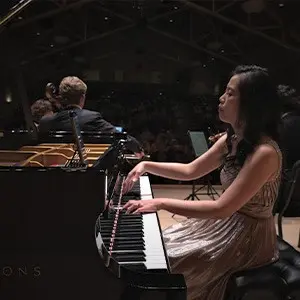
Before his Hollywood fame, a young Erich Korngold was hailed in Vienna as the “Mozart of the 20th century.” He wrote his thrillingly virtuosic and joyful piano quintet when he was just 24! Delight in these breathtaking masterworks by two Viennese greats with a mélange of musicians on the Mozart, and Artistic Director Gloria Chien joining the dynamic Vianos for the Korngold.
Sponsor: Portland State University
Online Virtual Concert
Friday, 7/22 • 7:00 pm
Available through Thursday, 9/1 • 11:59 pm
Program
Click on any piece of music below to learn more about it.
- MOZART String Quintet in D Major, K. 593
Wolfgang Amadeus Mozart (1756-1791)
I. Larghetto: Allegro
II. Adagio
III. Menuetto: Allegretto
IV. AllegroAside from Luigi Boccherini, Wolfgang Amadeus Mozart is essentially the only composer to add a second viola to the standard string quartet. This expanded ensemble obviously appealed to him, since he composed a total of six double viola quintets. Composing one viola quintet can be explained by compositional curiosity, but six? Even the fact that Mozart himself preferred playing viola to violin in chamber ensembles doesn’t fully account for his enduring interest in a subgenre he practically invented.
Within the intimate setting of a chamber ensemble, the second viola in a string quintet serves its customary harmonic function—to flesh out harmonies—but it also does more. Each voice in the ensemble can be likened to a character in an opera. In his operas, Mozart especially loved writing ensembles for several voices, sometimes adding additional characters to an already charged scene midway through. The challenge of making the music comprehensible as more elements are added to an already bubbling pot was clearly irresistible to him.
In this context, the String Quintet No. 5 in D Major, K. 593 (1790) can be heard as a mini-opera, with each instrument expressing not only its musical part, but its particular character. Many moments in K. 593 sound like spirited dialogues, or even arguments without words. After the opening Larghetto, in which the cello poses a question the other instruments attempt to answer, the first violin erupts with an impassioned cascade of notes. Subsequent violin solos are juxtaposed with calmer responses from the ensemble; the cello’s question returns in a recapitulation of the Larghetto.
Mozart’s Adagios are justifiably considered some of his most inventive and expressive music, and K. 593’s is no exception. To extend the opera analogy, the first movement lays out the narrative premise of the story, while the Adagio explores the emotional subtext underneath. Mozart uses thematic fragments from the first movement in the Adagio, such as subtle pauses and hesitations to construct new musical ideas, but narratively speaking, the action stops. This is a moment for emotional expression, not plot advancement. A lighthearted, graceful Menuet and Trio give way to an animated closing Rondo, in which the first violin once again takes the lead, while the ensemble is quick to respond (retort?).—© Elizabeth Schwartz
- ERICH KORNGOLD Piano Quintet in E Major, Op. 15 (1921)
I. Mässiges Zeitmass, mit schwungvoll
blühendem Ausdruck
II. Adagio: Mit grösster Ruhe, stets äusserst
gebunden und aus drucksvoll
III. Finale: Gemessen beinahe pathetischErich Korngold was a man out of time. Had he been born a century earlier, his romantic sensibilities would have aligned perfectly with the musical and artistic aesthetics of the 19th century. Instead, Korngold grew up in the tumult of the early 20th century, when his tonal, lyrical style had been eclipsed by the horrors of WWI and the stark modernist trends promulgated by his fellow Viennese composers Arnold Schoenberg, Alban Berg, and Anton Webern.
Korngold’s prodigious compositional talent emerged early. At age ten, he performed his cantata Gold for Gustav Mahler, whereupon the older composer called him “a genius.” When Korngold was 13, just after his bar mitzvah, the Austrian Imperial Ballet staged his pantomime The Snowman. In his teens, Korngold received commissions from the Leipzig Gewandhaus Orchestra; pianist Artur Schnabel performed Korngold’s Op. 2 Piano Sonata on tour, and Korngold also began writing operas, completing two full-scale works by age 18. At 23, Korngold’s opera Die tote Stadt (The Dead City) brought him international renown; it was performed in 83 different opera houses.
After Die tote Stadt, Korngold turned his attention to chamber music, and began working on his Piano Quintet in E Major, Op. 15 (1921). The first movement, marked “with a lively blooming expression,” unleashes Korngold at his most Romantic. Ravishingly opulent harmonies and dense textures, in the manner of Richard Strauss, fill the soundscape. The overall experience of listening to this music is the aural equivalent of walking through a hothouse full of exotic rare orchids; the steamy atmosphere of the greenhouse enhances the stunning beauty of the blooms. The Adagio, by contrast, has an inward, pared-down quality. It opens with viola and cello in slow steady octaves, anchored by deep chords in the piano. Even as the tempo changes from Adagio to faster interludes, Korngold maintains the crystalline texture by means of pizzicatos, harmonics, and continued octaves for various string pairs. Korngold ranges far and wide harmonically, but always returns to the steady stasis of the opening theme. What makes this movement so unusual is the combination of deeply expressive phrases and the calm serenity of its opening. The Finale is a study in the unexpected: it opens with a powerful violin cadenza, but soon gives way to a series of episodes that keep the listener playfully off-balance.
—© Elizabeth Schwartz
Artists
-
 Gloria Chien
Piano & Artistic Director
Gloria Chien
Piano & Artistic Director
-
Taiwanese-born pianist Gloria Chien has one of the most diverse musical lives as a noted performer, concert presenter, and educator. She made her orchestral debut at the age of sixteen with the Boston Symphony Orchestra with Thomas Dausgaard, and she performed again with the BSO with Keith Lockhart. She was subsequently selected by The Boston Globe as one of its Superior Pianists of the year, “who appears to excel in everything.” In recent seasons, she has performed as a recitalist and chamber musician at Alice Tully Hall, the Library of Congress, the Phillips Collection, the Dresden Chamber Music Festival, and the National Concert Hall in Taiwan. She performs frequently with the Chamber Music Society of Lincoln Center. In 2009, she launched String Theory, a chamber music series in Chattanooga, Tennessee that has become one of the region’s premier classical music presenters. The following year she was appointed Director of the Chamber Music Institute at Music@Menlo, a position she held for the next decade. In 2017, she joined her husband, violinist Soovin Kim, as Artistic Director of the Lake Champlain Chamber Music Festival in Burlington, Vermont. The duo became Artistic Directors at Chamber Music Northwest in Portland, Oregon in 2020. Most recently, she released two albums—her Gloria Chien LIVE from the Music@Menlo LIVE label and Here With You with acclaimed clarinetist Anthony McGill on Cedille Records.
Chien studied extensively at the New England Conservatory of Music with Wha Kyung Byun and Russell Sherman. She is Artist-in-Residence at Lee University in Cleveland, Tennessee, and she is a Steinway Artist.
Upcoming Concerts & Events
-
 Viano Quartet
String Quartet, Past Protégé Ensemble
Viano Quartet
String Quartet, Past Protégé Ensemble
-
Lucy Wang, violin
Hao Zhou, violin
Aiden Kane, viola
Tate Zawadiuk, celloPraised for their “virtuosity, visceral expression, and rare unity of intention” (Boston Globe), the Viano Quartet has quickly soared to international acclaim as one of the most dynamic and in-demand string quartets of their generation. The ensemble has captivated audiences worldwide ever since they were awarded First Prize at the 13th Banff International String Quartet Competition, with appearances at renowned venues such as Lincoln Center in New York, Berlin’s Konzerthaus, Toronto’s Koerner Hall, Hong Kong’s City Hall, and London’s Wigmore Hall. The Viano Quartet are Bowers Program Artists at The Chamber Music Society of Lincoln Center from 2024–2027.
Viano Quartet’s 2025–26 season includes debut performances at London’s Southbank Centre, the Frick Collection in New York, Dublin’s National Concert Hall, Vivo Performing Arts, Coast Live Music, Friends of Chamber Music Kansas City, Apex Concerts, the Amelia Island Chamber Music Festival, the Fortas Series at the Kennedy Center, Premiere Performances HK, and a mainstage full recital debut at the Chamber Music Society of Lincoln Center. This season also features collaborations with Avi Avital, Sir Stephen Hough, Gilbert Kalish, Anthony McGill, Miloš Karadaglić, and Vienna Teng. The quartet will premiere a newly written piece by composer Reena Esmail in the summer of 2026.
In 2025, the quartet received the Avery Fisher Career Grant as well as released their first full-length album, Voyager, with Apple Music/Platoon Records.
The Viano Quartet was formed in Los Angeles at the Colburn Conservatory of Music in 2015. The quartet is grateful for the unwavering support from their mentors at the Curtis Institute and Colburn Conservatory.
-
 Jessica Lee
Violin
Jessica Lee
Violin
-
Violinist Jessica Lee has built a multifaceted career as soloist, chamber musician, pedagogue, Assistant Concertmaster of the Cleveland Orchestra until the 2023-2024 season, and now as Associate Concertmaster of the Oregon Symphony. She was the Grand Prize Winner of the 2005 Concert Artists Guild International Competition and has been hailed as “a soloist which one should make a special effort to hear, wherever she plays.” Her international appearances include solo performances with the Plzen Philharmonic, Gangnam Symphony, Malaysia Festival Orchestra, and at the Rudolfinum in Prague. At home, she has appeared with orchestras such as the Houston, Grand Rapids, and Spokane symphonies.
Jessica has performed in recital at venues including Weill Hall at Carnegie Hall, Ravinia “Rising Stars,” the Phillips Collection in Washington D.C., and the Kennedy Center.
A long-time member of the Johannes Quartet as well as of The Bowers Program (formerly the Chamber Music Society of Lincoln Center Two), Jessica has also toured frequently with Musicians from Marlboro, including appearances at the Metropolitan Museum of Art and Boston’s Gardner Museum, and with the Guarneri Quartet in their farewell season. Her chamber music festival appearances include Chamber Music Northwest, Bridgehampton, Santa Fe, Seoul Spring, Caramoor, Olympic, and Music@Menlo. She also put together a six-video chamber music series during the pandemic which was a collaboration between the Cleveland Orchestra and the Cleveland Clinic to bring chamber music from iconic spaces in Cleveland to the greater Cleveland community.
Jessica has always had a passion for teaching and has served on the faculties of Vassar College, Oberlin College, as Head of the Violin Department at the Cleveland Institute of Music, and currently as Distinguished Artist at the McDuffie Center for Strings at Mercer College. She was accepted to the Curtis Institute of Music at age fourteen following studies with Weigang Li, and graduated with a Bachelor’s degree under Robert Mann and Ida Kavafian. She completed her studies for a Master’s degree at the Juilliard School.
-
 Lucy Wang
Violin
Lucy Wang
Violin
-
Canadian violinist Lucy Wang is a recipient of the prestigious 2025 Avery Fisher Career Grant and a founding member of the Viano Quartet. Praised for their “virtuosity, visceral expression, and rare unity of intention” (Boston Globe), the quartet rose to international acclaim as First Prize winners of the 2019 Banff International String Quartet Competition and are Bowers Artists at the Chamber Music Society of Lincoln Center from 2024–2027.
Lucy performs widely across North America, Europe, and Asia, and collaborates with leading artists such as pianists Marc-André Hamelin, Sir Stephen Hough, and Jon Kimura Parker, violinists James Ehnes and Pinchas Zukerman, guitarist Milos Karadaglic, soprano Fleur Barron, mandolinist Avi Avital, and singer-songwriter Vienna Teng. She has performed at renowned venues including London’s Southbank Centre, the Berlin Konzerthaus, Carnegie Hall, Dublin’s National Concert Hall, Walt Disney Concert Hall, Toronto’s Koerner Hall, and Hong Kong City Hall Theatre.
Committed to both core and contemporary repertoire, Lucy regularly collaborates with leading composers including Sir Stephen Hough, Kevin Lau, and Caroline Shaw, and will premiere a new work by Reena Esmail in 2026. She has mentored young artists at institutions such as Music@Menlo, the Colburn Academy, Stanford University, the University of Victoria, Northwestern University, and Duke University.
Her discography includes Voyager (Platoon Records, 2025) and Portraits (Curtis Studio, 2023), featured on CBC, BBC, and Performance Today. She maintains a vibrant social media presence with 50 million views and 600,000 followers worldwide.
Lucy graduated from the Curtis Institute and the Colburn Conservatory, where she studied with Martin Beaver. She plays on the ca. 1700 Bell Giovanni Tononi violin, generously on loan from the Canada Council for the Arts Musical Instrument Bank.
-
 Ettore Causa
Viola
Ettore Causa
Viola
-
Awarded both the “P. Schidlof Prize” and the “J. Barbirolli Prize” for “the most beautiful sound” at the prestigious Lionel Tertis International Viola Competition in 2000, Italian-born violist Ettore Causa has been praised for his exceptional artistry, passionate intelligence and complete musicianship. He has made solo and recital appearances in major venues around the world, and has performed at prestigious festivals. A devoted chamber musician, Causa has collaborated extensively with internationally renowned musicians.
At the Yale School of Music, Causa teaches graduate-level viola students and coaches chamber ensembles. He has performed on the School’s Faculty Artist Series and Oneppo Chamber Music Series and at the Yale Summer School of Music/Norfolk Chamber Music Festival. Before Causa joined the faculty of the School of Music in 2009, he taught both viola and chamber music at the International Menuhin Music Academy. He attended the International Menuhin Music Academy, where he studied with Alberto Lysy and Johannes Eskar, and the Manhattan School of Music, where he studied with Michael Tree.
Causa has published many highly regarded CDs on the Claves label. One notable recording is Romantic Transcriptions for Viola and Piano, on which he performs his own transcriptions, which was awarded a prestigious “5 Diapasons” by the French magazine Diapason.
In 2015, he was one of the honored guests at the 43rd International Viola Congress, where he performed his own arrangement of the Schumann Cello Concerto. Causa is an honorary member of British Viola Society and he performs on a viola made for him by Frederic Chaudièrein 2003.
Upcoming Concerts & Events
-
 Aiden Kane
Viola
Aiden Kane
Viola
-
American violist Aiden Kane has performed in North America, Europe, and Asia as a current member of the Viano Quartet, First Prize Laureates of the 2019 Banff International String Quartet Competition and recipients of the 2025 Avery Fisher Career Grant.
After leaving violin for the dark side, Aiden first studied viola with Daniel Foster through the National Symphony Orchestra’s Youth Fellowship Program. She subsequently earned a Bachelor’s and two Master’s degrees (in viola performance and chamber music studies, respectively) at the Colburn Conservatory of Music, where she studied with Paul Coletti. During her undergraduate years at Colburn, Aiden discovered her love for quartet life as the violist of the Calla Quartet, which received the Silver medal at the 2015 Fischoff Chamber Music Competition, and presented Colburn’s inaugural Musical Encounters outreach program. Since she joined the Viano Quartet, Viano has won international competitions, weathered a pandemic, moved from one coast to another, studied at the Curtis Institute of Music in the Nina von Maltzahn String Quartet-in-Residence program, and joined the Chamber Music Society of Lincoln Center Bowers Program—and Aiden loves quartet life even more for it all.
When she isn’t playing the viola, Aiden enjoys hiking, composing, and keeping an assortment of remarkably self-reliant houseplants.
-
 Peter Stumpf
Cello
Peter Stumpf
Cello
-
Peter Stumpf is Professor of Cello at the Indiana University Jacobs School of Music. Prior to his appointment, he was the Principal Cellist of the Los Angeles Philharmonic for nine years, following a twelve-year tenure as Associate Principal Cellist of the Philadelphia Orchestra. He received a Bachelor’s degree from the Curtis Institute of Music and an Artist’s Diploma from the New England Conservatory of Music.
A dedicated chamber music musician, he is a member of the Weiss-Kaplan-Stumpf Trio and has appeared at Carnegie Hall and the Kennedy Center, and in Amsterdam, Tokyo, and Cologne. He has performed with the chamber music societies of Boston and Philadelphia, and at numerous festivals including Marlboro, Santa Fe, Bridgehampton, Spoleto, and Aspen. He has toured with Music from Marlboro, and with pianist Mitsuko Uchida in performances of the complete Mozart Piano Trios. As a member of the Johannes Quartet, he collaborated with the Guarneri String Quartet on a tour including premieres of works by Bolcom and Salonen.
Concerto appearances have included the Boston Symphony, the Los Angeles Philharmonic, the Philadelphia Orchestra, and the Aspen Music Festival, among others. Solo recitals have been at Jordan Hall in Boston, on the Philadelphia Chamber Music Society series, on the Chamber Music in Historic Sites series in Los Angeles, and at the Philips and Corcoran Galleries in Washington, D.C. His awards include first prize in the Washington International Competition.
He has served on the cello faculties at the New England Conservatory and the University of Southern California.