

AT-HOME: Sounds of Brilliance & Unity
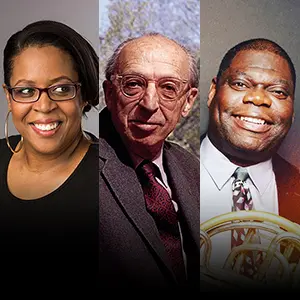
Artistic Director Emeritus and luminary clarinetist David Shifrin opens the concert with Weber’s show-stopping Clarinet Quintet. Some of CMNW’s and Oregon’s most beloved musicians perform Jeff Scott’s rag Startin’ Sumthin’, Valerie Coleman’s uplifting Umoja (Unity), and Aaron Copland’s sublime Appalachian Spring suite to complete the ebullient evening.
Online Virtual Concert
Thursday, 7/22 • 7:30 pm
Program
Click on any piece of music below to learn more about it.
- JESSIE MONTGOMERY Peace (2020)
JESSIE MONTGOMERY (b.1981) Peace (2020)
Peace (2020) by Jessie Montgomery, used by permission.
- WEBER Clarinet Quintet in B-flat Major, Op. 34
Carl Maria von Weber (1786-1826) Clarinet Quintet in B-flat Major, Op. 34 (26’)
I. Allegro
II. Fantasia
III. Menuetto capriccio presto
IV. Rondo, allegro giocosoCarl Maria von Weber’s friendship with clarinet virtuoso Heinrich Baermann fortuitously yielded music that helped accelerate the popularity of this versatile instrument in a variety of settings. Here, in his brilliant Clarinet Quintet in B-flat Major, Op. 34, the composer not only showcases the virtuosity and lyricism of the instrument, truly securing its place in the chamber music repertoire, but simultaneously infuses the music with his characteristically operatic style: dramatically shifting between mood, key, and affect, as though there were some secret libretto underlying this purely instrumental work. Of course, no such narrative exists save in the imaginative mind of a listener.
The drama begins at the outset of the work: calm leads to joviality, after which Weber plunges briefly into an intense minor-mode episode before easing into levity once again. In no more than a minute’s worth of music the composer has explored a full spectrum of emotions, and this capricious meandering continues throughout the entire quintet. The dramatic heart of the work is perhaps the ink-black Fantasia, in which the vocal tone of the clarinet is exploited in aria style. The movement fades to extreme quiet, the composer again utilizing the unique qualities of an instrument capable of the very softest tones. A humorous minuet pits the wind instrument against the strings: so often, they are engaged in a musical argument. The trio section, however, feels more like a genteel, amicable dialogue. In the Finale, Weber truly showcases the virtuosity of all musicians, most especially the clarinetist. Fireworks and confetti seem to spew from the clarinet’s bell in an endless display of theatrical showmanship. Here, an opera composer demonstrates his uncanny ability to leave his audiences in awe as they leave the theatre.
In today’s performance, the quintet will be bolstered by a full cadre of strings and added double basses, giving it the feel of a chamber concerto.
—© Ethan Allred
- JEFF SCOTT Startin’ Sumthin’ (2012)
JEFF SCOTT (b. 1967) Startin’ Sumthin’ (2012)
Startin’ Sumthin’ (2012) by Jeff Scott, used by permission.
- VALERIE COLEMAN Umoja (2020)
VALERIE COLEMAN (b.1970) Umoja (2020)
Umoja, by Valerie Coleman, VColeman Music Publishing, LLC (ASCAP).
- AARON COPLAND Appalachian Spring (1944)
AARON COPLAND Appalachian Spring (1944)
Aaron Copland wrote many of the best-known works of his Americana period during World War II. Drawing on symbols deeply ingrained in American culture, works like Fanfare for the Common Man and Lincoln Portrait deftly combined Copland’s leftist politics and American nationalism. It was Copland’s 1943–1944 collaboration with choreographer Martha Graham, Appalachian Spring, however, that made the strongest impact on the public.
Graham, a native of Allegheny, Pennsylvania, was one of the great choreographers of the 20th century. Copland recalled, “Nobody else seems quite like Martha…there’s something prim and restrained, simple yet strong, about her which one tends to think of as American.”
The story of Appalachian Spring takes place in rural Pennsylvania, where a newlywed couple prepares to make a life for themselves on the American frontier. The central focus of Copland’s score is a theme and variations on “Simple Gifts,” a song from the pacifist Shaker community of 19th century New England. Though unsung, the song’s lyrics emphasize one of the ballet’s primary themes: “’Tis the gift to be simple, ’tis the gift to be free.”
Indeed, it is the folk-like simplicity of Copland’s music that has made it so enduringly popular. His lush, evocative sounds captured the United States’ landscape and historical values at a time when modern warfare threatened to eclipse any hold on those traditions. Graham’s story, meanwhile, presented an egalitarian vision of American culture in stark opposition to fascism; men and women come together and share the burden of building their idealistic frontier community.
Copland would later arrange Appalachian Spring for full orchestra, but he preferred the original chamber instrumentation’s “clarity,” describing it as “closer to my original conception than the more opulent orchestrated version.”
—© Ethan Allred
2021 Summer Festival Program Book
Check your email for your concert password.
Click here for How to Watch tips.
When the concert is available, a video player will appear below. Enter your password to watch or re-watch the program.
PRO TIP: If the video player is not below or you have playback problems, please refresh your screen.
Expand to full screen by clicking the “Expand” button on the bottom right corner.
Artists
-
 Kenji Bunch
Composer & Viola
Kenji Bunch
Composer & Viola
-
Kenji Bunch writes music that looks for commonalities between musical styles, for understandings that transcend cultural or generational barriers, and for empathic connections with his listeners. Drawing on vernacular musical traditions, an interest in highlighting historical injustices and inaccuracies, and techniques from his classical training, Bunch creates music with a unique personal vocabulary that appeals to performers, audiences, and critics alike. With his work frequently performed worldwide and recorded numerous times, Bunch considers his current mission the search for and celebration of shared emotional truths about the human experience from the profound to the absurd, to help facilitate connection and healing through entertainment, vulnerability, humor, and joy.
Mr. Bunch is widely recognized for performing his own groundbreaking works for viola. He currently serves as Artistic Director of the new music group Fear No Music and is deeply committed to music education in his hometown of Portland, Oregon.
-
 Martin Hébert
Oboe
Martin Hébert
Oboe
-
Martin Hébert has served as the principal oboe of the Oregon Symphony since his appointment in 2006. Previously, he held that position with the Florida Orchestra, the Savannah Symphony Orchestra, and the Mexico City Philharmonic. Martin has also performed as guest principal oboe with the Pittsburgh Symphony, the Atlanta Symphony, and the Grant Park Music Festival Orchestra in Chicago.
Born in Cleveland, Martin attended the Cleveland Institute of Music, where he studied with John Mack, principal oboe of the Cleveland Orchestra.
Martin has been a featured soloist with the Oregon Symphony, as well as with other ensembles throughout the United States and Mexico. From 2002-2005, he was an Artist in Residence and soloist with the Crested Butte Music Festival in Colorado.In addition to his orchestral experience, Martin has played with opera and ballet companies in Portland, Honolulu, Atlanta, Tampa, Savannah, and Cleveland. As a chamber musician, he has performed in Oregon with Chamber Music Northwest, fEARnoMUSIC, Third Angle, and the Oregon Bach Festival.
Music is the Hébert family business. Martin’s father William was principal piccolo of the Cleveland Orchestra for 41 years, while his uncle Richard is the former principal bassoon of the Metropolitan Opera Orchestra; Martin’s brother Britton is a freelance bassoonist.Martin has toured with orchestras in Japan, Hong Kong, Western Europe, and South America. He has recorded with the Mexico City Philharmonic on Decca, the Atlanta Symphony on Telarc, and the Oregon Symphony on Pentatone.
Active as a teacher, adjudicator, and clinician, Hébert maintains a private studio of pupils, and he coaches youth groups across Oregon.
When not performing, teaching, or making reeds, Martin enjoys bicycling, theater and hiking in the magnificent Columbia Gorge. -
 Bella Hristova
Violin
Bella Hristova
Violin
-
Bulgarian-American violinist, Bella Hristova, has won international acclaim for her “expressive nuance and rich tone” (The New York Times) and “impressive power and control” (The Washington Post). An Avery Fisher Career Grant recipient, she has also won First Prize in the Michael Hill International Violin Competition, First Prize in the Young Concert Artists International Auditions, and Laureate of the International Violin Competition of Indianapolis.
Bella has performed extensively as a soloist with orchestras in North and South America, Asia, Europe, and New Zealand. In addition to her many appearances with orchestras, Bella has performed recitals at Carnegie Hall, the Kennedy Center, and performs frequently with The Chamber Music Society of Lincoln Center. Following multiple tours of New Zealand with renowned pianist, Michael Houstoun, the pair have recorded the complete Beethoven and Brahms violin sonatas.
A champion of music by living composers, Bella Hristova has commissioned composers including Joan Tower and Nokuthula Ngwenyama. In 2016, Bella was the featured soloist for a consortium of eight major orchestras for a new concerto commission written for her by her husband, acclaimed composer David Serkin Ludwig. The world premiere recording of the concerto was recently released with JoAnn Falletta and the Buffalo Philharmonic Orchestra.
Bella began violin studies at the age of six in her native Bulgaria. She later studied with Ida Kavafian at the Curtis Institute of Music and Jaime Laredo at Indiana University. She plays on a 1655 Amati violin and lives in New York City with her husband, David, and their four beloved (but poorly behaved) cats.
-
 Braizahn Jones
Bass
Braizahn Jones
Bass
-
Braizahn Jones is a double bassist, educator, and entrepreneur based in Portland, Oregon. He serves as Assistant Principal Bass of the Oregon Symphony and is on the faculty at Portland State University and Reed College. A graduate of the Curtis Institute of Music, he maintains a multifaceted career spanning orchestral performance, chamber music, and teaching.
As an orchestral musician, Jones has appeared extensively as a substitute with major ensembles including the Philadelphia Orchestra and the Seattle Symphony, and has performed at festivals such as Chamber Music Northwest, the Oregon Bach Festival, the Bellingham Music Festival, and the Pacific Music Institute. He has performed with many of today’s leading conductors and soloists.
Jones has been on the faculty of the National Orchestral Institute since 2019. He is the founder of Umami Bass, an international workshop and performance initiative dedicated to bass pedagogy and community building. The project has hosted successful programs in Japan and the United States, with further expansion underway.
Known for his precise, detail-oriented teaching, Jones works with students at all levels to develop sound musical clarity, and artistic confidence. Through his work as a performer, teacher, and organizer, Jones aims to foster musical environments that value depth, curiosity, and meaningful collaboration.
-
 Sarah Kwak
Violin
Sarah Kwak
Violin
-
The Oregon Symphony welcomed Concertmaster Sarah Kwak to the orchestra in August 2012, when she performed as soloist on Carlos Gardel’s Tango on the annual Waterfront Park Bowl concert program. Since then, she has performed to critical acclaim throughout Oregon. Hailed as a “world-class soloist,” Kwak is renowned for her “lyrical depth, thoughtful phrasing, myriad shadings of tone, and easy technical prowess.” After her concerto debut with the Oregon Symphony, The Oregonian said she “tore it up in a performance as dazzling as any recent star guest soloist.”
Sarah joined the Oregon Symphony after serving as first associate concertmaster in the Minnesota Orchestra from 1988 to 2012 and as that orchestra’s acting concertmaster from January 2010 to September 2011. Kwak, a 2008 McKnight Artist Fellowship winner, has been soloist with the Philadelphia Orchestra, Houston Symphony, and Curtis Chamber Orchestra, and she has toured internationally with the Casa Verde Trio, including a three-and-a-half-week tour of China. She was a founding member of the Rosalyra String Quartet, which made its New York debut in 1996 and was awarded a McKnight Artist Fellowship in 2000. The first artist ever to capture all three memorial awards at the Washington International Competition, Kwak also won the 1989 WAMSO Young Artist Competition. She has served on the faculty of Princeton University and at the University of Nevada at Reno.
She has participated in the Marlboro Music Festival, Chamber Music Northwest Winter Festival, Portland Piano International Summer Festival, Pensacola Festival, Pittsburgh Summerfest, Bargemusic of New York, Festival Mozart in France, and the Siletz Bay and Astoria festivals. She is the concertmaster of the Oregon Bach Festival and has toured with Asia Philharmonic Orchestra under Myung-Whun Chung. In addition, she has served as guest concertmaster with the Utah Symphony.
Born in Boston and raised in Lawrence, Kansas, Kwak entered Philadelphia’s Curtis Institute at 12, studied briefly at the Vienna Hochschule für Musik, and graduated from Philadelphia’s Curtis Institute of Music in 1983. Among her teachers were Joseph Sivo, Ivan Galamian, and Szymon Goldberg.
Kwak is a founding member of Classical Up Close, a non-profit organization whose mission is to present free chamber music concerts in neighborhoods around the metro area and to make classical music accessible to all.
-
 Paul Neubauer
Viola
Paul Neubauer
Viola
-
Violist Paul Neubauer’s exceptional musicality and effortless playing led The New York Times to call him “a master musician.” In 2025 he will release two albums for First Hand Records that feature the final works of two great composers: an all-Bartók album including the revised version of the viola concerto, and a Shostakovich recording including the monumental viola sonata.
At age 21, Mr. Neubauer was appointed principal violist of the New York Philharmonic, and he held that position for six years. He has appeared as soloist with over 100 orchestras including the New York, Los Angeles, and Helsinki philharmonics; Chicago, National, St. Louis, Detroit, Dallas, San Francisco, and Bournemouth symphonies; and Mariinsky, Santa Cecilia, English Chamber, and Beethovenhalle orchestras.
He has also premiered viola concertos by Béla Bartók (revised version of the Viola Concerto), Reinhold Glière, Gordon Jacob, Henri Lazarof, Robert Suter, Joel Phillip Friedman, Aaron Jay Kernis, Detlev Müller-Siemens, David Ott, Krzysztof Penderecki, Tobias Picker, and Joan Tower. He performs with SPA, a trio with soprano Susanna Phillips and pianist Anne-Marie McDermott, with a wide range of repertoire including salon style songs.
He has been featured on CBS’s Sunday Morning, A Prairie Home Companion, and in Strad, Strings, and People magazines. A two-time Grammy nominee, he has recorded on numerous labels including Decca, Deutsche Grammophon, RCA Red Seal, and Sony Classical.
Mr. Neubauer appears with the Chamber Music Society of Lincoln Center and is the artistic director of the Mostly Music series in New Jersey. He is on the faculty of The Juilliard School and Mannes College
Upcoming Concerts & Events
-
 Monica Ohuchi
Piano
Monica Ohuchi
Piano
-
Monica Ohuchi’s “commanding pianism” (The New York Times, Anthony Tommasini), performing “with beauty, clarity and drive…[offering a] warmth…expressiveness [that’s] irresistible and deeply moving” (The Times Argus, Vermont) allows her an active international career as a piano soloist, chamber musician, and pedagogue. Her “scintillating” (The Arts Desk, United Kingdom, David Nice) playing, combined with “an overt virtuosity [and] deep sensitivity that makes her lines sing” (Rutland Herald, Vermont) has taken her around the globe, from Lincoln Center in New York City, to remote villages in Bulgaria, to concert halls across Japan.
A pianist “dutifully and gracefully” (San Francisco Classical Voice) attentive to musical depth and detail, Ohuchi is a frequent soloist with orchestras; recent engagements include the Colorado Symphony Orchestra and the Marin Symphony Orchestra. Locally in her hometown of Portland, Oregon, Ohuchi performs with internationally acclaimed artists of Chamber Music Northwest, is often broadcast on All Classical Radio, is pianist of the quartet The Thunder Egg Consort, and enjoys soloing with regional orchestras.
Ohuchi is the pianist and Executive Director of the new music ensemble, Fear No Music. She is the Director of Music Performance at Reed College, where she also teaches piano and chamber music. Ohuchi holds advanced degrees from the Juilliard School.
-
 Tara Helen O’Connor
Flute
Tara Helen O’Connor
Flute
-
Tara Helen O’Connor, who Art Mag has said “so embodies perfection on the flute that you’ll forget she is human,” is an Avery Fisher Career Grant recipient, a two-time Grammy Award nominee, and a recipient of the Walter W. Naumburg Chamber Music Award. A Wm.S. Haynes artist, she is a season artist of the Chamber Music Society of Lincoln Center. She is professor of flute at the Yale School of Music and is the Artistic Director of the “Music from Angel Fire” Festival and in 2026, the Essex Winter Series.
Tara has also appeared on numerous film and television soundtracks including Barbie, Respect, The Joker, The Marvelous Mrs. Maisel, Only Murders in the Building, and Schmigadoon! Festival appearances include the Bravo! Vail festival, Chamber Music Northwest, Music@Menlo, Santa Fe Chamber Music Festival, Rockport Music, the Great Mountains Music Festival, and Chesapeake Chamber Music Festival.
A charismatic performer noted for her artistic depth, brilliant technique and colorful tone spanning every musical era, O’Connor has collaborated with such distinguished artists as vocalists Jennifer Johnson Cano, Susanna Phillips and Dawn Upshaw, violinist Jaime Laredo, clarinetist David Shifrin, guitarist Eliot Fisk, and pianists Jeremy Denk, Peter Serkin, and Stephen Prutsman, and with such revered ensembles as the Emerson, Orion, and St. Lawrence string quartets.
Tara has appeared on A&E’s Breakfast with the Arts, PBS’ Live from Lincoln Center and has recorded for Deutsche Grammophon, EMI Classics, Koch International, CMS Studio Recordings and Bridge Records.
Upcoming Concerts & Events
-
 Karla Donehew Perez
Violin
Karla Donehew Perez
Violin
-
A founding member of the Catalyst Quartet, Karla Donehew Perez maintains a busy performance schedule throughout the United States and around the world. In addition to her work with the Catalyst Quartet, she has been a featured soloist with the Berkeley Symphony, Sacramento Philharmonic, San Francisco Chamber Orchestra, Oakland East Bay Symphony, Puerto Rico Symphony Orchestra, Sphinx Symphony Orchestra, Sphinx Chamber Orchestra, and the New World Symphony. She has performed with Orpheus Chamber Orchestra and collaborated with Joshua Bell, Zuill Bailey, Awadagin Pratt, Anthony McGill, Stewart Goodyear, Fredericka Von Stade, Garry Karr, and members of the Guarneri, Juilliard, and Takács quartets. Donehew Perez has been Guest Concertmaster at the Tucson Symphony and spent two years as a fellow at the New World Symphony, often as Concertmaster or Principal Second Violin.
Born in Puerto Rico, Donehew Perez began playing the violin at age three. She made her solo debut with the Puerto Rico Symphony when she was nine. After moving to California she studied with Anne Crowden of The Crowden School. She holds Bachelor’s and Master’s degrees from the Cleveland Institute of Music where she studied with Paul Kantor, David Cerone, and William Preucil. She is on the faculty of the Longy School of Music at Bard College.
Donehew Perez performs on a violin made in 2013 by renowned German luthier Stefan Peter Grenier, supported in part by a Sphinx MPower Artist Grant, and a violin bow by Victor Fetique on loan from the Rachel Elizabeth Barton Foundation.
-
 William Purvis
Horn
William Purvis
Horn
-
William Purvis pursues a multifaceted career both in the U.S. and abroad as horn soloist, chamber musician, conductor, and educator. A passionate advocate of new music, he has participated in numerous premieres including horn concerti by Peter Lieberson, Bayan Northcott, Krzysztof Penderecki (New York premiere), and Paul Lansky; horn trios by Poul Ruders and Paul Lansky; Sonate en Forme de Préludes by Steven Stucky; and recent premieres by Elliott Carter, Retracing II for Solo Horn and Nine by Five with the New York Woodwind Quintet. He is a member of the New York Woodwind Quintet, the Yale Brass Trio, and the Triton Horn Trio, and is an emeritus member of the Orpheus Chamber Orchestra and the Orchestra of St. Luke’s. Mr. Purvis has been a frequent guest artist with the Chamber Music Society of Lincoln Center and the Boston Chamber Music Society, and has collaborated with many of the world’s most esteemed string quartets, including the Juilliard, Tokyo, Orion, Brentano, Mendelssohn, Sibelius, Daedalus, and Fine Arts string quartets. Recent Festival appearances have included the Sarasota, Norfolk, Sebago Long Lake, Chestnut Hill, and Phoenix Chamber Music Festivals in the U.S., the Great Mountain, Busan and Gimhae Chamber Music Festivals in South Korea, and the Kitaruizawa Festival in Japan. He has participated in performances on historical instruments with the Smithsonian Chamber Players, and a recording of the Quintets for Piano and Winds will be released in Spring of 2020. He has recorded extensively on numerous labels including Deutsche Grammophon, Sony Classical, Naxos, Koch, and Bridge. Mr. Purvis is currently Professor in the Practice of Horn and Chamber Music at the Yale School of Music, where he is also coordinator of winds and brasses, and serves as Director of the Yale Collection of Musical Instruments.
-
 Fred Sherry
Cello
Fred Sherry
Cello
-
Fred Sherry has introduced audiences on five continents and all fifty United States to the music of our time for over five decades. He was a founding member of TASHI and Speculum Musicae, artistic director of the Chamber Music Society of Lincoln Center, and has been a member of the Group for Contemporary Music, Berio’s Juilliard Ensemble and the Galimir String Quartet. He has also enjoyed a close collaboration with jazz pianist and composer Chick Corea.
Elliott Carter, Mario Davidovsky, Steve Mackey, David Rakowski, Somei Satoh, Charles Wuorinen, and John Zorn have written concertos for Sherry, and he has premiered solo and chamber works dedicated to him by Milton Babbitt, Derek Bermel, Jason Eckardt, Lukas Foss, Oliver Knussen, Peter Lieberson, Donald Martino, and Toru Takemitsu among others.
Fred Sherry’s vast discography encompasses a wide range of classic and modern repertoire; he has been soloist and “sideman” on hundreds of commercial and esoteric recordings. Mr. Sherry was the organizer for Robert Craft’s New York recording sessions from 1995-2012. Their longstanding collaboration produced celebrated performances of the Schoenberg Cello Concerto, all four String Quartets, and the String Quartet Concerto as well as major works by Stravinsky and Webern.
Mr. Sherry’s book 25 Bach Duets from the Cantatas was published by Boosey & Hawkes in 2011, the revised edition was released in 2019. C.F. Peters unveiled his treatise on contemporary string playing, A Grand Tour of Cello Technique, in 2018. He is a member of the cello faculty of The Juilliard School, The Mannes School of Music, and The Manhattan School of Music. -
 David Shifrin
Clarinet & Artistic Director Emeritus 1981–2020
David Shifrin
Clarinet & Artistic Director Emeritus 1981–2020
-
David Shifrin began performing with Chamber Music Northwest in 1978 and served as its Artistic Director from 1981 to 2020. He has performed with the Chamber Music Society of Lincoln Center since 1982 and served as its Artistic Director from 1992 to 2004.
Shifrin received Lincoln Center’s Avery Fisher Career Grant and the Avery Fisher Prize, as well as numerous awards and prizes competitions and organizations worldwide.
David Shifrin is the Samuel S. Sanford Professor in the Practice of Clarinet at the Yale School of Music where he teaches a studio of graduate-level clarinetists and coaches chamber music ensembles. He is also the Artistic Director of Yale’s Oneppo Chamber Music Society and the Yale in New York concert series. Previously, Shifrin served on the faculties of the Juilliard School, the University of Southern California, the University of Michigan, the Cleveland Institute of Music, and the University of Hawaii. He has appeared with many of the major orchestras in the United States and abroad and has served as principal clarinetist with the Cleveland Orchestra, American Symphony Orchestra, Los Angeles Chamber Orchestra, and the Symphony Orchestras of New Haven, Honolulu, and Dallas. Shifrin also continues to broaden the clarinet repertoire by commissioning and championing more than 100 works of 20th and 21st-century American composers. Shifrin’s recordings have consistently garnered praise and awards including three Grammy nominations and “Record of the Year” from Stereo Review.
Shifrin is represented by CM Artists in New York and performs on Backun clarinets and Légère reeds.
Upcoming Concerts & Events