

Jazz Notes: Gershwin Piano Concerto
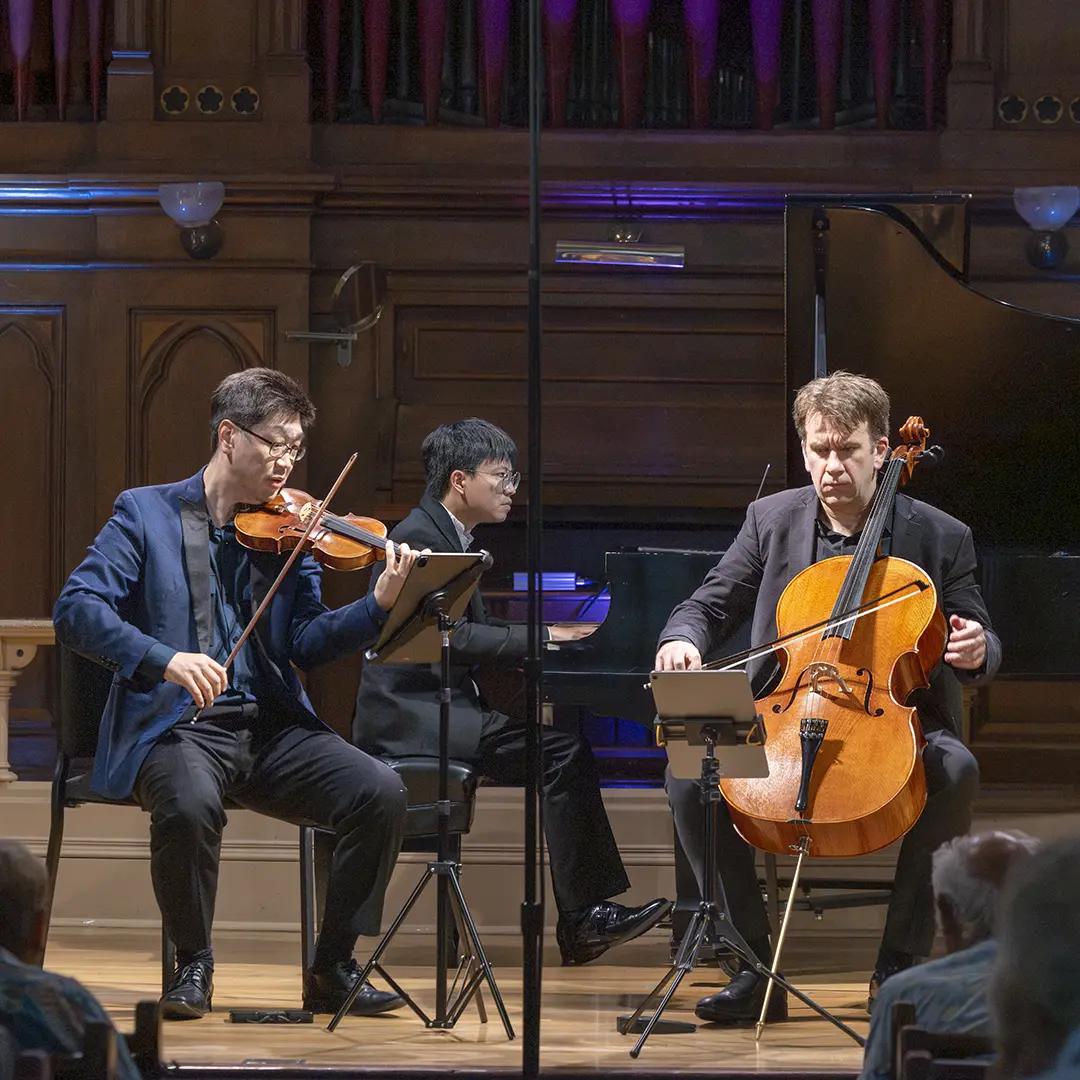
Whether first or 10th-generation Americans, virtually all of us come from someplace else, carrying the heartbeat and soul of our ancestry. We express this in our traditions, cuisine, culture, and music—all “jazzified” in a unique fusion of old and new.
The same is true for America’s greatest composers, whose music expresses their connections to their pasts in entirely original ways. The rhythm and harmony of Samuel Barber’s string quartet (encompassing the powerfully moving “Adagio for Strings”) and Lembit Beecher’s heartfelt Stories From My Grandmother contain threads anchored in the past but driven by a new energy that propels their musical past into the present and future.
George Gershwin brings all of this together in his 1925 Piano Concerto, fusing Jewish and Eastern-European folk (Klezmer) traditions with African and Caribbean influences in a full-fledged celebration of America’s truly new music: jazz! Experience this in a new chamber version arranged and performed by the astounding Kit Armstrong!
We have a special tradition of picnics before concerts at Reed College’s Kaul Auditorium. Reed’s catering service, Bon Appétit, offers food and drink service beginning at 6 PM. Alternately, you can bring your own picnic, but alcoholic beverages must be purchased on site.
6:30 PM | Kaul Auditorium Prelude Performance with CMNW’s Young Artist Institute students
Prelude performance sponsored by Ronnie-Gail Emden & Andrew Wilson.
Concert sponsored by Dan Boyce & Lilla Cabot and Jonathan Ater & Christiana Carr.
Reed College, Kaul Auditorium
Thursday, 7/2 • 8:00 pm
Program
Click on any piece of music below to learn more about it.
- SAMUEL BARBER String Quartet in B Minor, Op. 11
SAMUEL BARBER (1910–1981) String Quartet in B Minor, Op. 11 (19’)
I. Molto allegro e appassionato
II. Molto adagio
III. Molto allegroWhen Samuel Barber (1910–1981) began his String Quartet in B Minor, Op. 11, everything seemed to be going great. In May 1936, he wrote excitedly to a friend about “vague quartettish rumblings.” Then, after a brief trip to “raise hell” in France with his partner Gian Carlo Menotti, he settled down in a beautiful lakeside village to work on the quartet.
Soon, however, the difficulty of the task began to weigh on Barber. After a delayed premiere, he withdrew the final movement for revisions. Only seven years later, in 1943, did he arrive at the quartet we know today.
In the opening Molto allegro e appassionato, Barber introduces himself as a composer with little interest in avant-garde trends. His energetic music instead evokes models like Brahms and Beethoven, full of drama with a splash of modern harmony.
When Barber finished the quartet’s middle movement, he presciently exclaimed “it is a knock-out!” Today, we know this sublime music simply as the Adagio for Strings.
In the end, Barber chose to replace his original finale with music that previously would have closed the first movement, giving the quartet a more unified structure. This revised finale bravely breaks the Adagio’s spell, concluding the quartet with a spirit of epic grandeur.
—© Ethan Allred
- LEMBIT BEECHER “Stories From My Grandmother” (2009)
LEMBIT BEECHER (b. 1980)
Stories From My Grandmother (2009) (10’)I. It was like a, like a lighting
II. Slow MemoryStories From My Grandmother is a two-movement suite excerpted from a 50-minute documentary oratorio called And Then I Remember. The oratorio weaves recorded interviews that I conducted with my grandmother with music performed by a soprano soloist, small chorus, solo double bass, and chamber ensemble. The piece follows the story of my grandmother, Taimi Lepasaar, who was born in Estonia in 1922 and survived both the Russian and German occupations of Estonia during World War II before escaping the country near the end of the war, eventually making it to the United States. The two movements of Stories From My Grandmother are instrumental reflections on my grandmother’s stories. The first movement, “It was Like a, Like a Lightning,” tries to capture the visceral energy, fear and mournful sadness of one particular story, a portion of which I am including below:
And then, was the summer 1940 and I was in Alatskivi with my grandparents. In the evening, there was a dance. About six o’clock we left the farm and we went to the castle to dance together. It was about 9:30… the music stopped.. and the announcement came that the Russian troops have come over Lake Peipsi; the Russian army is coming towards this castle, towards us. We ask you all to take your bicycles and go home. And then was Estonia was conquered. 1940, that summer. It was like a, like a lightning, like somebody had hit you on the back. And then we all rode quietly, it was a… June night. The moon was lighting the road, but the hearts were heavy. And we drove home and went to the farm, but the farm was far away from the highway up on the hill. Next morning we were all standing there on the fence under the big linden trees, watching how the Russian army, marched along that highway towards Tartu, towards our city, and this moment we shared together. You know, it seemed that all the dreams were broken.
The second movement, “Slow Memory,” was not inspired by a specific story but is instead a meditation on memory and my grandmother’s way of storytelling. It tries to capture the mix of emotion and matter-of-factness within her voice; the moments of gentle lilt and the moments of struggle, in which a feeling of sadness seems to break through the veil of her words.
—© Lembit Beecher
- GEORGE GERSHWIN Piano Concerto (Trans. Kit Armstrong)
GEORGE GERSHWIN (1898–1937) Piano Concerto (35’) (Trans. Kit Armstrong)
I. Allegro
II. Adagio - Andante con moto
III. Allegro agitatoBy the early 1920s, George Gershwin (1898–1937) had established himself as a top American songwriter. His music, especially 1919’s “Swanee,” could be heard from Broadway to the average American living room. But among classical music fans, popular musicians like Gershwin held little appeal.
That changed quickly in 1924 with the premiere of the jazz-inspired mini concerto Rhapsody in Blue, which succeeded so spectacularly that Time magazine featured Gershwin on its cover.
In 1925, Gershwin accepted a commission to write his follow up to the Rhapsody, this time a full-scale Piano Concerto. After a bit of research into the classical concerto form, he finished the composition relatively quickly and premiered the concerto in December before an enthusiastic audience.
Like Gustav Mahler’s symphonies, Gershwin’s concerto sometimes seems to move through a series of musical snippets from everyday life. In the first movement, Gershwin explores the foundations of jazz, especially the famous “Charleston” rhythm, to capture “the young enthusiastic spirit of American life.” The second movement, with its impassioned trumpet solos, takes inspiration from the blues. As for the turbulent finale, Gershwin described it best as “an orgy of rhythms, starting violently and keeping to the same pace throughout.”
—© Ethan Allred
Artists
-
 Kit Armstrong
Piano/Organ
Kit Armstrong
Piano/Organ
-
Ever since Kit Armstrong entered the international music stage twenty years ago, his activities have exerted an enduring fascination upon music lovers. He performs recitals in major series, appears with the world’s finest orchestras, and has developed close artistic partnerships with leading instrumentalists and vocalists. He has held artist-in-residence appointments incorporating a wide spectrum of musical formats, combining his roles as composer, pianist, conductor, and organist. His project, Expedition Mozart, traverses Mozart’s music in various genres with an international group of distinguished chamber musicians and soloists—and has become a main feature at prestigious festivals and venues.
Armstrong came to classical music through composition at the age of five. He has since created a broad oeuvre of vocal, instrumental, chamber, and symphonic works, many of which have been commissioned by notable European cultural institutions. His compositions are published by Edition Peters.
Born in 1992 in California, USA, Armstrong pursued undergraduate studies in physics at California State University, chemistry, and mathematics at the University of Pennsylvania and mathematics at Imperial College London. Alfred Brendel has guided Armstrong as a musical mentor since 2005. In 2008, he earned a bachelor’s degree in music at the Royal Academy of Music, London, and in 2012 a master’s degree in pure mathematics at the University of Paris VI.
In 2012, Kit Armstrong purchased the Church of Sainte-Thérèse in Hirson, France, and transformed it into a hall for concerts, exhibitions, and outreach. This cultural centre has become home to interdisciplinary projects, reaching a regional as well as cosmopolitan public.
Upcoming Concerts & Events
- Jazz Notes: Gershwin Piano Concerto (currently selected)
- FREE Open Rehearsal: Dvořák “Dumky” Piano Trio
- SPECIAL EVENT | An Evening with Kit Armstrong: Liszt’s Pilgrimage
- Folk Voices: Dvořák “Dumky” Trio
- NEW@NIGHT: Echoes of Home
-
 Yoko Greeney
Piano
Yoko Greeney
Piano
-
Collaborative pianist and visionary arts advocate Yoko Greeney has been hailed as “one of the most significant members of Portland’s classical music scene” (Oregon ArtsWatch). Her multifaceted career—spanning performing, directing, program curating, teaching, and community-based work—is rooted in a deep commitment to artistic excellence and arts accessibility.
At the heart of Greeney’s work is collaboration—onstage and beyond. Celebrated for her sensitivity and stylistic range, she is a sought-after collaborative pianist who has performed at numerous venues and music festivals. Since settling in Portland, Oregon in 2010, she has shared the stage with a wide range of organizations, including the Oregon Symphony, Chamber Music Northwest, 45th Parallel Universe, Oregon Ballet Theatre, BodyVox, and Third Angle New Music, in addition to numerous live performances and recording projects with All Classical Radio.
A passionate advocate for arts accessibility, in 2022 Greeney co-founded SoundsTruck NW, a nonprofit organization that brings outdoor live music concerts directly to neighborhoods and communities where access is limited by utilizing its custom-built, solar-powered mobile stage. Described as “revolutionizing Portland’s concert landscape” (The Oregonian), SoundsTruck NW has been recognized internationally for its social impact, including being named a finalist for the 2024 SXSW Innovation Awards in Urban Design and a two-time prize winner at the 2024 International Sound Awards in Hamburg, Germany.
Originally from Osaka, Japan, Greeney has followed a global path—living and working in cities across Japan, Mexico, and the United States—before making Portland her home. She holds a Master’s degree from the Peabody Conservatory of The Johns Hopkins University and currently teaches at Lewis & Clark College.
Upcoming Concerts & Events
- Jazz Notes: Gershwin Piano Concerto (currently selected)
- FREE Open Rehearsal: Joan Tower “Petroushskates”
- NEW@NIGHT: Echoes of Home
- NEW@NIGHT: Across the Americas
- Voices of Our Land: Dvořák “American” Quintet
- Voices of Our Land: Dvořák “American” Quintet
- Americana: “Appalachian Spring”
- Americana: “Appalachian Spring”
-
 Braizahn Jones
Bass
Braizahn Jones
Bass
-
Braizahn Jones is a double bassist, educator, and entrepreneur based in Portland, Oregon. He serves as Assistant Principal Bass of the Oregon Symphony and is on the faculty at Portland State University and Reed College. A graduate of the Curtis Institute of Music, he maintains a multifaceted career spanning orchestral performance, chamber music, and teaching.
As an orchestral musician, Jones has appeared extensively as a substitute with major ensembles including the Philadelphia Orchestra and the Seattle Symphony, and has performed at festivals such as Chamber Music Northwest, the Oregon Bach Festival, the Bellingham Music Festival, and the Pacific Music Institute. He has performed with many of today’s leading conductors and soloists.
Jones has been on the faculty of the National Orchestral Institute since 2019. He is the founder of Umami Bass, an international workshop and performance initiative dedicated to bass pedagogy and community building. The project has hosted successful programs in Japan and the United States, with further expansion underway.
Known for his precise, detail-oriented teaching, Jones works with students at all levels to develop sound musical clarity, and artistic confidence. Through his work as a performer, teacher, and organizer, Jones aims to foster musical environments that value depth, curiosity, and meaningful collaboration.
Upcoming Concerts & Events
- Jazz Notes: Gershwin Piano Concerto (currently selected)
- Timeless Classics: Mozart Clarinet Quintet & “Rhapsody in Blue”
- Timeless Classics: Mozart Clarinet Quintet & “Rhapsody in Blue”
- Souvenir: Tchaikovsky Sextet
- Souvenir: Tchaikovsky Sextet
- Americana: “Appalachian Spring”
- Americana: “Appalachian Spring”
-
 Wonkak Kim
Clarinet
Wonkak Kim
Clarinet
-
Wonkak Kim is a visionary clarinetist whose artistry bridges tradition, innovation, and a rare depth of expressive integrity. Praised for his “excellent breath control” (The Washington Post) and “exuberant musicianship” (Fanfare), he has appeared as a soloist and chamber musician on major stages and at leading festivals in more than 20 countries across North America, Europe, and Asia, with performances broadcast internationally on Radio France, BBC Radio 3, ABC Australia, KBS, and NPR. His acclaimed discography on Naxos, MSR, Albany, and Navona has earned editorial recognition from BBC Music Magazine, Gramophone, and the American Record Guide.
Kim has commissioned and premiered over 100 new works and leads a wide range of intercultural projects that champion Korean and Korean-American voices. A sought-after educator, he is Associate Professor of Clarinet at the University of Oregon and has presented masterclasses at renowned institutions including The Juilliard School, Tianjin Juilliard (China), Korea National University of Arts, the Yale School of Music, and the Sibelius Academy (Finland). He was recently appointed Artistic Director of the historic ClarinetFest® 2026 in South Korea. Kim is a Performing Artist and Clinician for Buffet Crampon and Vandoren.
Upcoming Concerts & Events
- Jazz Notes: Gershwin Piano Concerto (currently selected)
-
 Amelia Lukas
Flute
Amelia Lukas
Flute
-
Powell Flutes Artist Amelia Lukas performs with “a fine balance of virtuosity and poetry” (The New York Times) and “excels at bringing drama and fire to hyper-modernist works with challenging extended techniques” (Oregon ArtsWatch). Recent solo engagements include her show “Natural Homeland” at the Alberta Rose Theatre and throughout the West Coast, and performances for Portland Japanese Garden, United for Ukraine, World Beat Festival, New Music Gathering, Siletz Bay Music Festival, Fear No Music, Friends of Chamber Music, Makrokosmos Project, Kenny Endo Ensemble, Portland Taiko, All Classical Portland’s live radio broadcasts, and on American Public Media’s Performance Today. In addition to her work with Lyra Trio PDX, she has featured in chamber music performance with the Oregon Bach Festival, Portland Piano International, Okaidja Afroso, 45th Parallel, and Willamette Valley Chamber Music Festival.
Lukas’s career includes founding the “truly original… impeccably curated” (Time Out New York) multimedia chamber series Ear Heart Music, membership in the American Modern Ensemble, and performances at Carnegie Hall, Lincoln Center, The Stone, Bargemusic, (Le) Poisson Rouge, Roulette, and New Music New York Festival. She holds degrees from the Royal Academy of Music (London), where she received three prizes for musical excellence, and from the Manhattan School of Music, where she was a founding class member for the Master’s degree in Contemporary Performance.
Amelia received the President’s Volunteer Service Award from former President Biden for her work supporting Ukraine and offers creative strategy and public relations services as the Principal and Founder of Aligned Artistry.
Upcoming Concerts & Events
- NEW@NIGHT: Echoes of Home
- Jazz Notes: Gershwin Piano Concerto (currently selected)
-
 Mikio Sasaki
Trumpet
Mikio Sasaki
Trumpet
-
Mikio (Miki) Sasaki has been described as a “musical switch-hitter,” a trumpeter able to move seamlessly between styles with clarity, authority, and imagination. A seasoned performer, Sasaki is currently a member of the internationally acclaimed Canadian Brass and a former member of Atlantic Brass Quintet and Saint Louis Brass. His wide-ranging career spans symphony orchestras, brass bands, contemporary music, jazz, and more. Sasaki has performed in renowned venues including Carnegie Hall, Disney Hall, and the Schubert Theatre on Broadway, as well as internationally in Brazil, Finland, Greece, Canada, Germany, Austria, and Great Britain. His long and varied resumé adds up to one thing: a deep, enduring love of music and creativity.
Alongside his performance career, Sasaki is Assistant Professor of Trumpet at the University of Oregon. He previously held teaching appointments at Texas Lutheran University and Brooklyn College and is deeply committed to music education. Sasaki regularly presents masterclasses at collegiate programs across the country and teaches young musicians and music educators through institutions such as American Band College, Juilliard Pre-College, and the Usdan Summer Camp for the Arts, sharing his enthusiasm and experience with students of all ages.
Sasaki earned degrees from The Juilliard School and the Yale School of Music and holds a doctorate from The University of Texas at Austin. His honors include a Grammy Award, and his recording credits range from indie rock to orchestral works. He continues to perform, record, and premiere new music in an ever-evolving musical landscape, with featured appearances at events such as the International Trumpet Guild Conference and the International Horn Society Conference.
Upcoming Concerts & Events
- Jazz Notes: Gershwin Piano Concerto (currently selected)
-
 Alicia Waite
Horn
Alicia Waite
Horn
-
Alicia Waite was appointed to the Oregon Symphony horn section in 2008. Prior to winning her post in Oregon, she held positions with the Virginia Symphony (Norfolk) and the Civic Orchestra of Chicago. Alicia regularly performs as a guest with the San Francisco Symphony, and she has also enjoyed performing with the Seattle and Milwaukee symphonies. During the summer months, Alicia has performed with Oregon Bach Festival, Santa Fe Opera, Grand Teton Music Festival, Colorado Music Festival, and Britt Festival. In addition to her symphonic work, Alicia is an avid chamber musician. She enjoys opportunities to perform with small ensembles with 45th Parallel Universe and Chatter PDX, and she has been a guest artist at Chintimini Chamber Music Festival. Beginning in the fall of 2025, Alicia joined the staff of Reed College teaching individual horn lessons.
Although Alicia is an Oregon native, born in Bend, she grew up primarily in Fort Collins, Colorado where she studied horn with Jack Herrick. Alicia moved to the Midwest after high school to continue her formal education in music. She earned her Bachelor of Music degree as a student of James DeCorsey at Lawrence University. She continued her studies at Northwestern University where she earned a Master of Music degree. While at Northwestern, Alicia studied with William Barnewitz, former Principal Horn of the Milwaukee Symphony, and Gail Williams, former Associate Principal Horn of the Chicago Symphony. Additional teachers included British soloist Michael Thompson and Daniel Gingrich, retired Associate Principal Horn of the Chicago Symphony.
Upcoming Concerts & Events
- Jazz Notes: Gershwin Piano Concerto (currently selected)
-
 Lucy Wang
Violin
Lucy Wang
Violin
-
Canadian violinist Lucy Wang is a recipient of the prestigious 2025 Avery Fisher Career Grant and a founding member of the Viano Quartet. Praised for their “virtuosity, visceral expression, and rare unity of intention” (Boston Globe), the quartet rose to international acclaim as First Prize winners of the 2019 Banff International String Quartet Competition and are Bowers Artists at the Chamber Music Society of Lincoln Center from 2024–2027.
Lucy performs widely across North America, Europe, and Asia, and collaborates with leading artists such as pianists Marc-André Hamelin, Sir Stephen Hough, and Jon Kimura Parker, violinists James Ehnes and Pinchas Zukerman, guitarist Milos Karadaglic, soprano Fleur Barron, mandolinist Avi Avital, and singer-songwriter Vienna Teng. She has performed at renowned venues including London’s Southbank Centre, the Berlin Konzerthaus, Carnegie Hall, Dublin’s National Concert Hall, Walt Disney Concert Hall, Toronto’s Koerner Hall, and Hong Kong City Hall Theatre.
Committed to both core and contemporary repertoire, Lucy regularly collaborates with leading composers including Sir Stephen Hough, Kevin Lau, and Caroline Shaw, and will premiere a new work by Reena Esmail in 2026. She has mentored young artists at institutions such as Music@Menlo, the Colburn Academy, Stanford University, the University of Victoria, Northwestern University, and Duke University.
Her discography includes Voyager (Platoon Records, 2025) and Portraits (Curtis Studio, 2023), featured on CBC, BBC, and Performance Today. She maintains a vibrant social media presence with 50 million views and 600,000 followers worldwide.
Lucy graduated from the Curtis Institute and the Colburn Conservatory, where she studied with Martin Beaver. She plays on the ca. 1700 Bell Giovanni Tononi violin, generously on loan from the Canada Council for the Arts Musical Instrument Bank.
Upcoming Concerts & Events
- Jazz Notes: Gershwin Piano Concerto (currently selected)
-
 Tate Zawadiuk
Cello
Tate Zawadiuk
Cello
-
Canadian cellist Tate Zawadiuk is known for connecting with audiences through his dynamic and zestful musicianship. He’s a founding member of the Viano Quartet, recipients of the 2025 Avery Fisher Career Grant and currently in residence at the Chamber Music Society of Lincoln Center Bowers Program (2024-2027). The quartet won first prize at the 2019 Banff International String Quartet Competition and has performed on some of the world’s most iconic stages, including Wigmore Hall, the Berlin Konzerthaus, and Flagey.
As a soloist, Tate has performed with orchestras like the Vancouver Symphony Orchestra, Calgary Philharmonic Orchestra, and Vancouver Youth Symphony Orchestra. He’s also had the chance to collaborate with incredible musicians like Emanuel Ax, James Ehnes, Marc-André Hamelin, and Johannes Moser.
Whether playing for a crowd of thousands or a small group of chamber music fans, Tate’s focus is always on sharing a story through his music that hopefully resonates with each listener. Tate studied at the Curtis Institute of Music as part of the Nina von Maltzahn String Quartet-in-Residence and earned his Bachelor’s and Master’s degrees from the Colburn Conservatory of Music, where he trained with Clive Greensmith and Ronald Leonard. In his spare time, Tate enjoys running, brewing specialty coffee, and is most likely somewhere trying on a new suit.
Upcoming Concerts & Events
- Jazz Notes: Gershwin Piano Concerto (currently selected)
-
 Viano Quartet
String Quartet, Past Protégé Ensemble
Viano Quartet
String Quartet, Past Protégé Ensemble
-
Lucy Wang, violin
Hao Zhou, violin
Aiden Kane, viola
Tate Zawadiuk, celloPraised for their “virtuosity, visceral expression, and rare unity of intention” (Boston Globe), the Viano Quartet has quickly soared to international acclaim as one of the most dynamic and in-demand string quartets of their generation. The ensemble has captivated audiences worldwide ever since they were awarded First Prize at the 13th Banff International String Quartet Competition, with appearances at renowned venues such as Lincoln Center in New York, Berlin’s Konzerthaus, Toronto’s Koerner Hall, Hong Kong’s City Hall, and London’s Wigmore Hall. The Viano Quartet are Bowers Program Artists at The Chamber Music Society of Lincoln Center from 2024–2027.
Viano Quartet’s 2025–26 season includes debut performances at London’s Southbank Centre, the Frick Collection in New York, Dublin’s National Concert Hall, Vivo Performing Arts, Coast Live Music, Friends of Chamber Music Kansas City, Apex Concerts, the Amelia Island Chamber Music Festival, the Fortas Series at the Kennedy Center, Premiere Performances HK, and a mainstage full recital debut at the Chamber Music Society of Lincoln Center. This season also features collaborations with Avi Avital, Sir Stephen Hough, Gilbert Kalish, Anthony McGill, Miloš Karadaglić, and Vienna Teng. The quartet will premiere a newly written piece by composer Reena Esmail in the summer of 2026.
In 2025, the quartet received the Avery Fisher Career Grant as well as released their first full-length album, Voyager, with Apple Music/Platoon Records.
The Viano Quartet was formed in Los Angeles at the Colburn Conservatory of Music in 2015. The quartet is grateful for the unwavering support from their mentors at the Curtis Institute and Colburn Conservatory.
Upcoming Concerts & Events
- SOLD OUT | Chamber Party | Stars & Strings: A Celebration with the Viano Quartet at Pittock Mansion
- Viano Quartet & Nina Bernat
- Folk Voices: Dvořák “Dumky” Trio
- NEW@NIGHT: Echoes of Home
- Jazz Notes: Gershwin Piano Concerto (currently selected)