

CMNW Presents the Oregon Bach Festival: Celebratory Cantatas
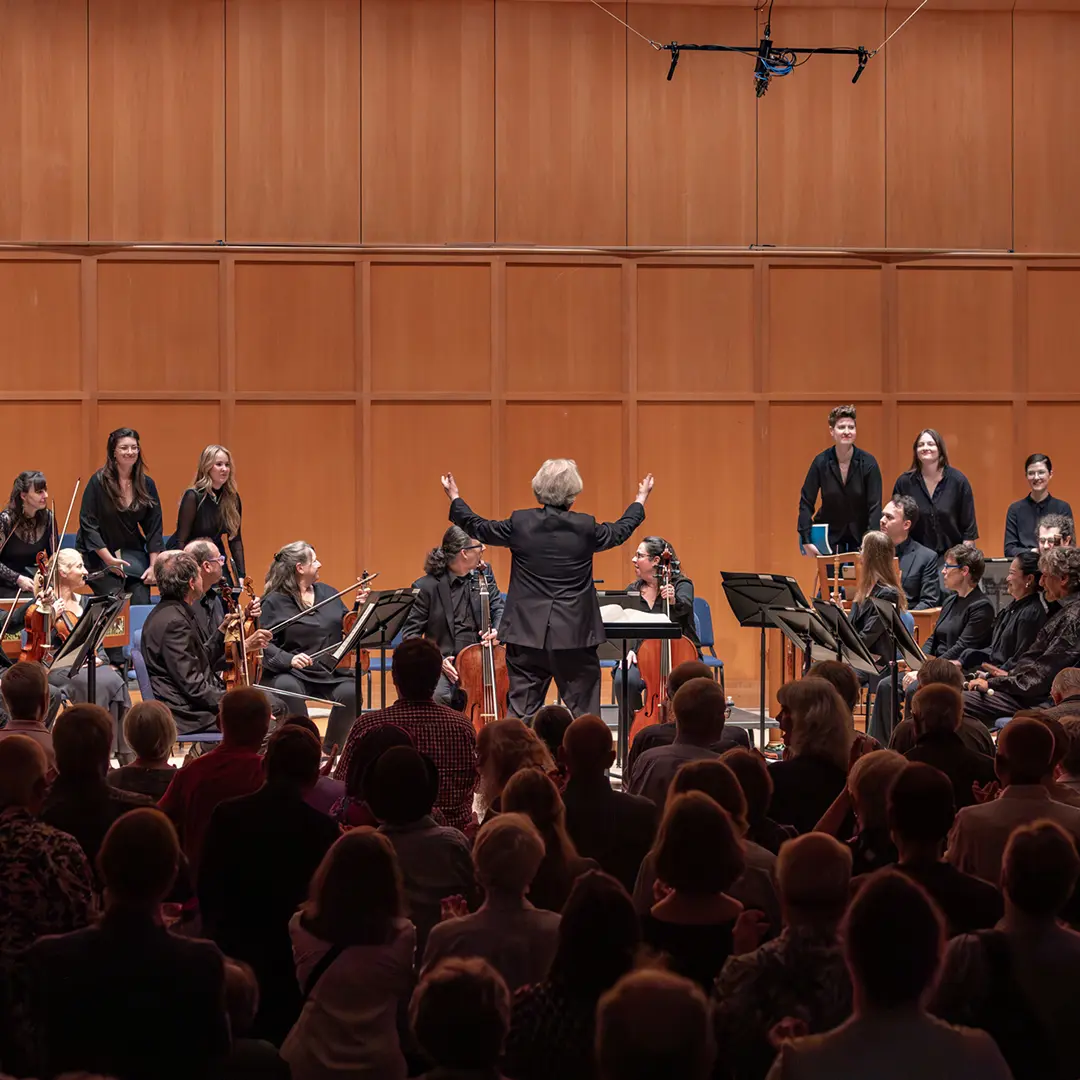
In every culture and land, music is a part of special events. One of the great masters of celebratory music is none other than Johann Sebastian Bach!
Bach wrote more than 300 cantatas, of which 200 survive, and a special subset of these were for special celebratory events rather than religious occasions. For these festivities, Bach composed many of his most spirited secular works—including Cantatas 201 and 207. These jubilant works—full of delightful wit, virtuosity, and musical pageantry—remind us that universities have long been gathering places for ideas, creativity, and community.
Join Maestro Jos van Veldhoven as he leads the Oregon Bach Festival’s esteemed soloists with the Berwick Academy for this joyous evening of music!
We have a special tradition of picnics before concerts at Reed College’s Kaul Auditorium. Reed’s catering service, Bon Appétit, offers food and drink service beginning at 6 PM. Alternately, you can bring your own picnic, but alcoholic beverages must be purchased on site.
Presented in collaboration with Oregon Bach Festival.
Reed College, Kaul Auditorium
Monday, 7/6 • 8:00 pm
Program
Click on any piece of music below to learn more about it.
- J. S. BACH Cantata 201: “The Contest Between Phoebus and Pan”
J. S. BACH (1685-1750) Cantata 201: “The Contest Between Phoebus and Pan”
I. Chorus: Geschwinde, ihr wirbelnden Winde
II. Recitative: Und du bist doch so unverschämt und frei
III. Aria: Patron, das macht der Wind
IV. Recitative: Was braucht ihr euch zu zanken?
V. Aria: Mit Verlangen druck’ ich deine zarten Wangen
VI. Recitative: Pan, ruck deine Kehle nun in wohlgestimme Fallen
VII. Aria: Zu Tanze, zu Sprunge, so wackelt das Herz
VIII. Recitative: Nunmehro Richter her!
IX. Aria: Phoebus, deine Melodei hat die Anmut selbst
X. Recitative: Komm, Mydas, sage du nun an
XI. Aria: Pan ist Meister, lasst ihn gehn
XII. Recitative: Wie, Mydas, bis du toll?
XIII. Aria: Aufgeblas’ne Hitze, aber wenig Grutze
XIV. Recitative: Du guter Mydas, geh’ nun hin
XV. Chorus: Labst das Herz, irh holden SaitenIn 1729, as Bach’s frustrations with the town council reached their boiling point, he abruptly stopped producing sacred cantatas and turned his focus to secular works. Taking over direction of the Collegium Musicum that spring, Bach suddenly had access to a group of talented musicians and a set of fine instruments. A new secular cantata, Geschwinde ihr wirbelnden Winde, BWV 201, was likely performed by the Collegium sometime that year. The libretto, titled “The Contest between Phoebus and Pan,” recounts the mythological triumph of refined, learned composition (represented by Apollo/Phoebus) over unsophisticated country music (Pan with his rustic pipes).
It’s hard to imagine equivalent tributes today, when celebrations of teachers and learning are sometimes drowned out. This seemingly extinct genre might remind the modern listener that education is not always guaranteed. Be thankful, Bach says, for any opportunity to learn.
—© John Wood
- J. S. BACH Cantata 207: “Vereinigte Zwietracht der wechselnden Saiten”
J. S. BACH (1685-1750) Cantata 207: “Vereinigte Zwietracht der wechselnden Saiten”
I. Marche
II. Chorus: Vereinigte Zwietracht der wechselnden Saiten
III. Recitative: Wen treibt ein edler Trieb zu dem, was Ehre heisst
IV. Aria: Zieht euren Fuss nur nicht zurucke
V. Duet Recitative: Dem nur allein soll meine Wohnung offen sein
VI. Duet Aria and Ritornello: Den soll mein Lorbeer schützend decken
VII. Recitative: Es ist kein leeres Wort, kein ohne Grund erregtes Hoffen
VIII. Aria: Ätzet dieses Angedenken
IX. Recitative: Ihr Schläfrigen, herbei
X. Chorus: Kortte lebe, Kortte blüheIn the world of Johann Sebastian Bach (1685–1750), the glory of education was second only to that of God. Bach studied diligently throughout his life to learn the musical idioms of both his predecessors and his contemporaries. An air of learnedness was foundational to Bach’s High-Baroque aesthetic. When he moved his family to Leipzig in 1723, it was in part so that his sons could attend the university. He served a teacher at the St. Thomas School and musical tutor to his own children. In his later years, he compiled encyclopedic collections that today are the foundation of many musical educations.
But Bach’s duties as a teacher were not always to his liking. He resisted the requisite that in addition to music he should also teach Latin to the St. Thomas students. By the end of the 1720s, he was increasingly disgruntled by the limited resources the school provided. In a scathing 1730 letter to the Leipzig town council, Bach complained that their lack of support was hampering his abilities to produce adequate music—the council had stopped awarding honoraria to student musicians, and Bach’s ensemble was in dire need of capable singers and instrumentalists. In response to Bach’s complaints, the council, finding him “incorrigible,” restricted his income.
Between his arrival in Leipzig and the falling out with his employers, Bach wrote hundreds of cantatas for Leipzig church services. He also found occasions for the performance of secular cantatas, including at various events for Leipzig University. Sometimes, works were even commissioned by students in honor of their favorite professors. In December 1726, Bach led a performance of Vereinigte Zwietracht der wechselnden Saiten, BWV 207, a secular cantata honoring the appointment of Professor Gottlieb Kortte. Bach cast four soloists in the roles of Honor (Ehre, bass), Diligence (Fleiß, tenor), Gratitude (Dankbarkeit, alto), and Good Fortune (Glück, soprano), each singing Kortte’s praises. The opening choral lines invite students to gather around: “United discord of quivering strings, piercing crash of rolling kettledrums! Tempt the eager students to come this way.” Later, the libretto pays tribute to Kortte’s specialty (Roman law) by namechecking Augustus (founder of the Roman empire).
—© John Wood
Artists
-
 Tobias Berndt
Baritone
Tobias Berndt
Baritone
-
Baritone Tobias Berndt has gained an international reputation particularly as a song and concert singer. His collaboration with conductors such as Hans Christoph Rademann, Philippe Herreweghe, Helmuth Rilling, Sir Simon Rattle, Herbert Bloomstedt, and Teodor Currentzis led him to perform with important orchestras throughout Europe. His comprehensive concert repertoire has ranged from Monteverdi to oratorios by Händel, Bach, Haydn, Mozart, Mendelssohn, and Britten to premieres by contemporary composers such as Jörg Widmann. He has appeared on stages in numerous opera engagements, and is one of the most sought-after Lieder singers, winning competitions such as Das Lied – International Song Competition in Berlin and the International Brahms Competition in Austria. The versatile singer began his musical training with the Dresdner Kreuzchor and studied with Hermann Christian Polster in Leipzig and continued his training with Rudolf Piernay in Mannheim. During further studies he also worked with Dietrich Fischer-Dieskau and Thomas Quasthoff.
-
 Berwick Academy
Orchestra
Berwick Academy
Orchestra
-
The Oregon Bach Festival Berwick Academy for Historically Informed Performance was founded in 2015 as an unparalleled training opportunity for elite students and early career professionals in the field of historical performance practice. Berwick Academy is among the few educational performance opportunities in the United States that are devoted exclusively to period practice and performance, with faculty and directors who are leading international performers and educators in the field. Acceptance to the program is highly competitive, with participants hailing from across the globe. At Berwick Academy, students work side-by-side with faculty to hone their craft and launch their careers in early music.
Students
VIOLIN
Marija Ivicevic (University of Toronto)
Emma Milian (The Juilliard School)
Krishna Rajagopal (Harvard University)
Radman Rasti (Texas Tech University)
Nicole Vega (Florida State University)
Danqi Zeng (Indiana University)VIOLA
Ekaterina Elistratova (Tchaikovsky Moscow State Conservatory)
Spencer Quarles (University of Michigan)VIOLONCELLO
Ruiwen Liu (San Francisco Conservatory of Music)
Nick Reeves (Roosevelt University Chicago College of Performing Arts)
Lisa Tulliez-Gattegno (McGill University)DOUBLE BASS
Zoe Czarnecki (The Juilliard School)FLUTE
Nuria Canales Rubio (Stony Brook University)
Mara Riley (Boston, MA)OBOE
Cole Walter Cosgrove (University of Hartford)
Jonathan Goya (Case Western Reserve University)BASSOON
Austin Wegener (The Juilliard School)TRUMPET
Samuel Ivory (Vancouver, B.C.)
Bradley Swanson (Fort Worth, TX)KEYBOARD
Andrew Bortvin (Johns Hopkins University Peabody Institute)
Mikhail Grazhdanov (Case Western Reserve University)
Shuntaro Sugie (The Juilliard School)Instructors
VIOLIN/VIOLA
Marc Destrubé & Augusta McKay LodgeVIOLONCELLO/CONTINUO
William SkeenWOODWINDS
Debra NagyBRASS
Kris KwapisKEYBOARD/CONTINUO
Peter Sykes -
 Carley DeFranco
Soprano
Carley DeFranco
Soprano
-
Described as “sunny,” “supple,” and “soaring,” soprano Carley DeFranco gives meaningful and embodied performances. Recent projects include the titular role in Theodora with Bach Charlotte and the west coast premiere of Lost Birds (Christopher Tin) with VOCES 8. A former Lorraine Hunt Lieberson Fellow with Emmanuel Music, Carley has sung over 100 Bach cantatas in their weekly series and has been a soloist and chorister in all of their recent concert and staged productions. She is a guest soloist with many choruses, orchestras, and early and chamber music organizations throughout the US and regularly performs with Boston Lyric Opera, Oregon Bach Festival, Sarasa Ensemble, Musicians of the Old Post Road, Handel & Haydn Society, Ensemble Altera, and the Harvard Choruses. A loving teacher, Carley is the founder of DeFranco Music LLC, which partners with local schools to offer music lessons, and a Voice Instructor in Harvard University’s Holden Voice Program.
-
 Ilse Eerens
Soprano
Ilse Eerens
Soprano
-
Praised for her luminous voice, musical sensitivity, and versatility, Belgian soprano Ilse Eerens enjoys an international opera and concert career in repertoire that spans from Bach to works of the 21st century. Recent highlights include the title role in the world premiere of Toshio Hosokawa’s Natasha at the New National Theatre Tokyo, Brahms’s Ein deutsches Requiem with the Gulbenkian Orchestra, Honegger’s Jeanne d’Arc au bûcher with Alain Altinoglu and the Frankfurt Radio Symphony, and Mahler’s Symphony No. 8 at La Monnaie. She has performed at leading opera houses and festivals including the Royal Opera House Covent Garden, the Salzburg Festival, Opéra de Lyon, and Bregenz Festival. She has collaborated with renowned conductors such as Riccardo Muti, Yannick Nézet-Séguin, Hartmut Haenchen, Ton Koopman, Peter Dijkstra, Philippe Herreweghe, Kazushi Ono, and Laurence Equilbey, and performed with esteemed ensembles including the Orchestre National de Radio France, Orquesta y Coro Nacional de España, and Amsterdam Baroque Orchestra.
-
 Julian Habermann
Tenor
Julian Habermann
Tenor
-
Julian Habermann, tenor, is an accomplished operatic and concert artist performing widely across Europe. He studied in Würzburg and Frankfurt with Christian Elsner and Hedwig Fassbender and has worked with Lioba Braun since 2021. In 2017, he was the youngest finalist in the international song competition Das Lied. He also received a scholarship to the Academy of the Heidelberger Frühling and participated for several years in the Liederwerkstatt at Kissinger Sommer. Habermann joined the Mainfranken Theatre Würzburg in the 2024–25 season and has appeared at leading venues and festivals including the Vienna Konzerthaus, Styriarte Graz, and the Komische Oper Berlin. A former member of the Hessisches Staatstheater Wiesbaden, he performed the Evangelist in a staged production of Bach’s St. Matthew Passion. He is especially admired for his interpretations of Bach and major choral repertoire, collaborating with renowned ensembles such as the Gaechinger Cantorey under Hans-Christoph Rademann, and working with conductors like Philippe Herreweghe.
-
 Kim Leeds
Mezzo-soprano
Kim Leeds
Mezzo-soprano
-
Described as a “rich, smooth mezzo soprano,” Kim Leeds has appeared as a soloist with Grammy-winning ensemble Apollo’s Fire, Grammy-nominated True Concord Voices and Orchestra, Gramophone award-winning ensemble Blue Heron, Tafelmusik Baroque Chamber Orchestra and Choir, the Oregon Bach Festival, Les Délices, Cantata Collective, Bach Akademie Charlotte, Bach Choir of Bethlehem, and Bach Society of St. Louis. Ms. Leeds has garnered multiple accolades including winning the Tafelmusik Vocal Competition in 2016, attending the Carmel Bach Festival as a Virginia Best Adams Fellow in 2017, attending the Aldeburgh Festival as a Britten-Pears Young Artist in 2019, and in 2022 was a semi-finalist in the Oratorio Society of New York Solo Competition.
As a choral artist, Ms. Leeds has performed with the Grammy-winning ensembles the Crossing and Apollo’s Fire; Grammy-nominated ensembles Seraphic Fire, True Concord, Clarion Choir; and the Oregon Bach Festival, Handel and Haydn Society, and Ensemble Altera. -
 Sylvia Leith
Mezzo-soprano
Sylvia Leith
Mezzo-soprano
-
Sylvia Leith, mezzo-soprano, is a soloist and consort singer. She has appeared as a soloist with the Baltimore Symphony, Washington Bach Consort, Oregon Bach Festival, St. Thomas Fifth Avenue, Bach Choir of Bethlehem, Winston-Salem Symphony, Lancaster Symphony, Cantata Collective, and Baroque Music Montana, among others. Known primarily for her performances of the High Baroque works of Bach and Handel, she is equally at home singing repertoire of the Romantic era including Mahler, Elgar, and Brahms, as well as 20th-century and newly composed works. Sylvia’s ensemble singing credits include Altera, Seraphic Fire, Skylark, TENET, Lorelei, Ekmeles, the Oregon Bach Festival Chorus, the Crossing, and the Choir of Trinity Wall Street. She is a founding member of the Polyphonists. Sylvia won first prize in the 2024 Bethlehem Bach Aria Competition and was a 2024 Virginia Best Adams vocal fellow at the Carmel Bach Festival.
-
 Edmund Milly
Bass-baritone
Edmund Milly
Bass-baritone
-
Bass-baritone Edmund Milly is sought after for his “annunciatory power” (The New York Times), “perfect diction” (Los Angeles Times), and distinctive “delicacy and personal warmth” (Boston Classical Review). Recent solo performances include Handel’s Messiah with the Portland Baroque Orchestra and the National Philharmonic, as well as Carmina Burana and Vaughan Williams’s Dona Nobis Pacem. A committed interpreter of Bach who has performed over 110 of Bach’s cantatas, Edmund continues to nurture this specialization through performances at Bachfest Leipzig, Oregon Bach Festival, the Bach Choir of Bethlehem, Trinity Church NYC, Cantata Collective, and Bach Charlotte. Edmund is a graduate of the American Boychoir School and the Yale Institute of Sacred Music, and a veteran of the U.S. Army Band “Pershing’s Own.” His growing discography includes several Grammy-nominated albums, including a recent solo credit on Benedict Sheehan’s Akathist. His quartet, the Polyphonists, recently made its Lincoln Center debut in Richard Einhorn’s Voices of Light.
-
 Steven Soph
Tenor
Steven Soph
Tenor
-
Praised as a “superb vocal soloist” (The Washington Post) with “impressive clarity and color” (The New York Times), tenor Steven Soph performs repertoire spanning the Renaissance to the present day. He has appeared as a soloist with the Cleveland Orchestra, Seattle Symphony, Philharmonia Baroque Orchestra, and American Classical Orchestra, and has performed in Carnegie Hall, Lincoln Center, and the Kennedy Center. A highly regarded interpreter of J. S. Bach, Steven is especially noted for his Evangelist and arias in the St. Matthew Passion, St. John Passion, and Christmas Oratorio. Steven performs regularly with leading vocal ensembles, including Grammy Award-winning Conspirare, Grammy-nominated True Concord Voices & Orchestra, Yale Choral Artists, Santa Fe Desert Chorale, Aeternum, and Ensemble Altera, and has toured with Grammy Award-winning Roomful of Teeth. International festival appearances include Utrecht Early Music Festival and Festival Laus Polyphoniae in Antwerp with Cut Circle. He holds degrees from the University of North Texas and Yale School of Music.
-
 Jos van Veldhoven
Conductor
Jos van Veldhoven
Conductor
-
In addition to guest conducting many choirs and orchestras in the Netherlands and far beyond, Jos van Veldhoven is currently Artistic Partner of the Oregon Bach Festival in the United States.
Jos was Artistic Director of the Netherlands Bach Society for more than 35 years, where he developed the company into a leading, world-class ensemble. Under his leadership an impressive CD series was created, and he made many concert tours in the Netherlands, Europe, the United States, and Japan. Not only the music of Bach and his contemporaries sounded, but also “new” repertoire from the 17th and 18th centuries. In his programming, Jos van Veldhoven knows how to connect tradition and adventure over and over again.
He is also the initiator of “All of Bach,” an unprecedented project in which the Netherlands Bach Society performs, records, and publishes all of Bach’s works online. More than 20 million followers worldwide now enjoy the recordings on YouTube, and they have received large acclaim all over the world.
Jos often attracts attention with performances of “new” repertoire within the early music genre, including many lesser known seventeenth-century oratorios and dialogues, and a large number of modern premieres of Baroque operas by composers such as Mattheson, Keiser, Bononcini, Legrenzi, Conti, and Scarlatti. In great demand as a guest conductor, Jos has conducted— among others—the Dutch Chamber Choir, the Netherlands Radio Choir, the Flemish Radio Choir, the Beethoven Orchester Bonn, the Robert Schumann Philharmonic, the Essen Philharmonic Orchestra, the Tokyo Symphony Orchestra, and many of the Dutch symphony orchestras.
Jos has been associated with the Conservatorium van Amsterdam and the Royal Conservatoire in The Hague as a teacher of choral conducting for more than 30 years. In 2007, Queen Beatrix of The Netherlands made him a Knight in the Order of the Dutch Lion for his groundbreaking work in early music.