

SPECIAL EVENT | An Evening with Kit Armstrong: Liszt’s Pilgrimage
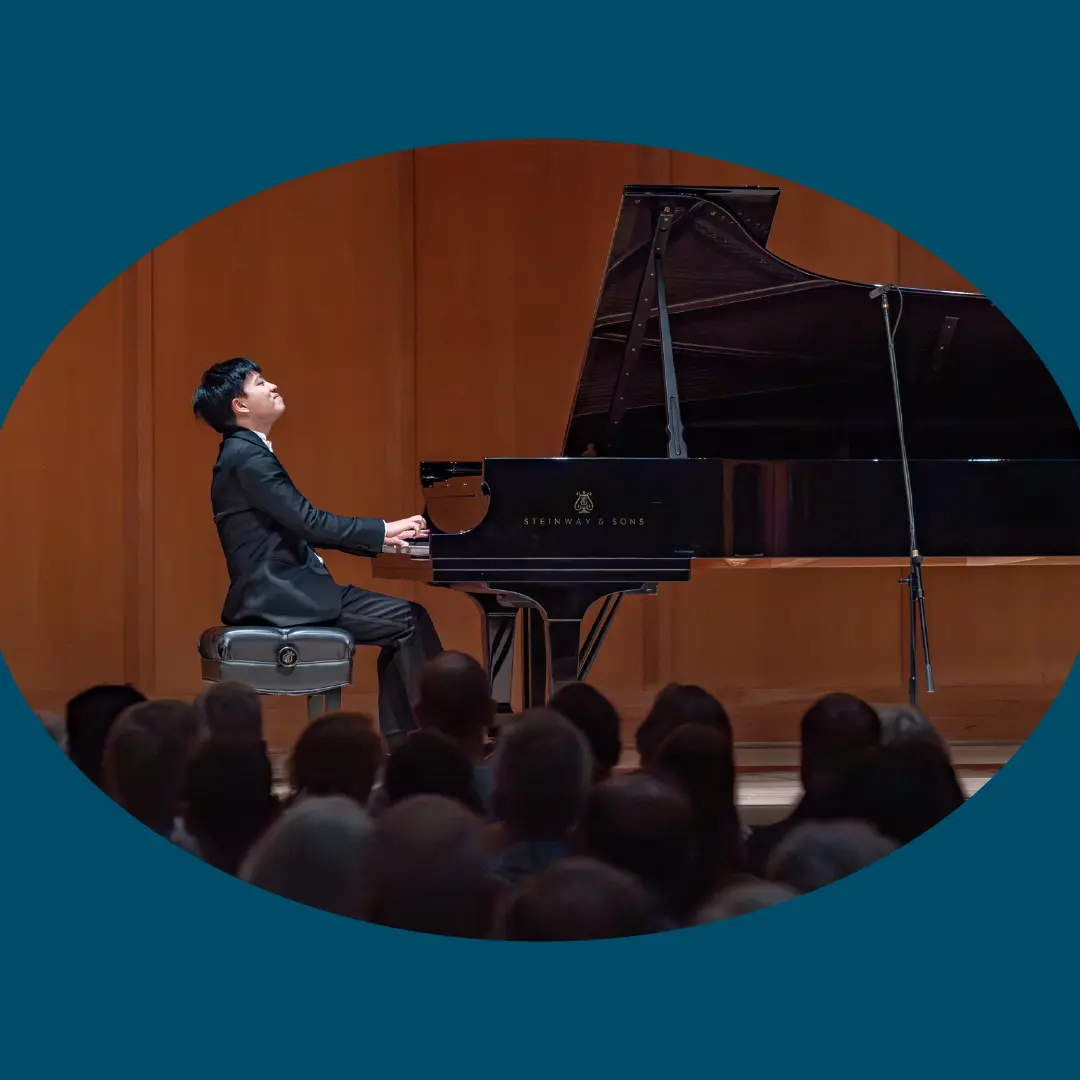
Pianist Kit Armstrong returns after his electrifying debut last summer with a recital that traces Franz Liszt’s idea of “home,” and how it was shaped by the cities that defined his artistic path. From the musical vibrancy of Paris, through the philosophical ideals of Weimar, to the spiritual reflection of Rome, this is a musical pilgrimage—echoing our Week 2 theme Songs from Home. Experience this illuminating journey as curated by one of today’s most original and imaginative artistic voices in this not-to-be-missed special event concert.
We have a special tradition of picnics before concerts at Reed College’s Kaul Auditorium. Reed’s catering service, Bon Appétit, offers food and drink service beginning at 6 PM. Alternately, you can bring your own picnic, but alcoholic beverages must be purchased on site.
6:30 PM | Kaul Auditorium Prelude Performance with CMNW’s Young Artist Institute students
Prelude performance sponsored by Ronnie-Gail Emden & Andrew Wilson.
Concert sponsored by Joseph Anthony & Heidi Yorkshire.
Reed College, Kaul Auditorium
Friday, 7/3 • 8:00 pm
Program
Click on any piece of music below to learn more about it.
- Program Notes for An Evening with Kit Armstrong: Liszt’s Pilgrimage
Confluence of origins and cultures is a particularly remarkable aspect of the life and work of Franz Liszt. His story could be likened to the well-known phenomenon of having different personalities in different languages. In the course of his career, he developed a series of artistic profiles in close connection with the geographical centres that he made home. The environments he inhabited held a pervasive influence on his whole being, from the language he spoke and worked in, to the subjects that occupied his interest, and, not least, his music. It has often been expressed that no other composer has ever embodied so many and such divergent styles.
I have designed this recital around a selection of stations in Liszt’s life, represented by favourite works that strike me as emblematic of his corresponding musical personality.
The programme starts in Paris, Liszt’s spiritual and physical home for a major part of his young years. Works by Frédéric Chopin and Charles-Valentin Alkan, two prominent musicians whom he befriended, let us imagine musical life in Paris as seen through Liszt’s eyes. One essential feature of their works was the exploration of piano sound textures, predicated on developments in technique involving a plethora of new figurations and, in close conjunction, the damper pedal. In them, technique was well on its way to becoming “transcendental”—Liszt would go on to formulate this observation explicitly with his famous etudes, adding a crucial subtlety: the name was to evoke not the maximisation of difficulty, but rather its subsumation in the service of expression. This realisation marks one of Liszt’s most significant ideas. It is still often misunderstood, and was probably not yet ripe in the mind of young Liszt, surrounded by show-offs interested above all in reveling in their newly-honed adroitness. The perfume of this zeitgeist, distilled into musical style, imbues one of Liszt’s first works, the 8 Variations which round off the first part of the programme.
We meet Liszt 20 years later in Weimar. Having left behind him a brilliant and unprecedented career as a performing pianist, he embarked on a new project: reforming the orchestra. Where traditional practice had regarded orchestra parts as collections and levels of sound akin to organ stops to be pulled, Liszt saw in them, first and foremost, individual musicians. He was surely influenced by his own experience as a soloist, holding whole halls in rapt attention all by himself—it was exactly this power that he sought to invest in every member. The new orchestra concept went hand-in-hand with a new programme music, which (in Liszt’s own words) depicted not the hero’s deeds, but his sentiments. The literature from Weimar’s “golden age” and the ideas of its authors including Goethe, Schiller, and Herder provided fruitful subject matter, as we hear in his character portraits of Gretchen (from Goethe’s Faust) and Prometheus (from Herder’s play).
A brief discursion into Liszt’s linguistic curriculum vitae: though as a child in Burgenland he would have first spoken a German dialect, as a young man French was his main language. Indeed, in his early correspondence with his mother, he wrote to her in French, while she wrote back in German. After integrating himself in Weimar and fumbling speeches to much embarrassment, he made a concerted effort to learn the German language properly. After all, it could not be that the founding father of German Romanticism in music spoke anything but a “pure” German, and certainly not a rural Austro-Bavarian dialect!
Another 20 years later, we see Liszt established in Rome, receiving the tonsure. Having carried out his best efforts to “solve the problem” of the orchestra, he turned to religious music, developing once more a unique and iconoclastic vision. He immersed himself in the Eternal City, and like he had done in Paris and in Weimar, found inspiration and a direct source of material in its tangible and intangible heritage. The play of light transformed under his spell into sounds that the coming century would recognise as impressionism, while the influence of Gregorian chant brought forth a radical avant-garde style, of few notes and loose lines yet reaching mind-boggling intensity.
Listening to Liszt’s music of religious contemplation, one might forget the unease many commentators have felt about his apparent constant changing of identity. Though it makes for satisfying storytelling to give a person one true personality—and one true home-culture and one true nationality—the reality is often more complex. It is certainly misleading to call Liszt a Hungarian piano virtuoso. He might have been on the road to becoming just that, when Carl Czerny (foremost among teaching musicians of his day) took him under his wing at the age of 10. But his road took a very different direction. In retracing it, we discover a compelling example that plurality is not dishonesty. We look upon Liszt as one of the most influential figures in the history of music, who at every step of the way left not only questions but also answers in the form of everlasting masterpieces.
—© Kit Armstrong
- CHOPIN Selections from Ètudes, Op. 10
CHOPIN (1810–1849) Selections from Ètudes, Op. 10
III. Ètude in E Major, “Tristesse”
IV. Ètude in C-sharp Minor, “Torrent”
IX. Ètude in F Minor
XII. Ètude in C Minor, “Revolutionary”- CHARLES-VALENTIN ALKAN Selections from 25 Prèludes, Op. 31
CHARLES-VALENTIN ALKAN (1813–1888) Selections from 25 Prèludes, Op. 31
VIII. La chanson de la folle au bord de la mer (The Song of the Madwoman at the Seashore)
- CHARLES-VALENTIN ALKAN “Bourrée d’Auvergne,” Op. 29
CHARLES-VALENTIN ALKAN (1813–1888)
Bourrée d’Auvergne, Op. 29
- LISZT Eight Variations, S. 148
LISZT (1811–1886)
Eight Variations, S. 148
- LISZT Selections
Faust Symphony, S. 108
II. Gretchen: Andante soavePrometheus, S. 99
Arr. Kit ArmstrongHarmonies poétiques et religieuses III, S. 173
VIII. Miserere d’après PalestrinaAve Maria (Die Glocken von Rom), S. 182
Années de pèlerinage III, S. 163
III. Aux cypres de la Villa d’Este: Threnodi: Andante non troppo lento
IV. Les jeux d’aeux à la Villa d’Este
Artists
-
 Kit Armstrong
Piano/Organ
Kit Armstrong
Piano/Organ
-
Ever since Kit Armstrong entered the international music stage twenty years ago, his activities have exerted an enduring fascination upon music lovers. He performs recitals in major series, appears with the world’s finest orchestras, and has developed close artistic partnerships with leading instrumentalists and vocalists. He has held artist-in-residence appointments incorporating a wide spectrum of musical formats, combining his roles as composer, pianist, conductor, and organist. His project, Expedition Mozart, traverses Mozart’s music in various genres with an international group of distinguished chamber musicians and soloists—and has become a main feature at prestigious festivals and venues.
Armstrong came to classical music through composition at the age of five. He has since created a broad oeuvre of vocal, instrumental, chamber, and symphonic works, many of which have been commissioned by notable European cultural institutions. His compositions are published by Edition Peters.
Born in 1992 in California, USA, Armstrong pursued undergraduate studies in physics at California State University, chemistry, and mathematics at the University of Pennsylvania and mathematics at Imperial College London. Alfred Brendel has guided Armstrong as a musical mentor since 2005. In 2008, he earned a bachelor’s degree in music at the Royal Academy of Music, London, and in 2012 a master’s degree in pure mathematics at the University of Paris VI.
In 2012, Kit Armstrong purchased the Church of Sainte-Thérèse in Hirson, France, and transformed it into a hall for concerts, exhibitions, and outreach. This cultural centre has become home to interdisciplinary projects, reaching a regional as well as cosmopolitan public.
Upcoming Concerts & Events
- Jazz Notes: Gershwin Piano Concerto
- FREE Open Rehearsal: Dvořák “Dumky” Piano Trio
- SPECIAL EVENT | An Evening with Kit Armstrong: Liszt’s Pilgrimage (currently selected)
- Folk Voices: Dvořák “Dumky” Trio
- NEW@NIGHT: Echoes of Home