

Viano Quartet & Nina Bernat
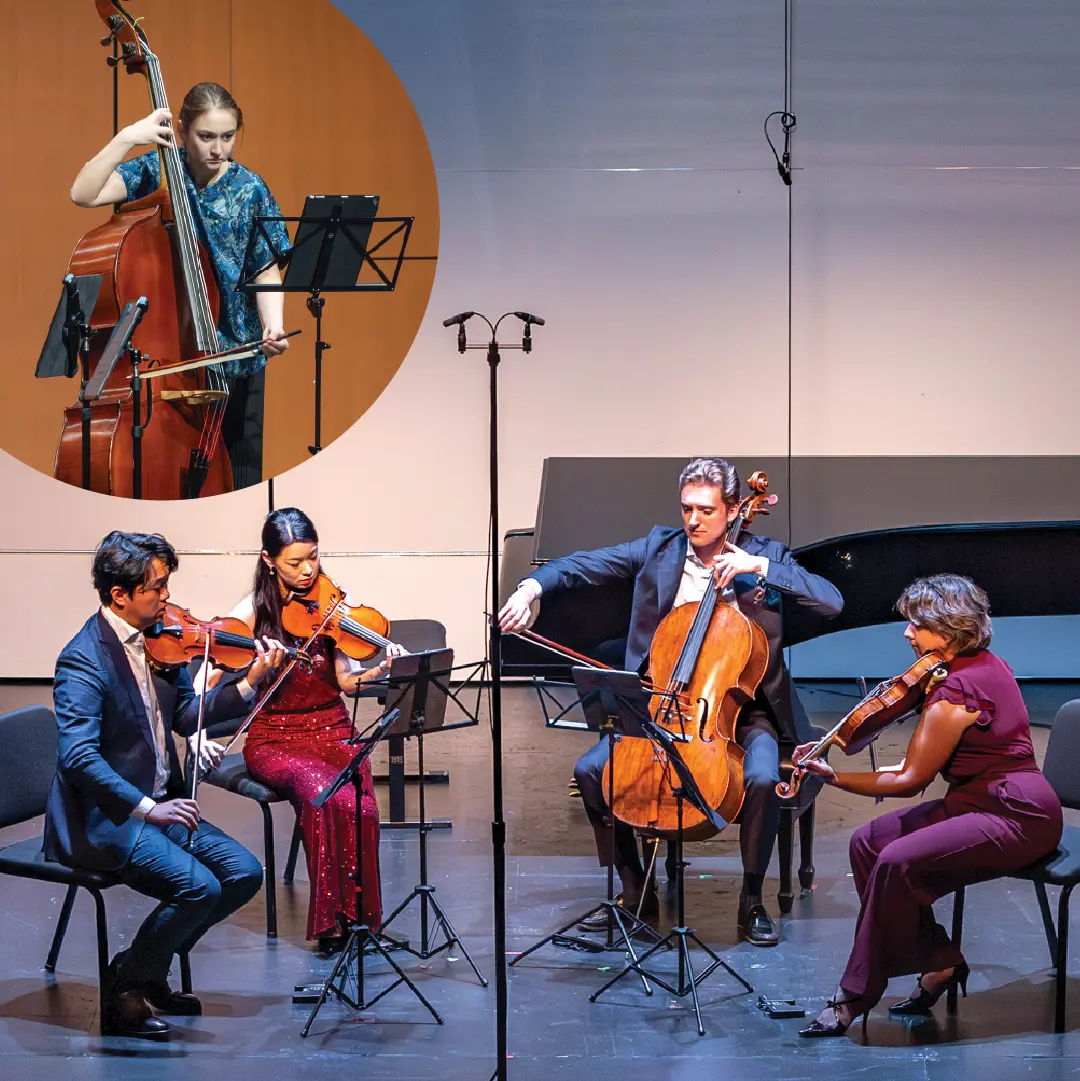
Now in its 17th year, CMNW’s Protégé Project has helped launch the careers of a new generation of world-renowned musicians and composers, and tonight is a celebration of their stellar rise! Acclaimed bassist Nina Bernat (2024) joins the dynamic Viano Quartet (2022)–all five Protégé Project Alumni now winners of the prestigious Avery Fisher Career Grant–for an evening of quartets and quintets. Their program will feature two CMNW-commissioned works written especially for them by Protégé Alumni Composers Alistair Coleman (2022) and Kian Ravaei (2023), as well as Dvořák’s String Quintet No. 2, which combines the Vianos’ virtuosity with the power and depth of Bernat’s double bass.
“[Viano Quartet] are capable of making their instruments both surge and whisper, and the Viano demonstrated their prowess, hypnotically conjuring the most rarefied emotions. The group conveyed the soothing iterations of the melancholic melody with such control and comforting suspense that I didn’t want it to end.”
— Classical Voice North America
“Speechless is perhaps not the best place to begin as a reviewer, but the accolades and awards Ms. Bernat has already garnered do make any expressions of appreciation by me feel a bit superfluous.”
— EarRelevant
First Baptist Church
Saturday, 3/6 • 8:00 pm
Program
Click on any piece of music below to learn more about it.
- KIAN RAVAEI “The Little Things” for String Quartet (2023)
KIAN RAVAEI (b. 1999)
The Little Things (2023)
CMNW Co-Commission - World Premiere1. I’ll Tell You How the Sun Rose
2. High From the Earth I Heard a Bird
3. Two Butterflies Went Out at Noon
4. A Narrow Fellow in the Grass
5. The Moon Was but a Chin of Gold
6. A Spider Sewed at Night
7. If I Can Stop One Heart From BreakingAll seven titles which comprise The Little Things come from Emily Dickinson, who never fails to direct our attention toward nature’s easily overlooked wonders. Movements II, III, IV, and VI evoke various animal life, while I and V portray the sun and moon respectively. The order of the movements suggests the cyclic journey of all living things from morning to night to a new morning.
In the final movement, we hear the voice of Nature singing Dickinson’s famous lines:
If I can stop one heart from breaking,
I shall not live in vain;
If I can ease one life the aching,
Or cool one pain,
Or help one fainting robin
Unto his nest again,
I shall not live in vain.
—© Kian Ravaei
- ALISTAIR COLEMAN (b. 1998) “Ghost Art Canticles” for String Quartet & Double Bass (2025)
ALISTAIR COLEMAN (b. 1998)
Ghost Art Canticles for String Quartet & Double Bass (2025)I. Sunburst
II. Evensong
III. PerpetuaWORLD PREMIERE | CMNW COMMISSION
Ghost Art Canticles, composed for String Quartet and Double Bass, is inspired by Austin, the final work of American artist Ellsworth Kelly. The only building Kelly ever designed, Austin takes the form of a chapel with vibrant stained-glass windows, a cross-shaped layout, 12 abstract panels evocative of the Stations of the Cross, and other religious allusions. However, Kelly conceived Austin as a “secular chapel,” stripping away sacred function to create “a place of calm and light.” It embodies what The New Yorker describes as Kelly’s lifelong pursuit of Ghost Art: “a translation from reality into something fully real, itself, only different.”
Growing up singing in a local church choir, one of my earliest memories was hearing Bach’s organ music fill the church with a roar of sound. Writing a new piece for Chamber Music Northwest’s festival celebrating Bach made me reflect on how deeply his music, like mine, was influenced by the church. While Bach primarily wrote for liturgical settings, his music is now performed in concert halls, allowing performers and listeners to draw new, secular meanings. I see a parallel in Kelly’s Austin—a space where traces of religious symbols remain, but their purpose has shifted. Ghost Art Canticles imagines music inhabiting this in-between space, drawing from both Kelly and Bach, where spiritual symbols become afterimages—ghosts of their former selves—that inspire new meanings.
The first movement, Sunburst, begins with a simple idea that gradually expands through canons, echoing Bach’s contrapuntal techniques and shifting light patterns in Austin. The second movement, Evensong, is a chorale, a direct nod to Bach’s meditative works. The final movement, Perpetua, spins out in relentless motion, evoking the restless play of color and light within the chapel. This title refers to both moto perpetuo (perpetual motion) and lux perpetua, an “everlasting light” in sacred texts—an idea that reflects Bach’s timeless influence on my music and others.
Ghost Art Canticles was commissioned by Chamber Music Northwest with generous support from Ravi Vedanayagam & Ursula Luckert. The piece is written for, and dedicated to, Nina Bernat and the Viano Quartet.
—© Alistair Coleman
- DVOŘÁK String Quintet No. 2 in G Major, Op. 77, B. 49
DVOŘÁK String Quintet No. 2 in G Major, Op. 77, B. 49
I. Allegro con fuoco
II. Scherzo: Allegro vivace
III. Poco andante
IV. Finale: Allegro assai
Artists
-
 Nina Bernat
Bass, Past Protégé
Nina Bernat
Bass, Past Protégé
-
American double bassist Nina Bernat, acclaimed for her interpretive maturity, expressive depth and technical clarity, emerges onto the world stage with awards and accolades, thrilling audiences everywhere. She was hailed by Star Tribune as a “standout” for her recent concerto debut with the Minnesota Orchestra, praising her performance as “exhilarating, lovely and lyrical…technically precise and impressively emotive.”
In 2023, Nina was honored as a recipient of the Avery Fisher Career Grant and winner of the CAG Elmaleh Competition. Recent 1st prizes include the Barbash J.S. Bach String Competition, the Minnesota Orchestra Young Artist Competition, the Juilliard Double Bass Competition, and the 2019 International Society of Bassists Solo Competition.
Engaged in all aspects of double bass performance, she has been invited to perform as guest principal bassist with the Israel Philharmonic Orchestra and Oslo Philharmonic, serving under the batons of conductors such as András Schiff and Osmo Vänskä. Nina is in demand as a passionate chamber musician. She began her involvement with the Chamber Music Society of Lincoln Center as a member of the Bowers Program in 2025. She has spent summers at Marlboro Music Festival, Verbier Festival, Music@Menlo, and Chamber Music Northwest.
She is quickly becoming a sought-after pedagogue, having given masterclasses at the Colburn School, Boston University Tanglewood Institute, and University of Texas at Austin, among others. She is on the faculty of Stony Brook University.
Nina performs on an instrument passed down from her father, Mark Bernat, attributed to Guadagnini.
Upcoming Concerts & Events
- Viano Quartet & Nina Bernat (currently selected)
-
 Viano Quartet
String Quartet, Past Protégé Ensemble
Viano Quartet
String Quartet, Past Protégé Ensemble
-
Lucy Wang, violin
Hao Zhou, violin
Aiden Kane, viola
Tate Zawadiuk, celloPraised for their “virtuosity, visceral expression, and rare unity of intention” (Boston Globe), the Viano Quartet has quickly soared to international acclaim as one of the most dynamic and in-demand string quartets of their generation. The ensemble has captivated audiences worldwide ever since they were awarded First Prize at the 13th Banff International String Quartet Competition, with appearances at renowned venues such as Lincoln Center in New York, Berlin’s Konzerthaus, Toronto’s Koerner Hall, Hong Kong’s City Hall, and London’s Wigmore Hall. The Viano Quartet are Bowers Program Artists at The Chamber Music Society of Lincoln Center from 2024–2027.
Viano Quartet’s 2025–26 season includes debut performances at London’s Southbank Centre, the Frick Collection in New York, Dublin’s National Concert Hall, Vivo Performing Arts, Coast Live Music, Friends of Chamber Music Kansas City, Apex Concerts, the Amelia Island Chamber Music Festival, the Fortas Series at the Kennedy Center, Premiere Performances HK, and a mainstage full recital debut at the Chamber Music Society of Lincoln Center. This season also features collaborations with Avi Avital, Sir Stephen Hough, Gilbert Kalish, Anthony McGill, Miloš Karadaglić, and Vienna Teng. The quartet will premiere a newly written piece by composer Reena Esmail in the summer of 2026.
In 2025, the quartet received the Avery Fisher Career Grant as well as released their first full-length album, Voyager, with Apple Music/Platoon Records.
The Viano Quartet was formed in Los Angeles at the Colburn Conservatory of Music in 2015. The quartet is grateful for the unwavering support from their mentors at the Curtis Institute and Colburn Conservatory.
Upcoming Concerts & Events
- Viano Quartet & Nina Bernat (currently selected)