

Dover Quartet: Brahms, Pura Fé & Dvořák
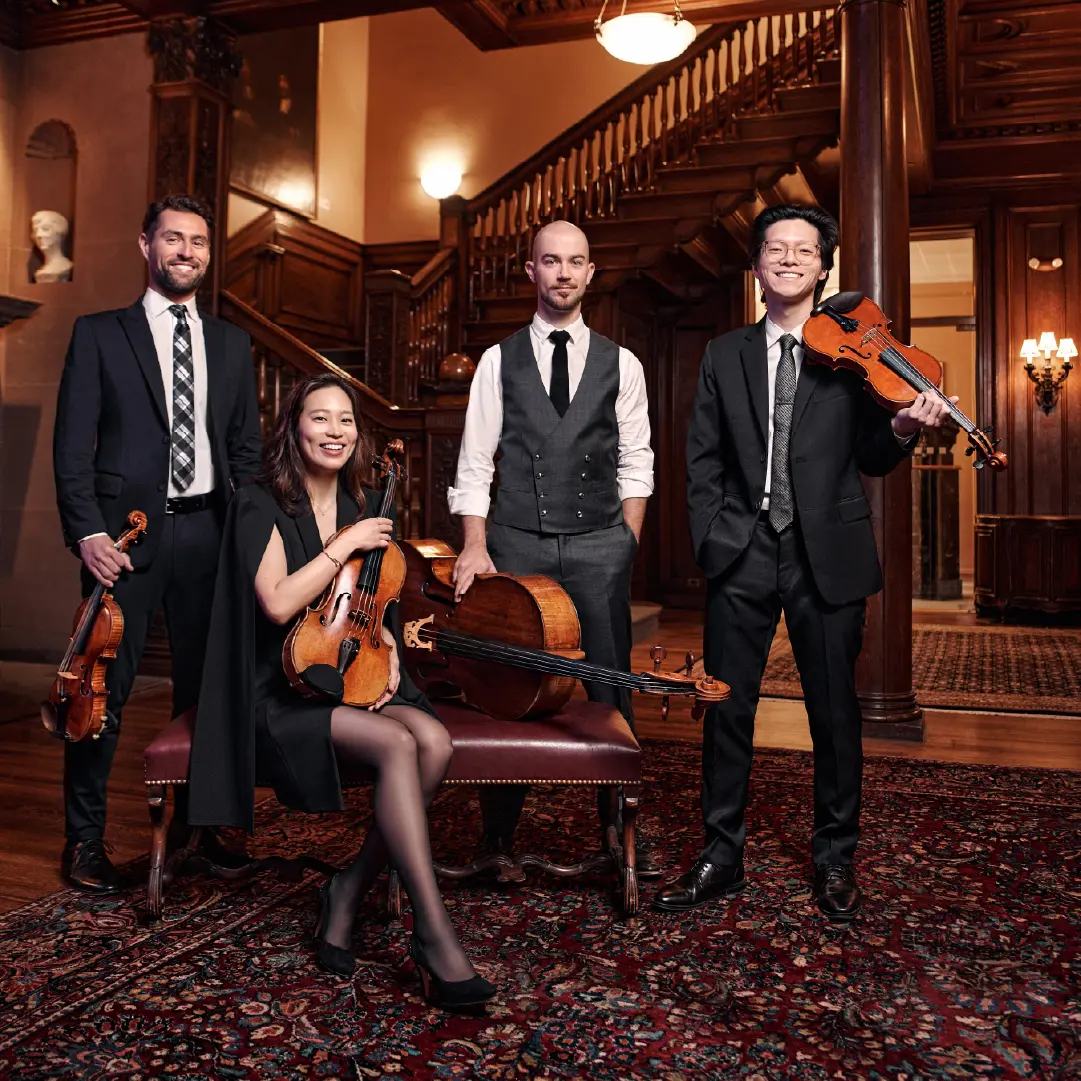
Named one of the greatest string quartets of the last 100 years by BBC Music Magazine and “the next Guarneri Quartet” by the Chicago Tribune, the two-time Grammy-nominated Dover Quartet is one of the world’s most lauded chamber ensembles. Hailed as “meticulously balanced, technically clean-as-a-whistle and intonationally immaculate” (The Strad), the Dovers return to CMNW to kick off our 2026/27 Year-Round Season. The evening begins with Brahms’s gorgeous String Quartet No. 3, followed by American Indian composer Jerod Impichchaachaaha’ Tate’s newest string quartet orchestration of Pura Fé’s—Indigenous activist, singer-songwriter, and storyteller—Rattle Songs, and Dvořák’s joyful String Quartet No. 11 serves as a fitting finale.
Flanagan Chapel, Lewis & Clark College
Wednesday, 10/28 • 7:30 pm
Program
Click on any piece of music below to learn more about it.
- BRAHMS String Quartet No. 3 in B-flat Major, Op. 67
BRAHMS String Quartet No. 3 in B-flat Major, Op. 67 (33’)
I. Vivace
II. Andante
III. Agitato – Allegro non troppo
IV. Poco Allegretto con variazioni- PURA FÉ Rattle Songs (Arr. Jerod Impichchaachaaha’ Tate)
PURA FÉ Rattle Songs (2024) (15’)
(arranged for string quartet by Jerod Impichchaachaaha’ Tate)
I. Shanoojhee
II. Viri Kuta
III. Haweheemo
IV. Grammah Easter’s Lullaby
V. For the Pepper (In Memory of Jim Pepper)
VI. Women’s Shuffle
VII. Great Grampah’s BanjoRattle Songs is a suite of compositions created by the Tuscarora vocalist, Pura Fé, for the ensemble Ulali. Pura Fé’s Tuscarora cousin, Jennifer Kreisberg, and Maya/Apache friend, Soni Moreno, are the other two vocalists of the group. In 1994, this Native trio made history when they released their album, Mahk Jchi (Our Hearts). This album is a unique work of genius, where Native songs are modernized through innovative arrangements and stunningly rich harmonies. Their work had a powerfully deep impact on my personal vision as a Native composer and I am privileged that they are my friends.
Chickasaw music is based in turtle shell shaking, as is our percussion for stomp dancing and social songs. The Tuscarora people share a very similar shell shaking tradition, as do most Native woodland tribes. In Rattle Songs, Ulali brought together songs from different parts of Indian Country and brilliantly couched them in traditional woodland shell shaking styles.
Camden Shaw, cellist of the Dover Quartet, also happens to be a fan of the Mahk Jchi album. Upon his discovery that I have an affinity for Ulali, he asked if I might be interested in orchestrating Rattle Songs for string quartet. My immediate acceptance and enthusiasm could not be overstated. After consulting with Pura Fé, I have created these orchestrations that are classically impressionistic in a post-modern style. I make no deliberate attempt to imitate the exact sound of rattles from the original songs; rather, I have created a new home for them in the string quartet. Pura Fé created Rattle Songs as a homage to her Native North American cousins and it is my hope that my orchestrations create another layer of honoring our people.
From the liner notes of Mahk Jchi:
“In ancient times a Tuscarora woman carried the name ‘Ulali’ for her beautiful voice. ‘Ulali’ is a songbird (Wood Thrush) name given to Pura Fé, Soni, and Jennifer, by Lawrence Dunmore of the Occaneechi Band of the Saponi Nation in North Carolina. ‘Ulali’ is a First Nations women’s a cappella trio, that sing in many styles and languages of their people of the Western Hemisphere.”—© Jerod Impichchaachaaha’ Tate
- DVOŘÁK String Quartet No. 11 in C Major, Op. 61, B. 121
DVOŘÁK String Quartet No. 11 in C Major, Op. 61, B. 121 (35’)
I. Allegro
II. Poco adagio e molto cantabile
III. Scherzo
IV. Finale (Vivace)The music in this work differs fundamentally from Dvořák’s previous string quartet with its subtitle “Slavonic.” In his new quartet the composer did not use a single melody that might have been described as “Slavonic;” for his inspiration he looked to the likes of Beethoven and Schubert. With its absence of Slavic undertones, the Quartet in C Major is fairly atypical for Dvořák. Nevertheless, it is a testimony of the next stage in his development and is undeniably one of Dvořák’s finest chamber pieces. The quartet betrays a Classical sense of equilibrium and great intellectual depth, clearly profiled thematic material and a high level of formal compactness in all four movements. The first movement in sonata form is surprising for its resourceful development of the main subject, the latter’s various transformations, and the remarkable harmonies overall. The second movement, with its dialogic development of the chief motif and the impulsively chromatic passages, is truly a gem among Dvořák’s adagios. The Beethoven model is most tangible in the third, scherzo movement, particularly in the brusque rhythms of its main section. The work culminates in the fourth movement, whose sense of boisterous joy appears to subside before the close, only to end brazenly in a short, rousing coda.
—© Courtesy of www.antonin-dvorak.cz
Artists
-
 Dover Quartet
String Quartet
Dover Quartet
String Quartet
-
Joel Link, violin
Bryan Lee, violin
Julianne Lee, viola
Camden Shaw, celloNamed one of the greatest string quartets of the last 100 years by BBC Music Magazine and “the next Guarneri Quartet” by the Chicago Tribune, the two-time Grammy-nominated Dover Quartet is one of the world’s most in-demand chamber ensembles. The group’s awards include a stunning sweep of all prizes at the 2013 Banff International String Quartet Competition, grand and first prizes at the Fischoff Chamber Music Competition, and prizes at the Wigmore Hall International String Quartet Competition. Its honors include the prestigious Avery Fisher Career Grant, Chamber Music America’s Cleveland Quartet Award, and Lincoln Center’s Hunt Family Award. The Dover Quartet is the Penelope P. Watkins Ensemble in Residence at the Curtis Institute of Music and Quartet in Residence at Northwestern University’s Bienen School of Music.
The Dover Quartet’s 2024-25 season includes premiere performances throughout North America of newly commissioned works by Jerod Impichchaachaaha’ Tate, a citizen of the Chickasaw Nation and a leading composer of American Indian classical music; collaborative performances with preeminent artists that include pianists Michelle Cann, Marc-André Hamelin, and Haochen Zhang; and tours to Europe and Asia. Recent collaborators of the sought-after ensemble include Leif Ove Andsnes, Emanuel Ax, Inon Barnaton, Ray Chen, Anthony McGill, Edgar Meyer, the Pavel Haas Quartet, Roomful of Teeth, and Davóne Tines. The quartet has also recently premiered works by Mason Bates, Steven Mackey, Marc Neikrug, and Chris Rogerson.
The Dover Quartet’s highly acclaimed three-volume recording, Beethoven Complete String Quartets (Cedille Records), was hailed as “meticulously balanced, technically clean-as-a-whistle and intonationally immaculate” (The Strad). The quartet’s discography also includes Encores (Brooklyn Classical), a recording of 10 popular movements from the string quartet repertoire; The Schumann Quartets (Azica Records), which was nominated for a Grammy for Best Chamber Music/Small Ensemble Performance; Voices of Defiance: 1943, 1944, 1945 (Cedille Records); and an all-Mozart debut recording (Cedille Records), featuring Michael Tree, the late, long-time violist of the Guarneri Quartet. The quartet’s recording of Steven Mackey’s theatrical-musical work Memoir, recorded with the percussion group arx duo and narrator Natalie Christa Rakes, was released on Bridge Records in August 2024. A recording of the Tate commissions and Dvořák’s String Quartet in F Major, Op. 96 (“American”) will be released in 2025 on Curtis Studio, the record label of the Curtis Institute of Music.
The Dover Quartet draws from the lineage of the distinguished Guarneri, Cleveland, and Vermeer quartets. Its members studied at the Curtis Institute of Music, Rice University’s Shepherd School of Music, the New England Conservatory, and the Conservatoire Supérieur de Musique et de Danse de Paris. They were mentored extensively by Shmuel Ashkenasi, James Dunham, Norman Fischer, Kenneth Goldsmith, Joseph Silverstein, Arnold Steinhardt, Michael Tree, and Peter Wiley. The Dover Quartet was formed at Curtis in 2008; its name pays tribute to Dover Beach by fellow Curtis alumnus Samuel Barber.
The Dover Quartet plays on the following instruments and proudly endorses Thomastik-Infeld strings:
Joel Link: a very fine Peter Guarneri of Mantua, 1710–15, on generous loan from Irene R. Miller through the Beare’s International Violin Society
Bryan Lee: Nicolas Lupot, Paris, 1810; Samuel Zygmuntowicz, Brooklyn, 2020
Julianne Lee: Robert Brode, 2005
Camden Shaw: Joseph Hill, London, 1770doverquartet.com
curtis.edu/doverquartet
On Facebook, Instagram, and YouTube @DoverQuartetUpcoming Concerts & Events
- Dover Quartet: Brahms, Pura Fé & Dvořák (currently selected)